
In today’s rapidly changing, post-Christendom world, pastoral decision-making has become increasingly complex. For priests beginning the work of parish renewal, that challenge is magnified.
That’s why the data Archbishop Miller shared with pastors last year is so crucial. At sessions held in spring 2024, he provided insights to help priests assess their communities effectively and make informed decisions about how to allocate time and ministerial resources.
The numbers tell a mixed story.
• Mass attendance in the Archdiocese of Vancouver is both rising and falling: While attendance is climbing back toward pre-COVID levels, only 17 per cent of Catholics attended Mass weekly in 2023—down from 19 per cent in 2019.
• Catholic population stability: The percentage of Catholics in Vancouver remains steady at 12 per cent of the total population, just shy of 500,000 people.
• Projections for growth in diocesan vocations show a short-term increase, but long-term decline: The number of active diocesan priests is expected to rise slightly from 55 to 58 by 2029 but then decline over the following decade due to retirements and aging clergy.
• Permanent diaconate growth: The permanent diaconate is thriving, with 40 active permanent deacons projected by 2034.
From a national perspective, a recent Cardus study gives further context, highlighting concerning trends in belief and practice across Canada that can help pastors understand religious convictions within their own flock.
One striking statistic: Nearly 70 per cent of Canadian Catholics believe the Eucharist is only a symbol, contradicting the Church’s teaching on the Real Presence. Archbishop Miller pointed to findings like these as critical for shaping catechesis. He has referred to these sorts of trends as a mixed bag.
Vancouver’s priest-to-laity ratio, for example, is better than in many North American dioceses. Other numbers, however, paint a more troubling picture.
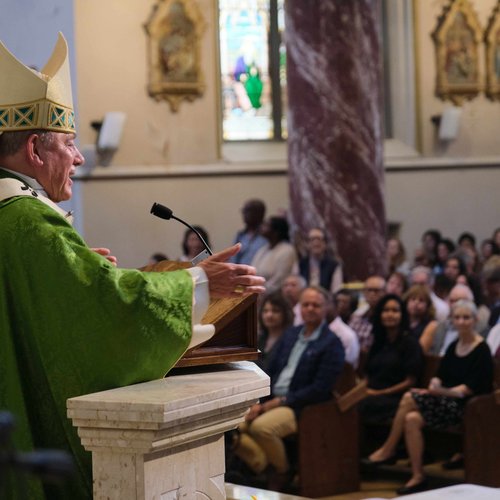
“Not even 20 per cent—one in five—of Catholics regularly practise their faith by living a sacramental life,” the Archbishop said.
“Where are they?” he asked. “We don’t often think of them as parishioners, but they are. They are Catholics living within our parish boundaries.”
It’s a reality the priests already know well, he said. “I know it in my own family, and I’m sure I’m not alone,” he said.
“You know these statistics of declining engagement, because I’ve heard you say, over and over, that you experience the pain of this loss of practice in your families and among your friends.”
Having recently returned from the Synod on Synodality in Rome, the Archbishop took the opportunity to introduce priests to the synodal approach.
“What we are doing today mirrors the way discussions proceeded at the Synod of Bishops last October,” he said.
Synodality, he said, means exploring concrete means of “walking together” as a Church, with a new way of discerning and collaborating becoming a normal part of parish and diocesan life.
Then came his challenge: “If you’re like me, you know that this situation requires urgent responses.”
Before that can happen, however, an admission is necessary. “However painful it may be, that we need to change.”
To guide the Church through this transition, the Archbishop referenced Msgr. James Shea’s concept of shifting from “Christendom to Apostolic Mission”—a prescription for evangelizing a post-Christian culture.
“Our greatest enemy,” he warned, “is the complacent attitude that says, ‘We have always done it this way.’”
He then unveiled 12 key principles for evangelizing in the Church of the future:
• Recognize that Christendom is no longer the dominant cultural influence in the Archdiocese of Vancouver.
• Confront the hard truths about our reality with courage, while maintaining unwavering hope in Christ.
• Adopt an apostolic mindset, confident in the truth of the Gospel and the transforming power of the Holy Spirit.
• Embrace a synodal approach to discernment, seeking guidance from the Holy Spirit.
• Break the cycle of repeating the past while expecting different results.
• Align all institutions—families, parishes, schools, health care, and outreach—with the mission of evangelization.
• Recognize the missionary role of the family and equip families for evangelization.
• Reform priestly, religious, and lay formation to meet the needs of this new apostolic age.
• Embrace the co-responsibility of clergy and laity in the Church’s mission.
• Move beyond a narrow, parochial mindset and collaborate in ways never seen before in Vancouver.
• Align budgets and resources with the Church’s mission, ensuring financial priorities reflect evangelization efforts.
• Prepare for difficult decisions ahead—decisions that will require pruning, sacrifice, courage, and generosity
With his retirement approaching, the Archbishop admitted he won’t be able to see “the fruit of the transformation” he was encouraging. “I regard it as my responsibility at least to see to it that a fuse is lit that will move the Church in Vancouver into an apostolic mode in living out her mission.”
Your voice matters! Join the conversation by submitting a Letter to the Editor here.