
In his Easter morning homily, Archbishop J. Michael Miller invites the faithful to “return to Galilee” and the place they first encountered Christ, the same invitation Jesus gave his Apostles following his resurrection.
“Brothers and sisters: we always need to return to our Galilee,” Archbishop Miller told the faithful at Holy Rosary Cathedral. “To go back – not to an abstract, ideal Jesus, a man only of the past, but to the concrete memory of our first strong encounter with him.”
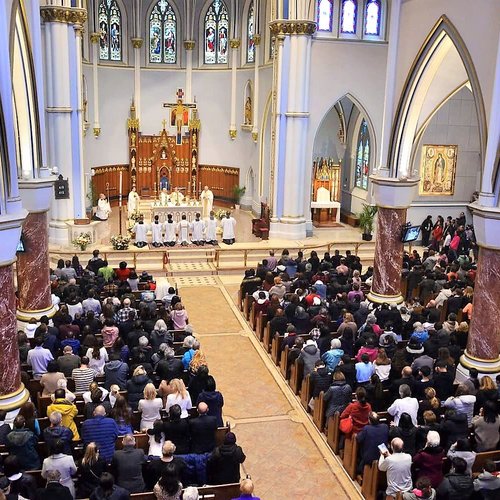
Returning to Galilee is “an invitation to recall our first encounter with Jesus, our first call,” the Archbishop said.
Matthew’s Gospel recounts Jesus appearing to his Apostles after his resurrection, telling them to leave the Upper Room in Jerusalem and go back to Galilee, the “periphery” inhabited by Gentiles, said the Archbishop. “He’s telling them to come out from hiding and to open up to the mission, to put aside their fear, and to walk confidently toward the future. It will be from Galilee that Jesus unleashes them for their mission ‘to make disciples.”
Quoting author Stanley Hauerwas, the Archbishop said Galilee will become a kind of “staging area for the disciples to go to the nations to announce the new age begun by Jesus.”
Similarly the faithful are called to “go forward, to put aside any sense of defeat that we might feel when we look at the state of the world and of the Church, to roll away the stone from the tombs in which we often confine our hope, and to look to the future with confidence because Christ is risen.”
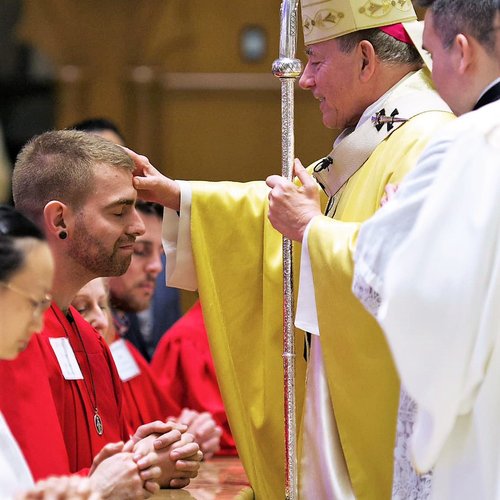
At the Easter Vigil the night before, the Archbishop welcomed 14 catechumens and candidates into full communion with the Church, telling them in the words of Pope Francis that “Easter begins by upsetting our expectations.”
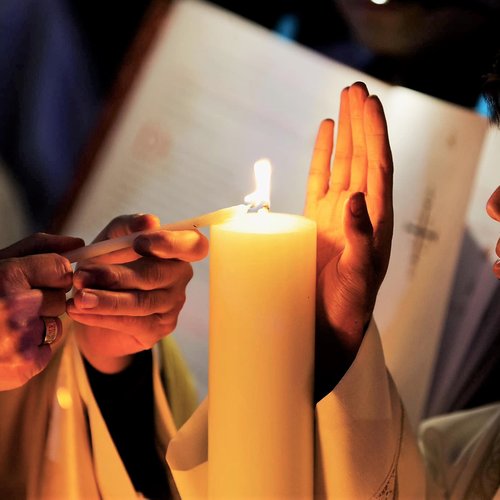
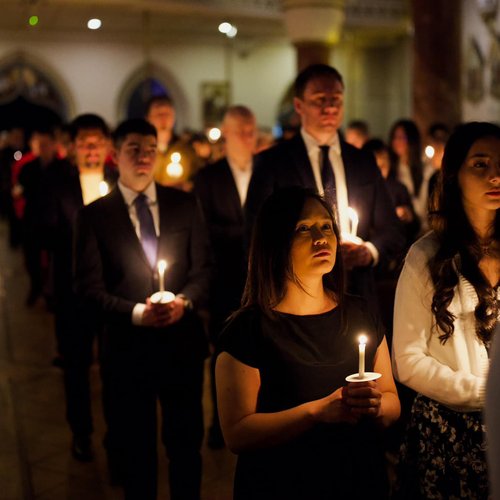
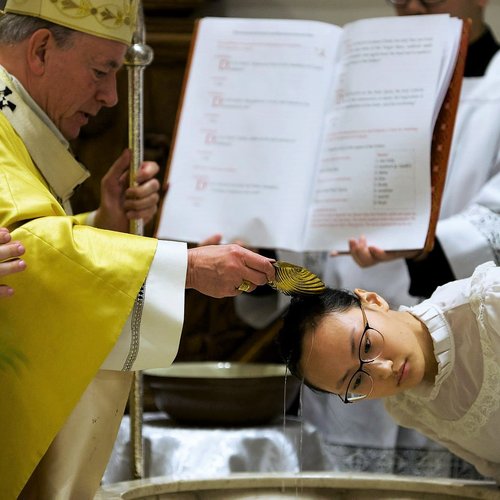
Jesus’ resurrection, he said, “is the defeat of death. It’s not just an idea in the minds of his disciples, a symbol of a reborn faith or of a hope revived in the face of tragedy. No, his body has been raised, filled with life, and is available, so to speak, to be shared with us, as we believe happens in the Eucharist we are celebrating.”
Jesus walks amid us today, he said, ready to change us and set us free from every obstacle to joy. “Thanks to him, evil has been robbed of its power; failure can no longer hold us back from starting anew; and death has become a passage to the stirrings of new life.”
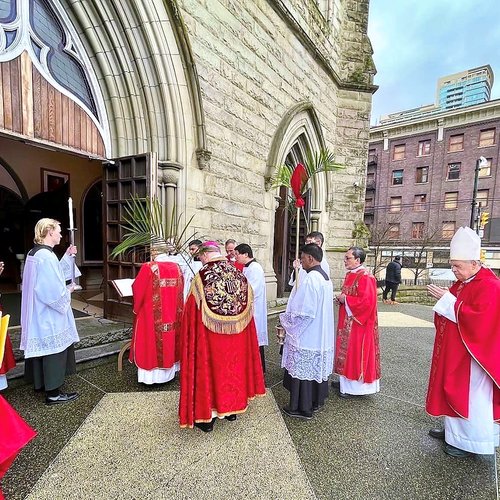
The Easter Masses marked the end of a busy Holy Week for the Archbishop that started with a Palm Sunday procession from the steps of Holy Rosary Cathedral.
In his Palm Sunday homily, the Archbishop addressed Jesus’ cry from the cross, “My God, my God, why have you forsaken me?” and drew parallels with the pain in our own lives.
“There are times in our lives when we cry out to God and ask him “Why?” Why is this happening to me? To us? Why is my family suffering from this tragedy? Why are so many people dying in such a horrific war in Ukraine? Why are innocent children killed in their school?
“Perhaps the hardest question, the one underlying all others, is this: Why is God silent? This silence pierces our soul.”
Although God the Father didn’t abandon his son, and Jesus knew that, “he certainly felt like being forsaken. He experienced the utmost abandonment.”
Yet Jesus wasn’t controlled by these feelings. “He didn’t abandon his hope, and he didn’t stop praying … As St. Luke records, Jesus dies saying ‘Father, into your hands I commend my spirit.’”
God’s response can come about “through the mystery of his silence,” said the Archbishop. “Even if we fail to understand why certain things happen in our lives, we are called to trust in the goodness and loving kindness of God, to remain “unshakably certain that God is our Father and loves us, even when his silence remains incomprehensible.”
He invited the faithful to “gaze often upon a Crucifix – even taking it off the wall or from around your neck or on your rosary – and thank Jesus for loving you and giving himself for your salvation. For it is by his cross and resurrection that he has set you free – the great mystery which once again becomes present as we celebrate this Eucharist.”
The solemness of Palm Sunday was contrasted by the joy of the Chrism Mass on Wednesday when priests of the archdiocese gathered at the Mass that “manifests publicly the intimate, sacramental brotherhood of our presbyterate and the common mission we share in serving those entrusted to our pastoral care.”
The Archbishop offered particular thanks to older and retired priests who remain joyful in their commitment to their priestly ministry. “May you know the joy of handing on the torch, of seeing a new generation of priests born of your spiritual fatherhood, and the joy of experiencing that hope which does not disappoint.”
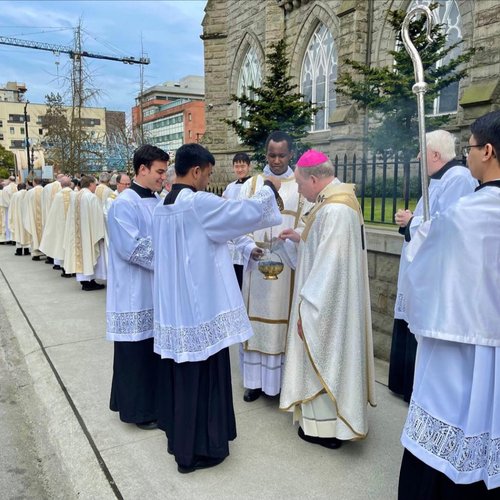
He reminded the priests and deacons present that their ministry is to guide and shepherd the faithful, with “a joyful holiness, not a sad and weary mediocrity. Focus on being with the Lord, and you will have nothing to fear.”
He also urged the faithful to “never get tired of asking the good Lord for the priests we need, the priests you deserve. Pray often and fervently for your priests, and for an increase of priestly vocations from men inspired by parish communities that are alive with a contagious apostolic zeal.”
The next day, Holy Thursday, the Archbishop reflected on the Last Supper and the meaning of the washing of the feet, recalling the words of Pope Benedict: “Every good work for others – especially for the suffering and those not considered to be worth much – is a service of the washing of feet.”
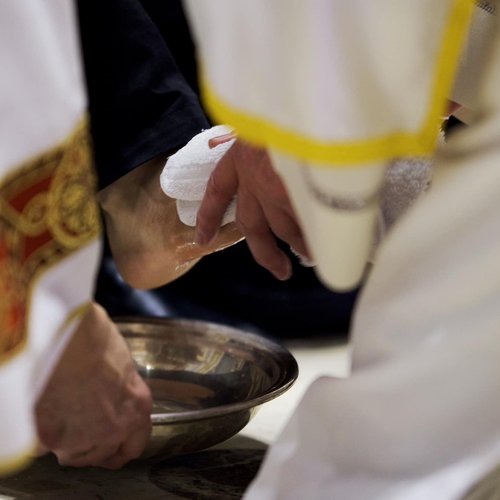
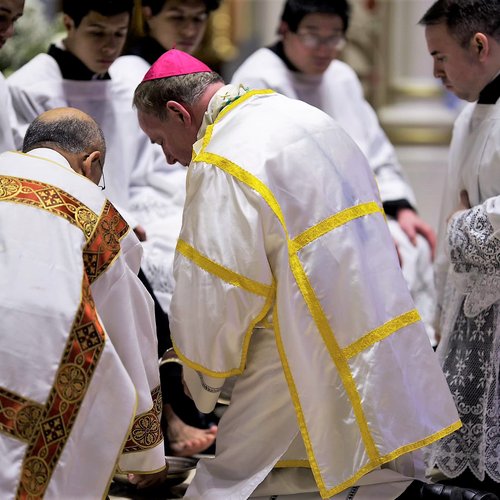
He quoted Pope Francis who said, “Washing one another’s feet signifies welcoming, accepting, loving and serving one another. It means serving the poor, the sick and the outcast.”
Such service, the Archbishop said, can be shocking and make us uncomfortable. “This is what it will look like if you become my disciple. This is what you will look like. You will look like a slave. You will look like a fool. St. Paul knew this truth when he wrote: ‘We are fools for the sake of Christ.’”
Jesus’ instruction at the Last Supper Jesus was not just “an ideal to admire,” he said, but “a commandment to obey.”
It’s a “tall order,” he said, as was the institution of the Eucharist at the Last Supper, where many of his disciples left him because of the difficulty of accepting it.
He described Christ who nourishes us in the Eucharist as “the poor person in the Downtown East Side who holds out his hand, in the suffering neighbour who begs for attention and help, in the family member, friend or acquaintance who asks for our attention and welcome. He is in the unborn child who is awaiting birth and in the young adult who knows nothing about God and who doesn’t have faith. He is in every human being, even the smallest and the defenceless. Our Holy Communion with the Lord comes to completion, so to speak, when we give of ourselves to others.”
On Good Friday the Archbishop repeated his message of service to others, saying Jesus’ death is an invitation “to unite his suffering on that first Good Friday to our suffering in the 21st century.”
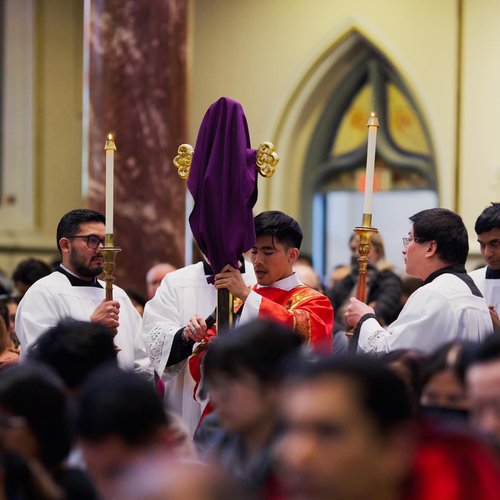
While our instinct is to avoid suffering, ours, and others, out of fear and repugnance, the Lord’s face is revealed in the faces of those around us.
“The face of the Man of Sorrows, who took upon himself the burden of all our mortal anguish, is reflected in that of every person who is humiliated and offended by the events of life, in the sick and suffering, the alone and addicted. Jesus’ face is reflected in everyone who is a refugee, made to feel unwelcome and despised; in those who are abandoned by their relatives, by society, and left without care; those living on the streets of our City; and those who are victims of war in Ukraine, abuse in our institutions and human trafficking in our midst. Jesus rescues us from the slavery of thinking about only our own desires and hopes. He breaks the chain of our indifference and enables us, if we but respond, to recognize his face in the suffering of others.”