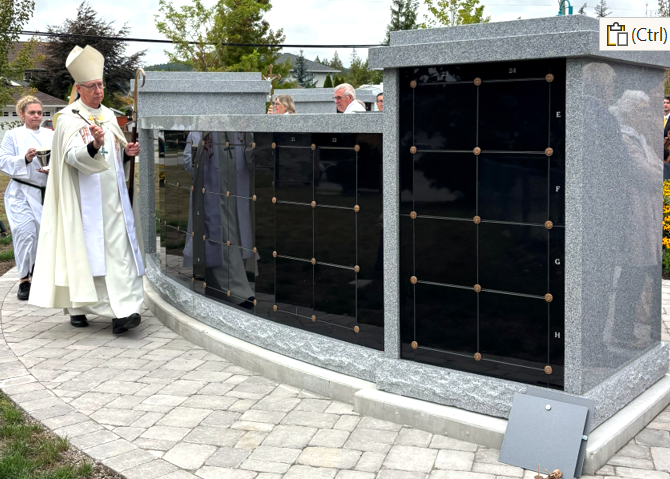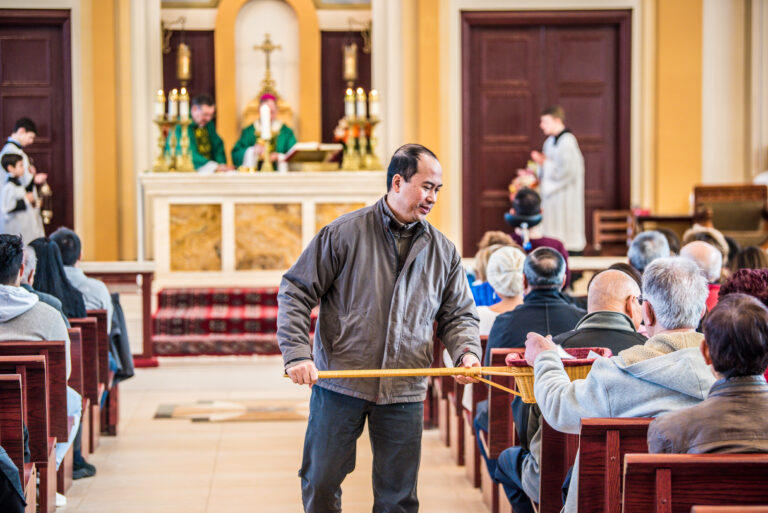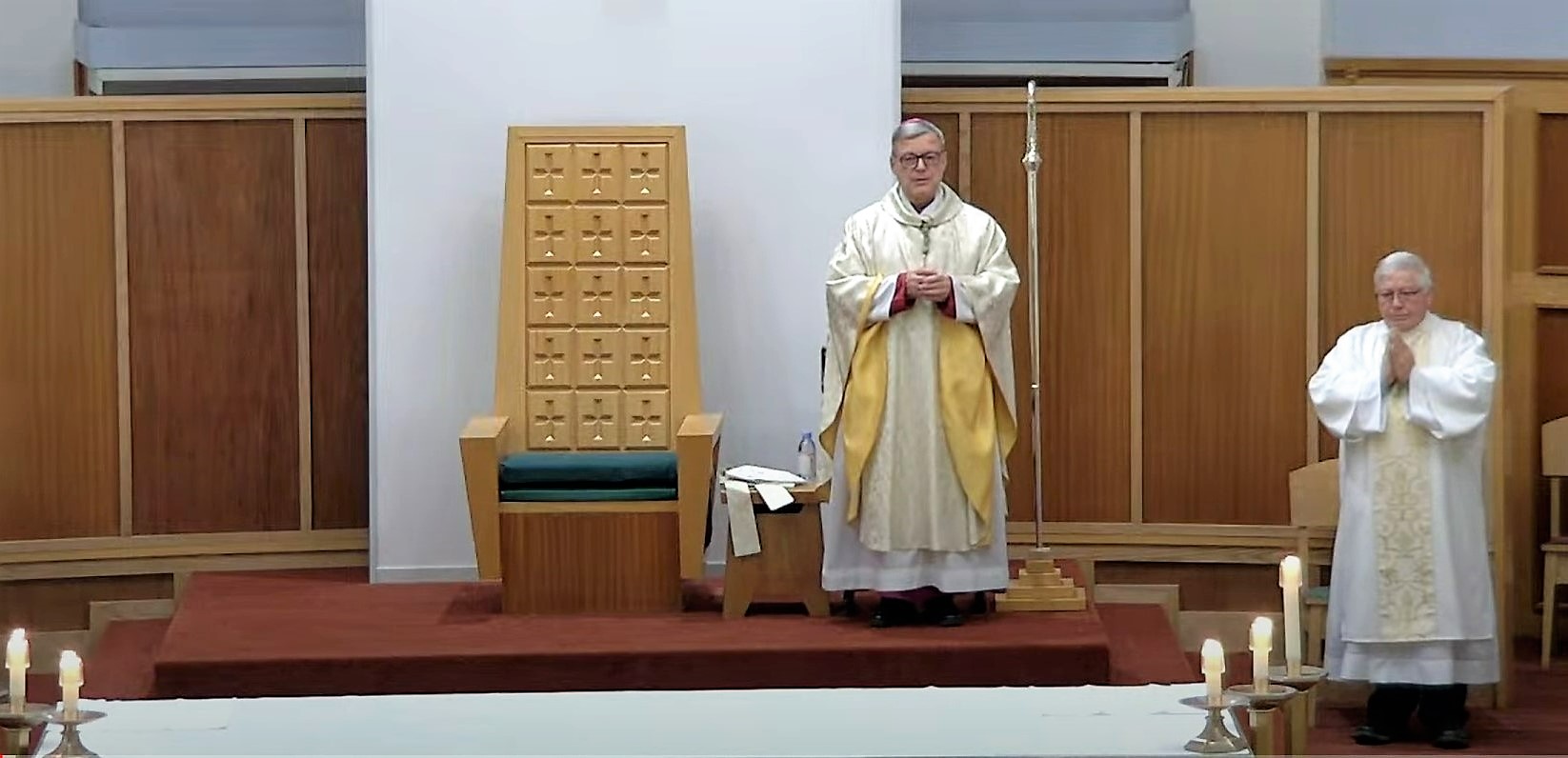

At the end of his farewell Mass at St. Paul Cathedral Nov. 21, retiring Bishop Paul Terrio confided to the faithful: “The first time our new Bishop-elect Gary Franklin and I spoke, he said, ‘listen, I hope you will consider hanging around.’
“That’s what he said. He’s very down to earth and approachable and you’re going to be able to connect with him very easily.”
Bishop Terrio also told them that Edmonton Archbishop Richard Smith had already asked him upon retiring to help out at St. Joseph Seminary with spiritual guidance and counselling for the seminarians.
“So I said to him, ‘yes, that’s what I did for a lot of my life as a priest, working in seminary, so I’ll go there.’”
“So I’m leaving one job but I’m getting two in a sense.”
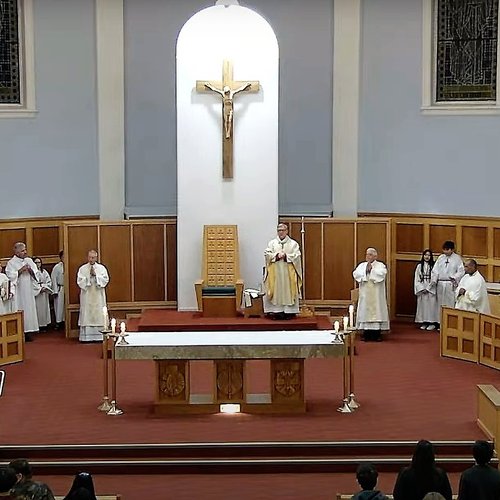
Pope Benedict XVI appointed Father Paul Terrio as Bishop of St. Paul on Oct 18, 2012, and ny Dec. 12 of that year, on the feast of Our Lady of Guadalupe, he was ordained in St. Paul Cathedral by the Archbishop of Edmonton, Richard Smith. A new chapter of life had begun.
At the time, Father Terrio thought he was of an age where something seismic like this wouldn’t happen. Being chosen and then ordained a bishop at the age of 69 was a genuine surprise – especially considering that bishops are required to submit their resignations when they turn 75. “It might be a short run for me” he was quoted as saying at the time.
And yet Bishop Paul Terrio lasted a full 10 years in the role. Now, retiring at the age of 79, four years beyond the traditional resignation date, Bishop Terrio gets to engage in a sort of perfect symmetry as he oversees the ordination of his successor, Bishop-elect Gary Franken, on the very same Dec. 12 day he received his own mantle of office, exactly one decade later.
It’s been quite the journey.
It took time visiting the local parishes and becoming acquainted with the area’s traditions. Discovering who his people were, meeting their families, learning to know them and their lives in Alberta. As a native Montrealer he certainly had to embrace a new way of living, trading in the urban sophistication of an international city for the rugged individualism and no-nonsense reality of the wide-open Alberta frontier.
Clearly, something took hold in that time.
“I’m now very much an Albertan,” Bishop Terrio told reporter Mario Cabradilla. “I have a relationship and know many of the people in this area and it’s a wonderful place, and a good place to be in today’s society. I’m very grateful that I was sent here, and this is now my home. So, I’m making arrangements to stay here.”
He really thought they would want someone younger for the St. Paul diocese. Not to mention the fact that there were other dioceses requiring both English and French, as Bishop Terrio is fluent in both (not to mention Portuguese and functional Italian too). Maybe knowing multiple languages better prepares one for change?
Bishop Terrio started with a flock of nearly 56,000 faithful and has seen it nearly double in 10 years. He supported his parishes, strengthened them, helped them personally whenever possible and supported his priests and religious as best he knew how. He was excited to bring the Poor Clare Sisters and their order’s gifts of prayer, simplicity, community, and joy to the St. Paul diocese as a whole. His time has been worthwhile and joyful.
He embraced the challenges. From the devastation of the 2016 wildfire in Fort McMurray to the diocese’s important relationships with the Cree, Dene, and other Indigenous communities. He knows not all difficulties are the same.
“A disaster like the wildfires allows [for] grace. The outpouring of support and people helping people was an outstanding experience,” even as he acknowledges that the healing and relationship building with indigenous communities remain “a good journey of dialogue where we are learning and growing in reconciliation.”
Pastors are forever in the people business and just because one becomes a bishop doesn’t mean that critical reality ever really gets left far behind. Not that it should.
“Being a priest with people, being a pastor, that’s what it’s all about,” he says.
But what of the biggest challenge he faced as bishop? What could possibly be the “one main thing” that rose above all others, demanding he sit up and take notice?
“The secularization of society. There’s no bad will there, …it’s just what’s happening,” said Bishop Terrio. “It’s sort of an innocent and practical agnosticism or atheism where people don’t necessarily say they don’t believe in God…[they just] practically live as though there is no God.”
It is the same battle currently faced by all bishops around the country these days, and remains a fight that, while not easily won, is worth the time and effort it demands.
So, come Dec 12, 2022, when Bishop Paul Terrio of the St. Paul Diocese officially becomes Bishop Emeritus of same, what advice would he offer to incoming Bishop-Elect Franken?
“Just … get to know [the people] and … circulate through the territory, and then [go] from parish to parish.” What comes after that remains unsaid only because it is so obvious.
The rest will take care of itself.
Which is precisely how 10 years of service can pass in the blink of an eye.
Send us a letter to the editor about this or any other article.