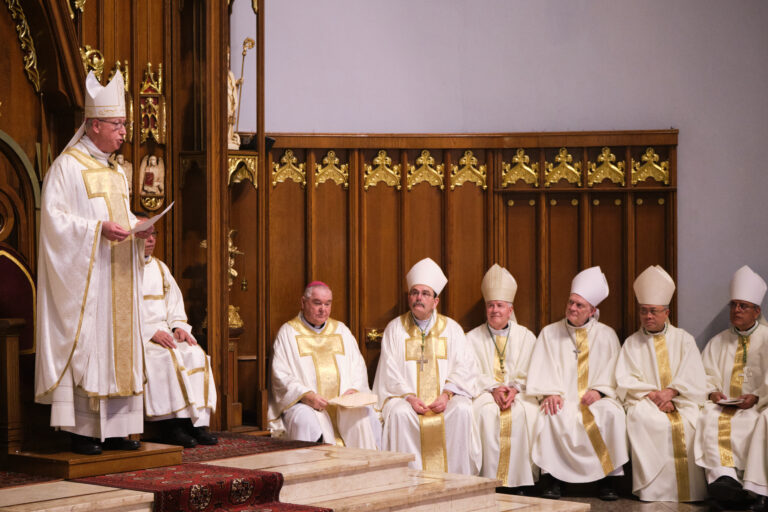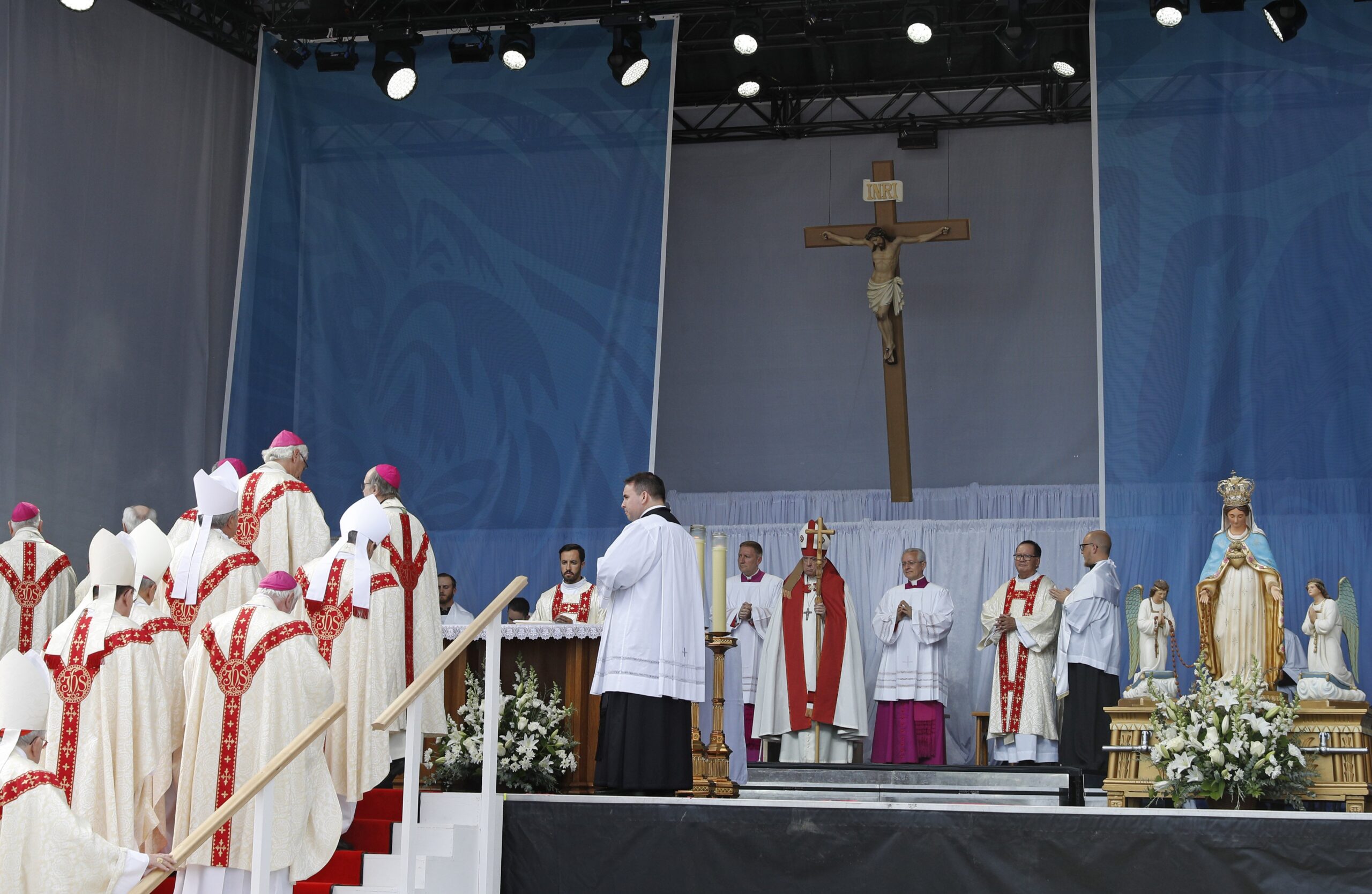

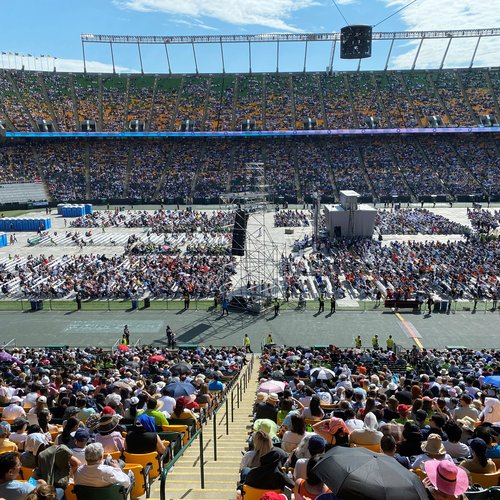
On the second day of his 5-day “Penitential Pilgrimage” to Canada, Pope Francis presided at the Holy Mass at Commonwealth Stadium in Edmonton, with the presence of the faithful.
In his homily, the Holy Father invited everyone to think about their own grandparents, as the Church celebrates the feast day of Saints Joachim and Anne, in whose home the child Jesus came to know his relatives and “experienced the closeness, tender love and wisdom of His grandparents.”
Pope Francis highlighted that we are children of a history that needs to be preserved – not isolated individuals – as no one comes into the world detached from others. Thus, our roots and families in which we grew up are part of a unique history that preceded us and gave us life.
In this light, “we did not choose that history” but “received it as a gift”, one we are to cherish. We are “descendants” of those who went before us and their “inheritance” which is “centered on righteousness, fidelity to God and His will.”
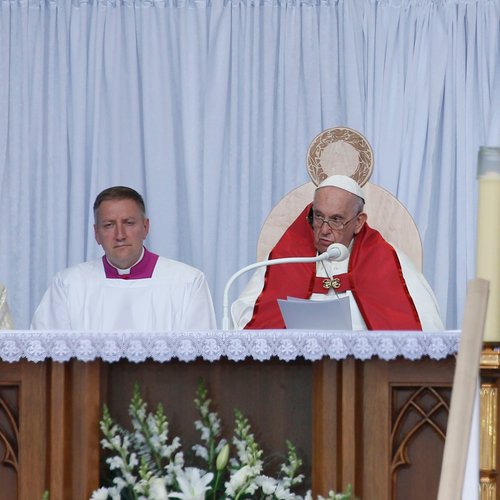
Pope Francis gives the homily as he celebrates Mass at Commonwealth Stadium in Edmonton. (CNS photo/Paul Haring)
“We are here thanks to our parents, but also thanks to our grandparents, who helped us feel welcome in the world,” the Pope said, adding they are the ones who love us unconditionally, without expecting anything back. Thanks to them, he continued, “we received a caress from the history that preceded us: we learned that goodness, tender love and wisdom are the solid roots of humanity.”
Further appreciating grandparents, the Pope said it is in their homes that many of us “breathed in the fragrance of the Gospel,” and discovered a “familiar” faith, through affection, encouragement, care and closeness.
He pointed out that it is in this way that Joachim and Anne loved Mary, and how Mary, in turn, loved Jesus, with a love that “never smothered Him or held Him back,” and the Pope invited everyone to learn not to pressure the consciences of others, or fail to love and respect those who preceded us or are entrusted to our care.
He encouraged us not to lose their memory, nor forget the history that gave birth to our own lives. Rather, we should remember those whose hands caressed us and who held us in their arms; “for in this history we can find consolation in moments of discouragement, a light to guide us, and courage to face the challenges of life.”
In addition to being children of a history that needs to be preserved, we are authors of a history yet to be written, the Pope said, noting that we are marked by both light and shadows, and by the love we did or did not receive.
He added that this is the mystery of human life: we are someone’s children but we too are called to give life, as fathers, mothers and grandparents to someone else. We should, therefore, ask ourselves what kind of society we want to build and bequeath to those who come after us, in light of the much we have received from those who preceded us.
Using the image of the life-giving sap that travels from roots, to branches, leaves, flowers and to the fruit of a tree, Pope Francis said that authentic tradition is expressed in this vertical dimension – from the bottom up. He, thus, warned against falling into a “caricature of tradition” which is not vertical – from roots to fruits, but horizontal – forwards and backwards, saying that this only leads to a backwards culture, trapped in the mentality that says “we have always done it this way.”
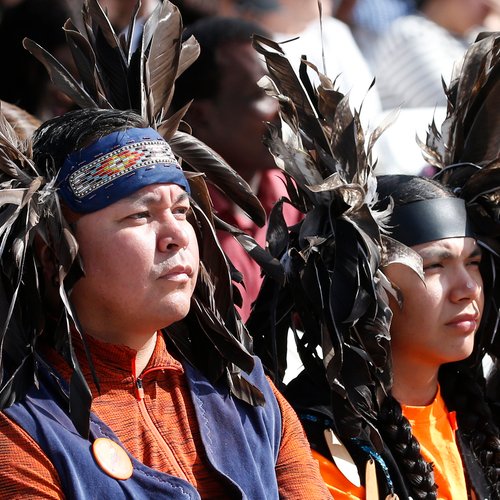
Indigenous people attend Pope Francis’ celebration of Mass at Commonwealth Stadium in Edmonton.(CNS photo/Paul Haring)
Reflecting on the day’s Gospel reading, Pope Francis noted that Jesus tells his disciples that they are blessed because they can see and hear what prophets and righteous people could only long for – the Messiah that those who can see and hear are called to welcome and proclaim. Similarly, those before us passed on a passion, strength and flame that is up to us to reignite.
Likewise, our grandparents and elders “wanted to see a more just, fraternal and solidary world, and they fought to give us a future” and it is up to us not to let them down and to bear fruit, because “we are the branches that must blossom and spread new seeds of history.”
Highlighting the “unique and irreplaceable” role we all have in history, Pope Francis asked everyone to question what we are passing on to those who come after us and what kind of mark we will be leaving behind.
He added that the Lord does not want us to be mere critics of our system, closed and backwards looking, but rather “artisans of a new history, weavers of hope, builders of the future, peacemakers.”
Concluding, the Holy Father invoked the intercession of Saints Joachim to help us cherish the history that gave us life and “remind us of our spiritual duty to honour our grandparents and our elders, to treasure their presence among us in order to create a better future.”
The Pope prayed, in this light, for a future where the elderly are not cast aside because they are no longer useful and cannot produce, or one that is indifferent to the need of the aged to be cared for and listened.
He further prayed for a future in which “the history of violence and marginalization suffered by our indigenous brothers and sisters is never repeated.”
“That future is possible if, with God’s help, we do not sever the bond that joins us with those who have gone before us, and if we foster dialogue with those who will come after us,” the Pope said. “Young and old, grandparents and grandchildren, all together. Let us move forward together, and together; let us dream.”
Below is Pope Francis’ homily at the Mass celebrated at Commonwealth Stadium in Edmonton July 26.
Today we celebrate the feast of the grandparents of Jesus. The Lord has gathered all of us together precisely on this occasion, so dear to you and to me. It was in the home of Joachim and Anne that the child Jesus came to know his older relatives and experienced the closeness, tender love and wisdom of his grandparents. Let us think about our own grandparents, and reflect on two important things.
First: we are children of a history that needs to be preserved. We are not isolated individuals, islands. No one comes into this world detached from others. Our roots, the love that awaited us and welcomed us into the world, the families in which we grew up, are part of a unique history that preceded us and gave us life. We did not choose that history; we received it as a gift, one that we are called to cherish, for, as the Book of Sirach reminds us, we are “descendants” of those who went before us; we are their “inheritance” (Sir 44:11). An inheritance that, quite apart from any claim to prestige or authority, intelligence or creativity in song or poetry, is centred on righteousness, on fidelity to God and his will. This is what they passed on to us. In order to accept who we really are, and how precious we are, we need to accept as part of ourselves the men and women from whom we are descended. They did not simply think about themselves, but passed on to us the treasure of life. We are here thanks to our parents, but also thanks to our grandparents, who helped us feel welcome in the world. Often they were the ones who loved us unconditionally, without expecting anything back. They took us by the hand when we were afraid, reassured us in the dark of night, encouraged us when in the full light of day we faced important life decisions. Thanks to our grandparents, we received a caress from the history that preceded us: we learned that goodness, tender love and wisdom are the solid roots of humanity. It was in our grandparents’ homes that many of us breathed in the fragrance of the Gospel, the strength of a faith which makes us feel at home. Thanks to them, we discovered that kind of “familiar” faith, a domestic faith. Because that is how faith is fundamentally passed on, at home, through a mother tongue, with affection and encouragement, care and closeness.
This is our history, to which we are heirs and which we are called to preserve. We are children because we are grandchildren. Our grandparents left a unique mark on us by their way of living; they gave us dignity and confidence in ourselves and others. They bestowed on us something that can never be taken from us and that, at the same time, allows us to be unique, original and free. From our grandparents we learned that love is never forced; it never deprives others of their interior freedom. That is the way Joachim and Anne loved Mary and Jesus; and that is how Mary loved Jesus, with a love that never smothered him or held him back, but accompanied him in embracing the mission for which he had come into the world. Let us try to learn this, as individuals and as a Church. May we learn never to pressure the consciences of others, never to restrict the freedom of those around us, and above all, never to fail in loving and respecting those who preceded us and are entrusted to our care. For they are a precious treasure that preserves a history greater than themselves.
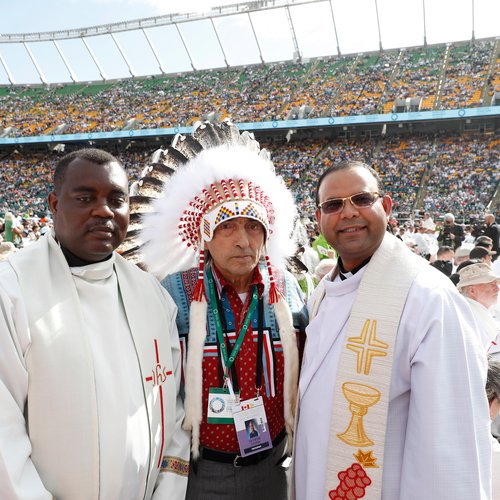
Priests pose for a photo with Phil Fontaine, former national chief of the Assembly of First Nations, before Mass at Commonwealth Stadium. (CNS photo/Paul Haring)
The Book of Sirach also tells us that preserving the history that gave us life does not mean obscuring the “glory” of our ancestors. We should not lose their memory, nor forget the history that gave birth to our own lives. We should always remember those whose hands caressed us and who held us in their arms; for in this history we can find consolation in moments of discouragement, a light to guide us, and courage to face the challenges of life. Yet preserving the history that gave us life also means constantly returning to that school where we first learned how to love. It means asking ourselves, when faced with daily choices, what the wisest of the elders we have known would do in our place, what advice our grandparents and great-grandparents would have given us.
So, dear brothers and sisters, let us ask ourselves: are we children and grandchildren capable of safeguarding this treasure that we have inherited? Do we remember the good teachings we have received? Do we talk to our elders, and take time to listen to them? And, in our increasingly well-equipped, modern and functional homes, do we know how to set aside a worthy space for preserving their memory, a special place, a small family memorial which, through precious pictures and objects, allows us to remember in prayer those who went before us? Have we kept their Bible, their rosary beads? In the fog of forgetfulness that overshadows our turbulent times, it is essential, brothers and sisters, to take care of our roots, to pray for and with our forebears, to dedicate time to remember and guard their legacy. This is how a family tree grows; this is how the future is built.
Let us now think of the second important thing. In addition to being children of a history that needs to be preserved, we are authors of a history yet to be written. Each of us can recognize ourselves for who and what we are, marked by both light and shadows, and by the love that we did or did not receive. This is the mystery of human life: we are all someone’s children, begotten and shaped by another, but as we become adults, we too are called to give life, to be a father, mother or grandparent to someone else. Thinking about the people we are today, what do we want to do with ourselves? The grandparents who went before, the elderly who had dreams and hopes for us, and made great sacrifices for us, ask us an essential question: what kind of a society do we want to build? We received so much from the hands of those who preceded us. What do we, in turn, want to bequeath to those who come after us? “Rose water”, that is a diluted faith, or a living faith? A society founded on personal profit or on fraternity? A world at war or a world at peace? A devastated creation or a home that continues to be welcoming?
Let us not forget that the life-giving sap travels from the roots to the branches, to the leaves, to the flowers, and then to the fruit of the tree. Authentic tradition is expressed in this vertical dimension: from the bottom up. We need to be careful lest we fall into a caricature of tradition, which is not vertical – from roots to fruits – but horizontal – forwards and backwards. Tradition conceived in this way only leads us to a kind of “backwards culture”, a refuge of self-centredness, which simply pigeonholes the present, trapping it within the mentality that says, “We’ve always done it this way”.
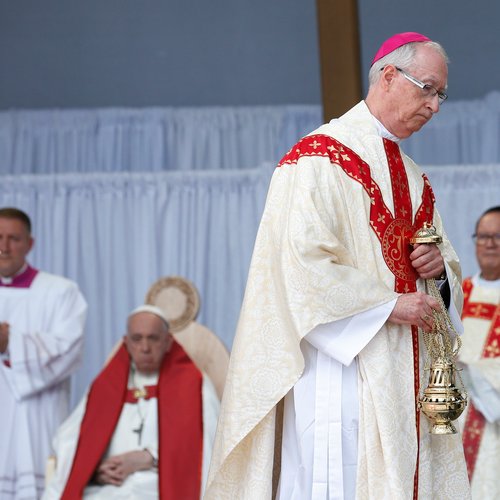
Archbishop Richard Smith of Edmonton, Alberta, burns incense as Pope Francis celebrates Mass at Commonwealth Stadium. Vancouver Deacon Rennie Nahanee, a Squamish Elder, is at the right.(CNS photo/Paul Haring)
In the Gospel we just heard, Jesus tells the disciples that they are blessed because they can see and hear what so many prophets and righteous people could only hope for (cf. Mt 13:16-17). Many people had believed in God’s promise of the coming Messiah, had prepared the way for him and had announced his arrival. But now that the Messiah has arrived, those who can see and hear him are called to welcome him and proclaim his presence in our midst.
Brothers and sisters, this also applies to us. Those who preceded us have passed on to us a passion, a strength and a yearning, a flame that it is up to us to reignite. It is not a matter of preserving ashes, but of rekindling the fire that they lit. Our grandparents and our elders wanted to see a more just, fraternal and solidary world, and they fought to give us a future. Now, it is up to us not to let them down. It is up to us to take on the tradition received, because that tradition is the living faith of our dead. Let us not transform it into “traditionalism”, which is the dead faith of the living, as an author once said. Sustained by those who are our roots, now it is our turn to bear fruit. We are the branches that must blossom and spread new seeds of history. Let us ask ourselves, then, a few concrete questions. As part of the history of salvation, in the light of those who went before me and loved me, what is it that I must now do? I have a unique and irreplaceable role in history, but what mark will I leave behind me? What am I passing on to those who will come after me? What am I giving of myself? Often we measure our lives on the basis of our income, our type of career, our degree of success and how others perceive us. Yet these are not life-giving criteria. The real question is: am I giving life? Am I ushering into history a new and renewed love that was not there before? Am I proclaiming the Gospel in my neighbourhood? Am I freely serving others, the way those who preceded me did for me? What am I doing for our Church, our city, our society? Brothers and sisters, it is easy to criticize, but the Lord does not want us to be mere critics of the system, or to be closed and “backwards-looking”, as says the author of the Letter to the Hebrews (cf. 10:39). Rather, he wants us to be artisans of a new history, weavers of hope, builders of the future, peacemakers.
May Joachim and Anne intercede for us. May they help us to cherish the history that gave us life, and, for our part, to build a life-giving history. May they remind us of our spiritual duty to honour our grandparents and our elders, to treasure their presence among us in order to create a better future. A future in which the elderly are not cast aside because, from a “practical” standpoint, they are “no longer useful”. A future that does not judge the value of people simply by what they can produce. A future that is not indifferent to the need of the aged to be cared for and listened to. A future in which the history of violence and marginalization suffered by our indigenous brothers and sisters is never repeated. That future is possible if, with God’s help, we do not sever the bond that joins us with those who have gone before us, and if we foster dialogue with those who will come after us. Young and old, grandparents and grandchildren, all together. Let us move forward together, and together, let us dream. Also, let us not forget Paul’s advice to his disciple Timothy: Remember your mother and your grandmother (cf. 2 Tim 1:5).
Vatican News