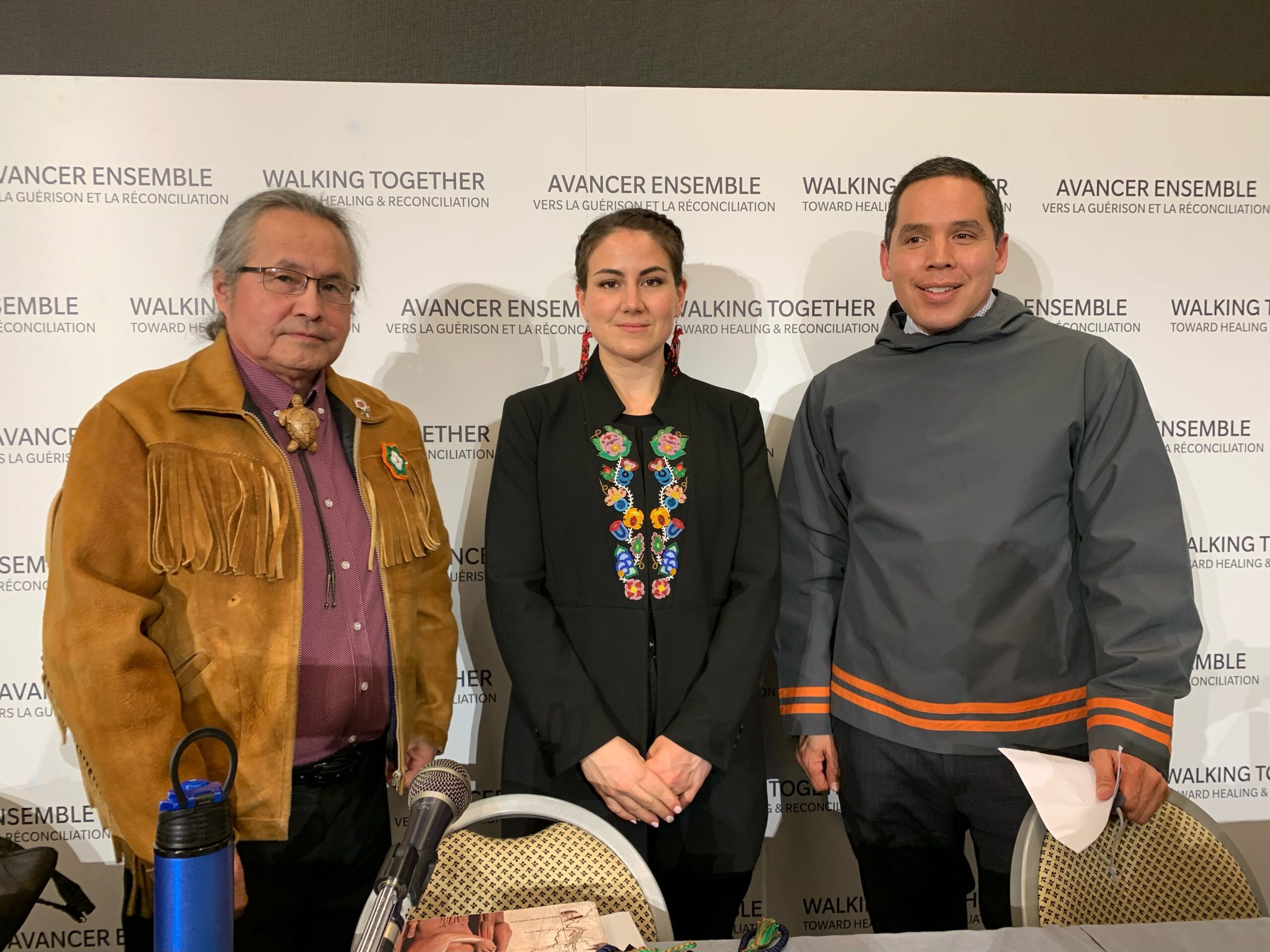

Indigenous leaders described Pope Francis’ residential school apology as the beginning of a path forward, with the next step to follow when he brings his message of sorry and healing to Canada this summer.
Metis, First Nations and Inuit leaders all welcomed the Pope’s apology Friday, calling it “absolutely historic” and “long overdue.” But it is also “a piece of the puzzle,” in the words of Inuit Tapiriit president Natan Obed, who said “there is much more to do … an apology is a part of a larger picture.”
Obed credited the Pope for the “long overdue” apology delivered “in an empathetic and caring way. I was touched by the way in which he expressed his sorrow and also the way in which he condemned the actions of the Church …”
Obed also voiced his appreciation for Canadian bishops who worked with Indigenous leaders to help them reach “a better place in order to fill the actions that are necessary to bring about justice and healing.”
He told a press conference with the other Indigenous leaders and the Canadian bishops “we are here to articulate as clearly as we possibly can about what the Catholic Church still needs to do ensure that there is truth, there is justice, there is healing, and there is reconciliation” for the role the Church played in the residential school system.
“Individual survivors and intergenerational survivors all will have very different feelings and perspectives” about the apology, he said, “from the many Inuit who attended residential schools where there was abuse, to the intergenerational trauma still being experienced today.”
The work that remains to be done “must be in concert, in partnership with the Catholic Church if we are to show that this week is a true turning point in the relationship between us and the Catholic Church.”
For Cassidy Caron, president of the Métis National Council, the Pope’s apology was “absolutely historic and so meaningful to so many people.” After receiving it she was able to say, “I hear that we were heard. He truly reflected the way that we are. That we’re all connected in a web of interconnected relationships.”
The meeting with Francis was an invitation to him to join the Metis on “a pathway forward for truth, healing, reconciliation, and justice” and “opens a door for us to continue to move forward on our healing journeys,” she said, adding the Pope made a similar point “when he says that any truly effective process of healing requires concrete actions.”
Caron noted how moved the Pope was by the experiences he heard from delegates. “Just imagine what he’s going to feel when he comes to our homelands and meets with our people, sees our communities,” expressing hope he will visit residential schools and spiritual sites.
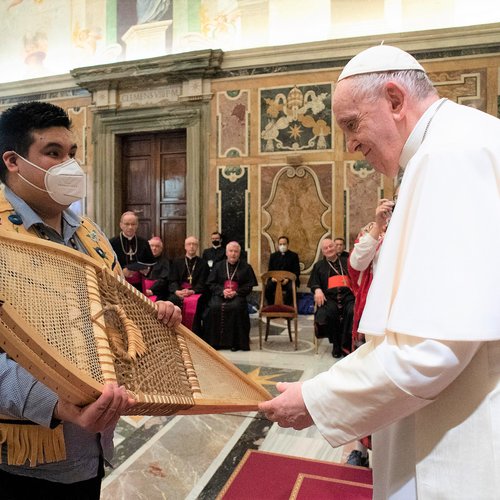
Chief Gerald Antoine, Northwest Territories regional chief of the Assembly of First Nations, said the apology was “indeed a historic step” that needs to be followed by an apology by the Pope in Canada.
“We accept this apology as a gesture of good faith that acknowledges he will come to our home and to visit with our families to formally apologize to all our family members.”
Using a hunting analogy Antoine described the apology as a “positive gesture … it’s like hunting. We just spotted a fresh track and we still need to work. We still need to follow those tracks.”
The apology was “a real blessing for us as a delegation,” he said, praising the elders who shared their stories.
CCCB Vice President Bishop William McGrattan of Calgary thanked everyone responsible for the meetings, saying they were culmination of a walk that began years ago with “the desire to meet with Pope Francis and to allow him to hear the voices of those who have suffered.”
Bishop McGrattan said the meetings between Pope and delegates showed “a man, a father, whose heart was moved by those stories, those experiences of the elders who had gone to residential schools.”
The next step, he said, was “the offering of an apology needs to be followed up with action.”
Bishop McGrattan pledged the Church’s commitment to helping obtain the release of records from schools and religious communities as part of “this path of healing, of truth, of justice and reconciliation.”
The Pope’s final address made it clear he saw “the gifts of spirituality, of culture and language” that Indigenous communities have provided Canada and the world and “need to be cherished.”
He closed by saying the Church in Canada wants to begin healing, justice and truth at the local level “so that Canadians and Catholics can know the past” and end colonialism and the forces that contributed to it.
All the leaders expressed their appreciation for the delegates, for the elders and survivors in Rome, and for those at home who need to hear it in person.
I’m so honoured to sit here today and to have sat beside our elders and our survivors in that meeting,” said Caron. “Because this is for them. And I can only imagine what our survivors who are not with us today would have felt if they were. This is so long overdue. But we’re here now and we’re able to move forward. And we look forward to bringing these messages back home and we look forward to when the Pope visits and delivers a similar, if not stronger, message when he does arrive to our communities.”
Obed acknowledged the “heartfelt expression of the Church” and paid tribute to the work of delegates and the contributions of survivors, who will have “very different feelings and perspectives” about the apology.”
Antoine called it “a day that we’ve been waiting for. When I say we, it is our family. All those people that are back at home. And it’s certainly one that will be lifted up. In history. None of this would have been possible without the collaboration and strength of our people, our family, our leadership, our organizations.