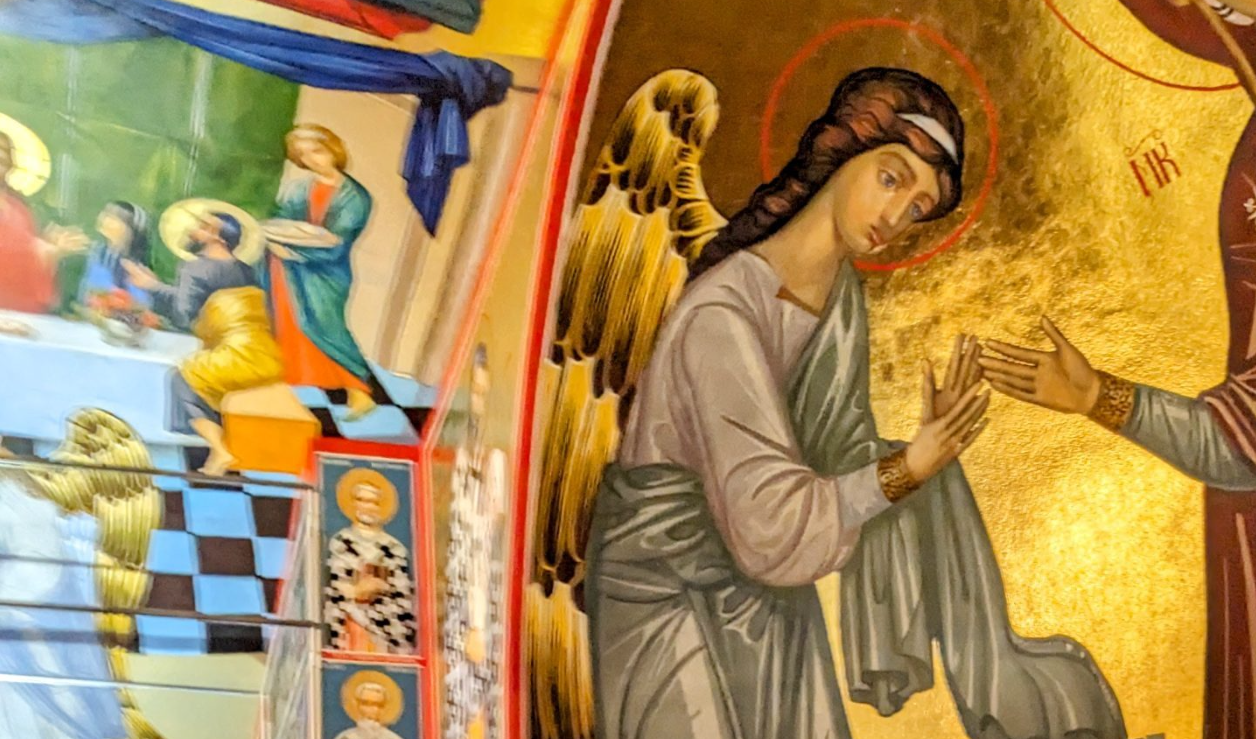

Light pooled across the nave of St. Clement of Ohrid Macedonian Orthodox Cathedral, gilding the scaffold rails and the edge of a saint’s painted robe. The scent of beeswax and incense lingered in the air. Above, artist Georgi Danevski balanced on a platform, one hand steadying himself while the other coaxed the curve of a halo into being. The jars of pigment at his feet shimmered like crushed gemstones.
In that moment, the world outside disappeared. The space felt timeless yet alive, anchored in centuries of Orthodox tradition while speaking powerfully to the present. I stood in awe, initially hesitant to approach Danevski, worried that my questions might interrupt his concentration. Yet as he descended the ladder and greeted me warmly, that anxiety dissolved. There was an ease to him, a generosity of spirit, and I sensed in him a kindred soul.
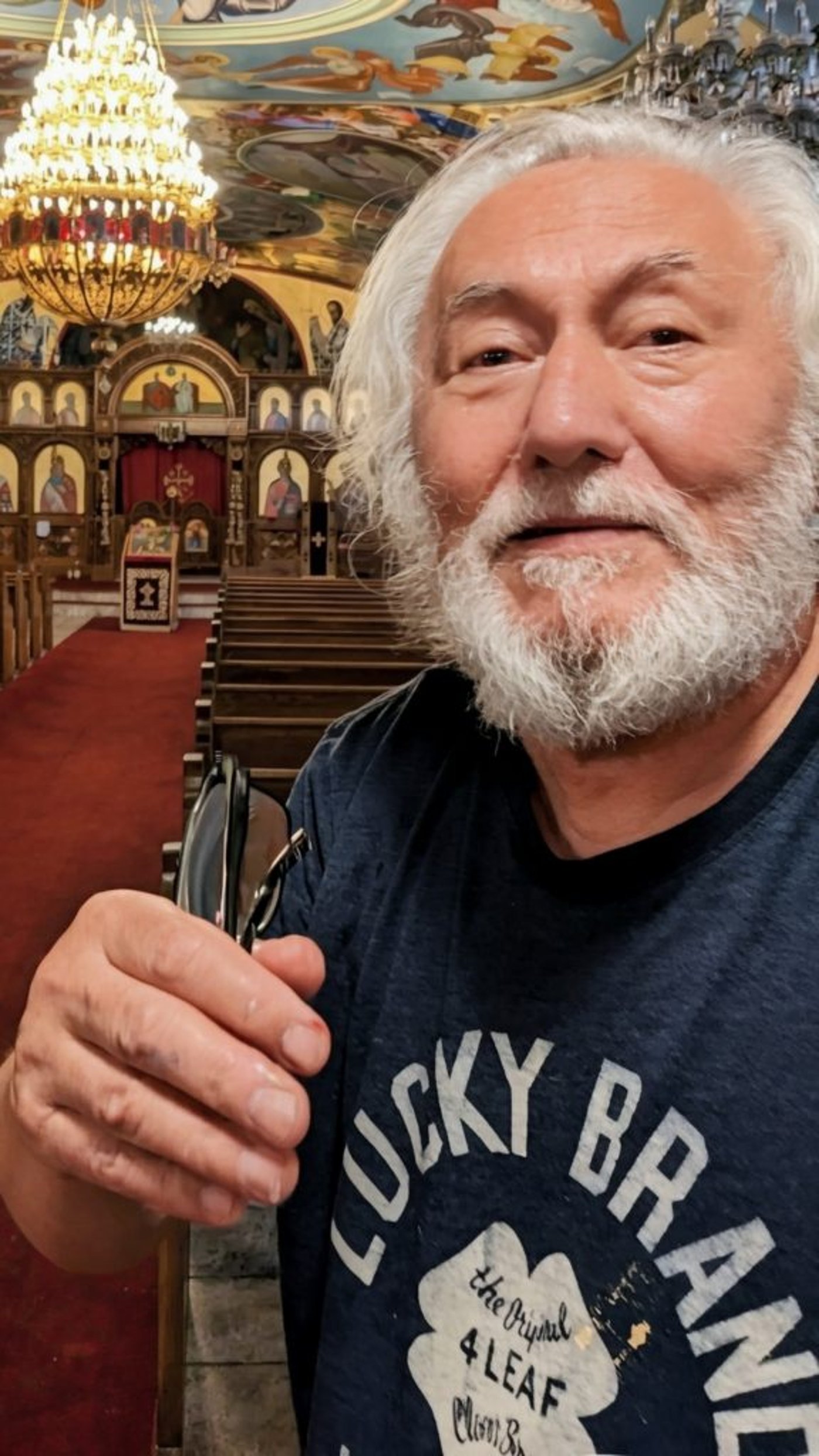
As we spoke, Danevski’s art revealed itself not merely as decoration but as theology in colour. He spoke of making “heaven present” through his work, of creating images meant to be prayed with, not just admired. He shared his influences — Orthodox mysticism, Catholic devotional traditions, and the philosophical tension between beauty and suffering. In his words and gestures, I saw echoes of my own search for meaning and expression.
At one point, he insisted on pausing his work to prepare tea for us both. It was a simple act, yet it carried a profound weight — an extension of the hospitality that marked his art. As the steam curled from the cups, he mused on how artistic expression itself reveals aspects of quantum reality: the mysterious interplay of presence and absence, of what is seen and unseen.
This was more than an interview. It was a conversation that bridged two spiritual traditions and, in some ways, two lives.
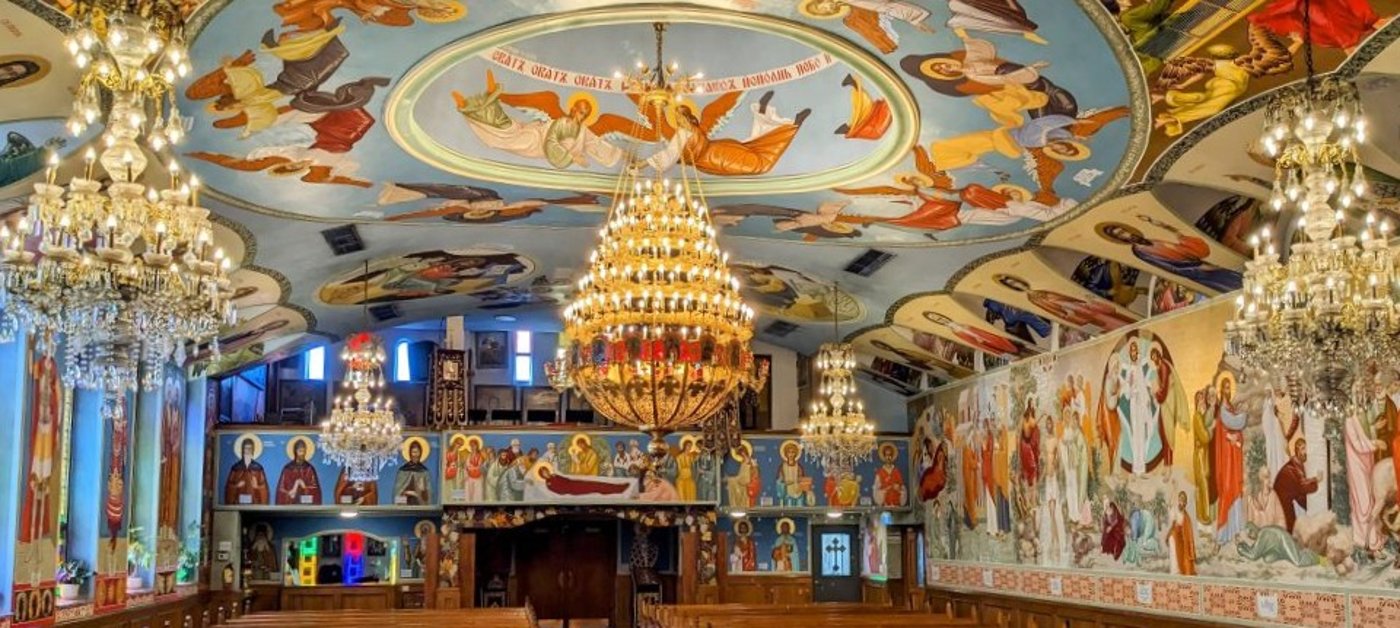
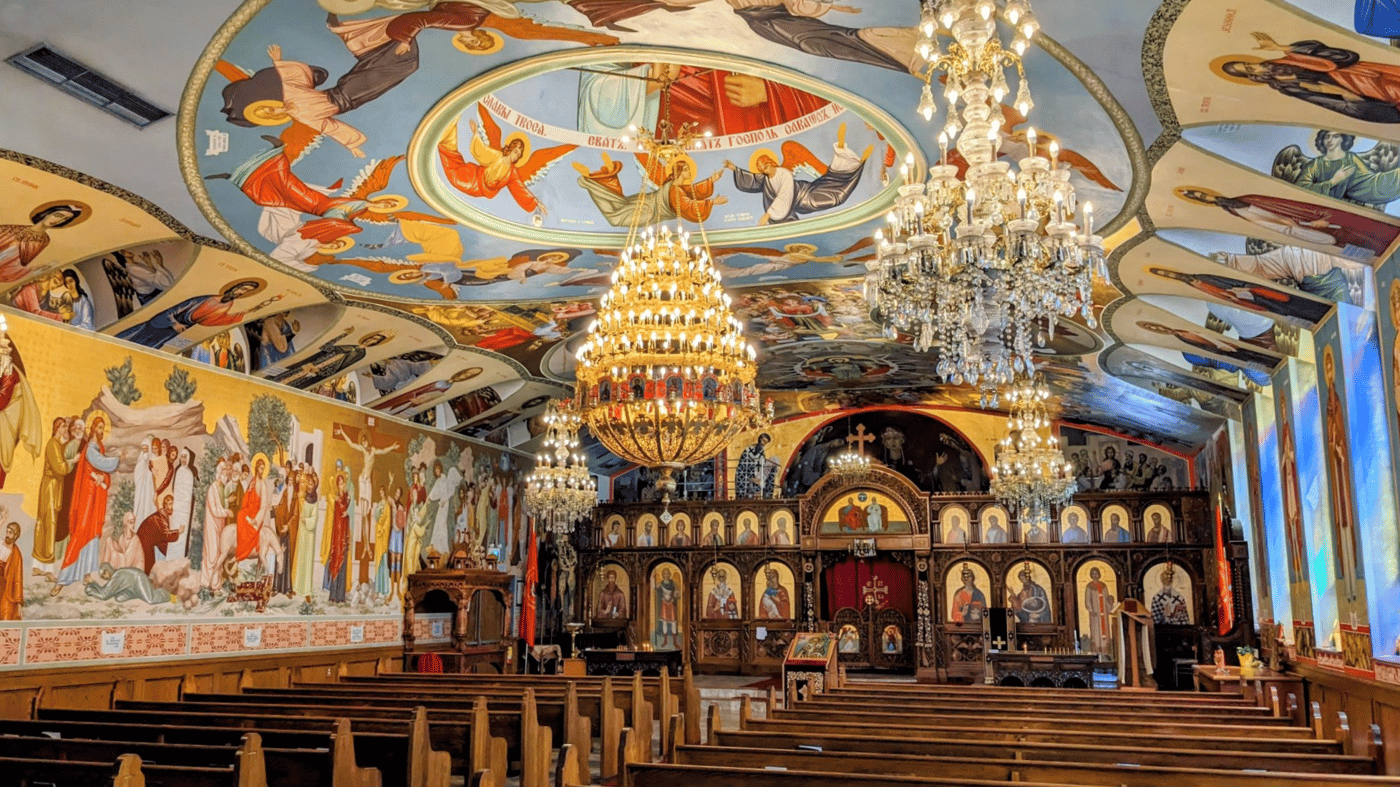
The interior of St. Clement of Ohrid Macedonian Orthodox Cathedral in Toronto, with iconography by Georgi Danevski.
Listening, I found myself captivated not only by his brush but by his words, which seemed to weave philosophy and theology into everyday gestures. The tea was strong and good, grounding the loftiness of his ideas in the warmth of shared humanity.
We talked about art as a vocation, not merely a craft; about painting not as labour but as prayer. Watching him return to his work after our exchange, I saw not just an artist but a man who carried centuries of faith into every brushstroke.
Leaving the cathedral, I carried that sense of stillness and recognition. Danevski’s murals invite viewers of all backgrounds to pause and consider the divine, reminding us that beauty speaks a universal language.
For me, this encounter became more than research for a project. It was a moment of unexpected connection, an invitation to witness grace made tangible — through pigment, prayer, and the hand of a man whose art draws heaven and earth closer together.
Icons and skylines: Orthodox church unveils new icons that ‘speak to the heart’
The city skyline tells many stories. Glass towers glint above bustling streets, while neighbourhoods layer histories of migration, struggle and celebration. Yet just north of the city’s downtown core, another kind of skyline rises — not in steel and concrete, but in domes and crosses.
Inside the soaring St. Clement of Ohrid Macedonian Orthodox Cathedral in the Thorncliffe Park neighbourhood of Toronto, the air is alive with the scent of beeswax and the glow of gold leaf.
Here, Macedonian Canadian iconographer Georgi Danevski bends over a wall, brush in hand, tracing a delicate line that will become part of a saint’s halo. Around him, scaffolding climbs toward a vault already alive with radiant figures. The work is painstaking, almost silent except for the occasional scrape of a ladder or the soft hum of liturgical music playing in the background.
Danevski’s work is part of the preparations for the cathedral’s 60th-anniversary celebration. Delegations from Macedonia, including bishops and lay leaders, will join local parishioners and guests. By then, much of Danevski’s work will be unveiled, though the project will still be in progress.
The murals are part of a vision that reaches far beyond decoration or an anniversary celebration. They are meant to speak to the heart — to Orthodox faithful, to Catholics and other Christians, and to anyone drawn by beauty in a city where cultures and faiths meet daily.
Born in Yugoslav Macedonia, Danevski grew up surrounded by the visual language of Eastern Christianity — a tradition where art is theology in color, and every line carries spiritual meaning. His training combined rigorous classical technique with the deep symbolism of Orthodox iconography. Over decades, he honed a style that honours ancient forms while embracing the vitality of contemporary colour and composition.
When he came to Canada in 1995, Danevski brought more than his brushes and pigments. He carried a conviction that sacred art could be both faithful to tradition and alive to the present moment.
“An icon is not just an image,” he says. “It is a window to eternity, a confession of the heart.”
His earlier work at St. Dimitrija Solunski Macedonian Orthodox Church in Markham established his reputation in the Greater Toronto Area. That project, completed over several years, transformed the church into a pilgrimage site for Orthodox faithful and art lovers alike.
While St. Clement’s murals differ in design and setting, they share the same goal — to lift the gaze upward toward the divine.
Toronto has the largest concentration of people who claim Macedonian heritage outside the Balkans, with estimates exceeding 100,000. Yet, when Father Sasho Celeski became pastor of St. Clement in 2019, Sunday liturgies drew about 30 parishioners, mostly older families who traveled from the suburbs. Many had left the neighbourhood years before as demographics shifted, and the parish faced the challenge of renewing both attendance and mission.
In the six years since, attendance has increased, and young families are once again an integral part of parish life. The murals, says Father Celeski, are central to this renewal.
“The restored icon murals in the church, and the new murals Georgi is painting in the sanctuary, will draw people here — Orthodox as well as all peoples of the Toronto area and beyond,” he says.
The project follows plans Father Celeski proposed — a vision not only for restoring sacred art, but for revitalizing the parish community and strengthening the Macedonian Orthodox presence in Toronto.
On an afternoon in mid-August, scaffolding filled the sanctuary. Danevski, wearing a paint-smeared shirt, worked with deliberate patience, mixing pigments to match the shimmering palette already climbing the walls. Saints emerged from the plaster with serene, elongated faces, their garments flowing in folds of deep blue and crimson. Overhead, angels hovered, their wings catching the afternoon light streaming through stained glass.
In Orthodox tradition, icons are considered a form of proclamation — a “visual Gospel” that teaches as much as it adorns. Each saint, feast scene and symbolic element is placed with theological intention. For Danevski, that means long hours not only painting, but also studying liturgical texts, consulting with clergy and ensuring that every figure fits harmoniously into the narrative arc of salvation history.
While the murals are unmistakably Orthodox in style and theology, their resonance reaches further. Catholic teaching recognizes Orthodox sacred art as part of a shared Christian patrimony, and many of the saints depicted are venerated in both traditions.
“Beauty can speak where words fail,” says Danevski. “Even if our traditions differ, beauty reminds us of the same Creator.”
Father Celeski shares this vision, seeing the murals as an invitation: “Our doors are open. People come in from the street, sometimes just curious, and they leave with something more — a sense of peace.”
St. Clement of Ohrid stands in a neighbourhood that has undergone dramatic changes since the parish was founded six decades ago. As the mother church for Macedonian Orthodox Christians in Toronto, it has since seen the birth of two other Macedonian Orthodox parishes in the city, including St. Dimitrija Solunski in Markham.
Today, the streets around St. Clement hum with the many languages spoken by immigrants from Asia, Africa and Latin America, who have joined established communities from Europe and the Middle East. In this environment, sacred spaces like St. Clement offer both continuity for the Macedonian community and points of contact with neighbours of other faiths.
Father Celeski says he believes the art will draw not only Orthodox faithful, but also people of other backgrounds:
“This project is for everyone. It’s for the city. If people can encounter beauty here, they can also encounter each other with more openness.”
Lee Purcell is an adjunct faculty member from the United States who teaches communication studies. He produced this report onsite as part of the God in the City Catholic journalism seminar in Toronto.
Your voice matters! Join the conversation by submitting a Letter to the Editor here.