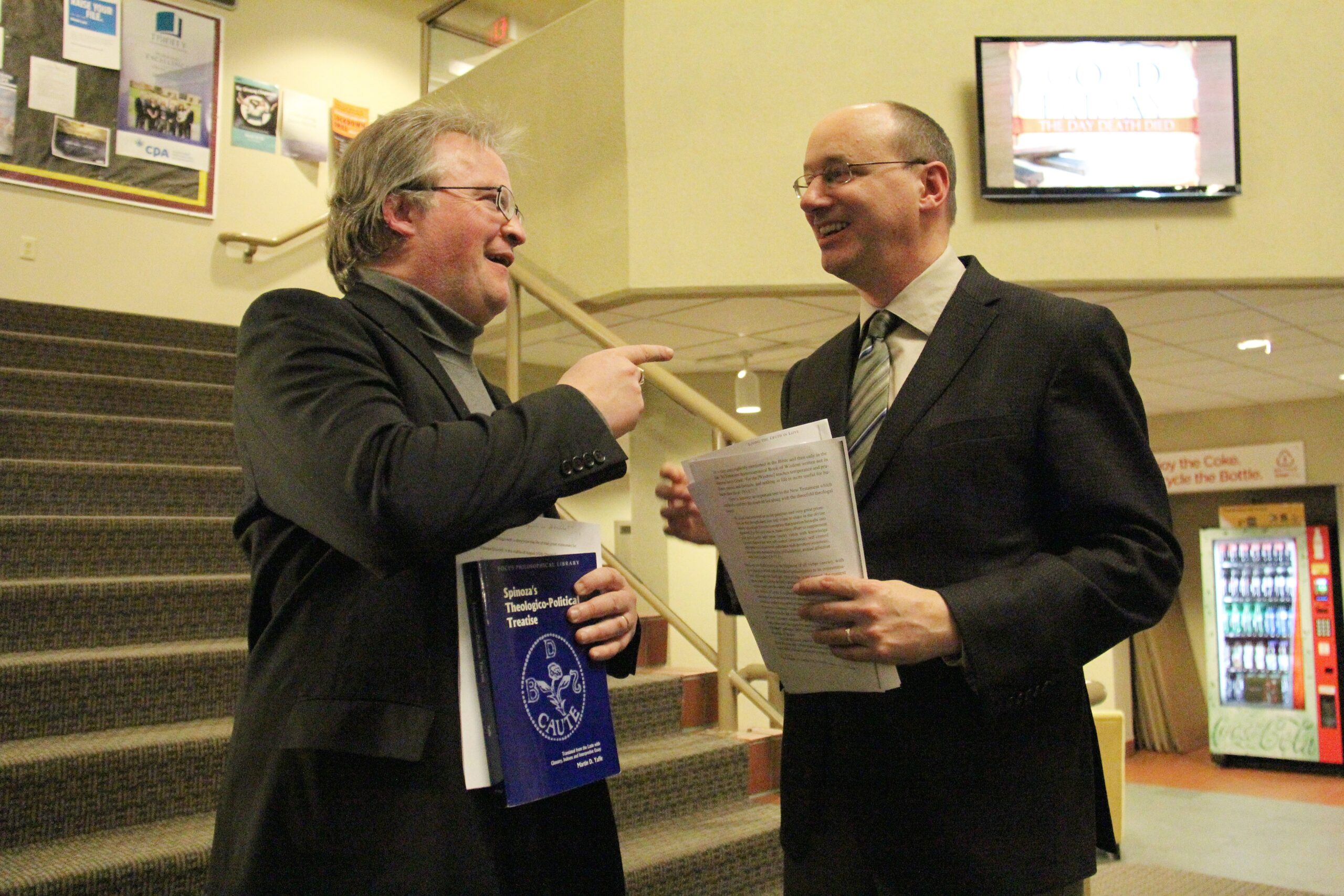

LANGLEY—Today’s perception of freedom of speech is a far cry from what its promoters meant in the 17th century, according to Trinity Western University professor Grant Havers.
Enlightenment thinkers agreed “freedom of speech must lead to progress,” he told a group of about 50 during a public lecture at the university March 4.
“It must actually benefit society. It’s not simply a pretext to say whatever you like. I suspect these enlightenment minds would be shocked by the way in which the Charlie Hebdo crowd have been portrayed as martyrs to freedom of speech.”
Employees at that controversial magazine in France were gunned down Jan. 7 after printing insulting depictions of Mohammed. The event drew international attention and sparked many questions about the limits of free speech.
Chris Morrissey, a Catholic Pacific College professor and B.C. Catholic columnist, also spoke, expounding on free speech according to St. Thomas Aquinas and Pope Leo XIII.
“That liberty of thinking and of publishing anything whatsoever, with no restraint at all, is not a good by its own nature over which human society should rightly rejoice,” he said, quoting the Pontiff. “It is the font and origin of many evils.”
Morrissey argued that freedom of speech isn’t a right at all. “It’s a virtue. It’s a kind of courage.” As part of the virtue of courage, it needs to be kept in balance between two extremes: cowardice and recklessness.
“Think of rights as justly permitted degrees of freedom for the sake of developing virtues.” Therefore, he continued, virtuous people are the ones who know the limits of free speech and should be the referees of wild debates.
Havers had a similar message, drawing on a treatise philosopher Baruch Spinoza published anonymously in 1674.
“Without the leavening influence of Christian morality, freedom of speech will devolve into tyranny and hatred,” he said, summing up Spinoza’s thoughts.
Spinoza listed seven dogmas he believed citizens should follow to keep the peace in a society of opposing views. They included: “God exists,” “God is unique,” “worship of God is true justice and charity,” and “salvation is through God alone.”
Some Church councils and Dutch bishops considered Spinoza a heretic for his beliefs about Scripture. But, Havers said, Spinoza laid out good foundations for freedom of speech.
“In keeping with the right of the highest powers, no one can act against their decrees, yet he can altogether think, judge, and consequently also say something contrary to their decrees, provided that he only says or teaches and defends it simply, and by reason alone, not by a ruse, in anger, in hatred, or in the spirit of introducing something into the republic on the basis of the authority of his own decree,” Spinoza wrote then.
Havers maintained that “neither Charlie Hebdo or jihadists pass the test. They do not act in a spirit of charity.”
He suggested people might “have to truly rediscover the supremacy of God, as Spinoza advocates, in order to have authentic freedom of speech in our time.”