
The Archdiocese of Vancouver is conducting a survey to help us better understand how the COVID-19 pandemic and responses have affected Catholics. This survey should take about 10 minutes.
Open with this intro by Father Roger Landry or a variation on it
On Aug. 11, the U.S. Centers for Disease Control loosened most of its COVID-19 guidelines, and many other national, state, and local governments, institutions and industries have recently done the same. It’s an important marker that collectively almost everyone wants to move on from the pandemic.
While there are still variants and people whose conditions make them vulnerable, while some continue to suffer with long COVID cases, while we continue to mourn those who have died because of it, we give thanks to God that, for the most part, the pandemic, and the revolution it caused to daily life are over.
There are many analyses being done as to the long-term impact of the pandemic on health care, the economy, culture, remote work, travel, schools, interpersonal interaction, child psychology and other social dimensions.
It is similarly important for the leaders and faithful of the Church to take this time to examine the impact of the pandemic on Catholic life.
Several surveys have shown that one-third of American Catholics who were coming to Mass at the beginning of March 2020 now no longer regularly attend. The decision to lock churches and prevent access to the sacraments during the worst months of the pandemic has had a calamitous impact on the faith life of millions of Catholics, on the vitality of their parishes and dioceses and on the Church’s whole mission.
Some of the faithful just lost their good habit of keeping holy the Lord’s Day. Others began to watch Mass on television or via livestream and have continued to substitute virtual participation for real. Others concluded that Mass must not be all that important if Church leaders – during a deadly pandemic when many were dying and others were wondering if they would be next – rather hastily had decided to eliminate the possibility of attending Mass and receiving other sacraments.
As the Church in the United States enters more deeply into the Eucharistic Revival, it is important to assess with candor and courage the way pandemic decisions have impacted Eucharistic life and faith. For some, shutting off access to Mass and the Holy Eucharist only increased their hunger for Holy Communion, gratitude for the Mass and appreciation for the gift of the priesthood that makes the Eucharistic Lord available. For many others, however, perhaps especially for those whose Eucharistic faith may have been weaker, the decision to suspend the public celebration of Mass attenuated or eliminated that hunger.
It’s easier to tear down than to build. It’s impossible to deny that the decision to shut down access to the Mass, made hurriedly and under duress, has had disastrous consequences. It’s important for Church leaders and faithful to admit that a mistake was made and to learn from it and resolve not to repeat it. Pandemic decision-making did not communicate courage but fear. It did not show that we are the spiritual descendants of the Martyrs of Abitene, Gorkum and Casamari; of Sts. Tarcisius, Oscar Romero and Pedro Maldonado, and other Eucharistic martyrs and saints. It did not confirm that the Eucharist is the source and summit, root, and center of the Christian life, but seemed to prioritize the health of the body over the health of the soul.
That does not mean we should have disregarded the pandemic, its dangers, and legitimate precautions. The obligation to attend Mass should have been suspended so that those at high risk, who care for those at high risk, who were uncomfortable putting themselves at risk, or who work in health care and similar professions, could with clean conscience make the decision to stay away. Stopping the distribution of the Precious Blood was obvious for epidemiological reasons. Following the best advice of medical professionals with regard to social distancing, masks, and handwashing – as well as legitimate governmental restrictions regarding indoor crowd size – was prudent.
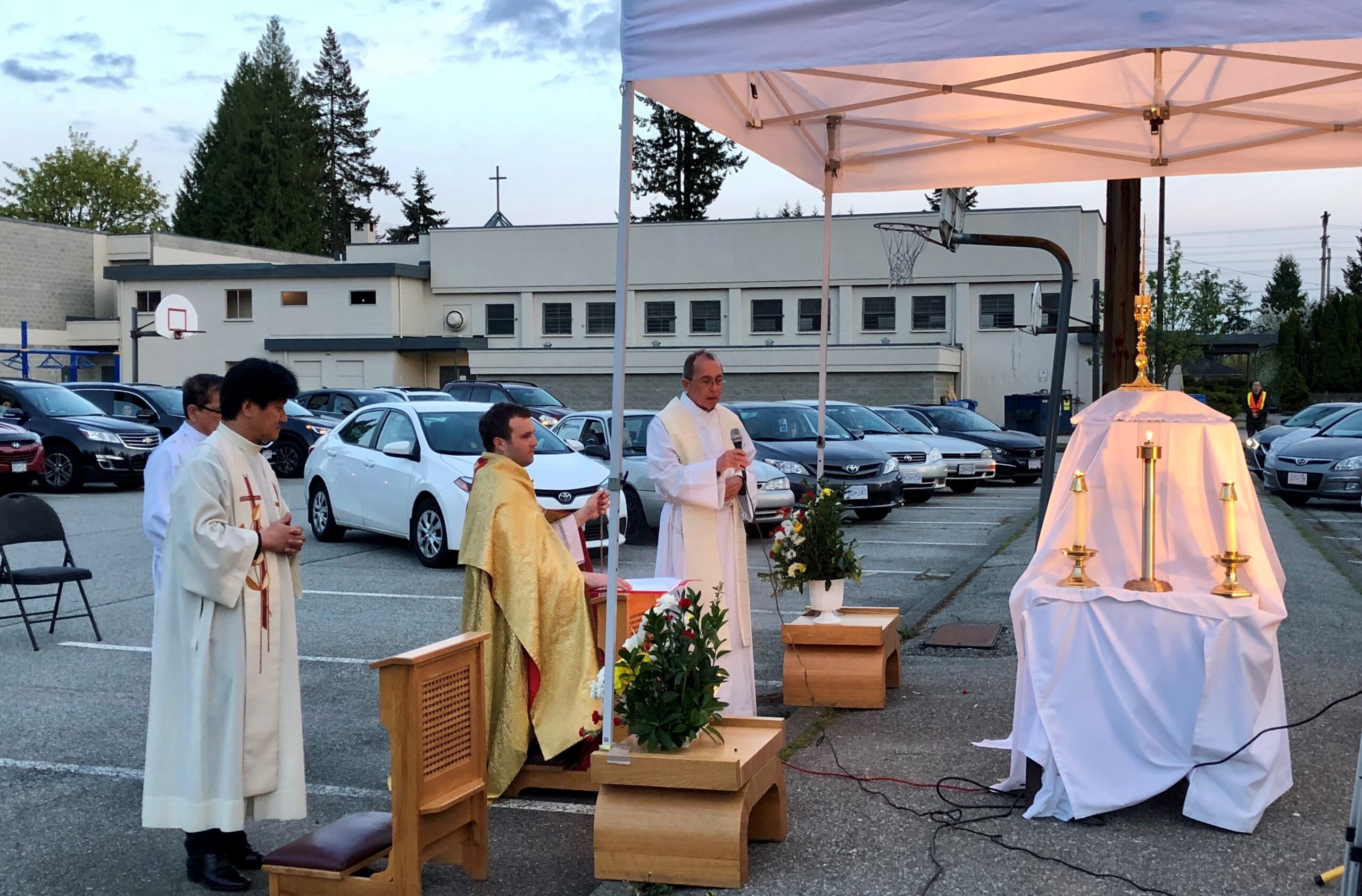
But while doing all of that, it was still possible to maintain access to Mass and Holy Communion, whether that meant celebrating outdoors in parking lots and fields, celebrating indoors with successive crowds of small, socially-distanced people, celebrating via livestream and then allowing people to come for Holy Communion, or many of the other temporary solutions that creative priests, when given the permission, devised while respecting legitimate civil and ecclesiastical regulations. Such efforts testified to the importance of the Holy Eucharist in the life of faith, especially in the most trying times.
In some places, however, dioceses – not draconian secularist governments – prevented even such balanced and effectively safe solutions, as if the real priority were actually not to have Mass so that everyone would stay at home. Such decisions were scandalous to faithful and clergy alike.
This post-pandemic period is a time – calmly, serenely, and wisely – to prepare to do much better the next time civil and health authorities declare a pandemic. Learning from our mistakes, it’s a chance to plan how to ensure access to the sacraments, balancing healthy precaution with the courage and risk-taking that should characterize anyone who claims to be following the Crucified One who calls us to love as he loves.
There are some other lessons we can learn.
Diligent priests became better and lazy priests became lazier, and the level of fatherly concern had an impact on the rate of return of the faithful. Some priests did everything possible to reach their people and help them grow in faith, with outdoor and livestreamed Masses, Eucharistic processions in flatbed trucks, confessions in parking lots, anointings in hazmat suits, regular phone calls, emails, videos, interactive Zooms and more. Other priests did very little, not offering confessions, not telephoning parishioners, not even celebrating private Masses in their churches because of a pseudo-theological hang-up about Masses without a congregation. Out of fear or indolence, they hid the talent the Lord had given them in the ground (Matthew 25:25).
Many government leaders manifested their ignorance or hostility toward faith and religious freedom, considering liquor stores – but not churches – essential services. Only a small percentage of Church leaders and faithful stood up to these abuses. We need to be prepared to be bolder the next time.
Catechesis was confused. To downplay the severity of shutting off access to sacraments, some dioceses’ messages made it seem as if spiritual communions were commensurate with sacramental communions, perfects acts of contrition were equivalent to sacramental confessions, and prayers as one was dying were tantamount to the Anointing of the Sick. Nowhere close. God, who created the sacraments, can indeed work outside of them, but the sacraments work by their valid celebration, whereas these substitutions are totally dependent on the (often imperfect) dispositions of the recipient.
Science, the new secular religion, was manipulated. Rather than “following the science,” some scientific leaders regularly engaged in misinformation for the sake of behavioral crowd control – as we saw, among other things, with changing contradictory information about masks. Many dioceses, however, followed their advice as if they were obeying the Commandments. Bad scientific guidance made it seem as if the distribution of Holy Communion were the most dangerous act imaginable. It’s important for bishops, in order to lead effective in such circumstances, to have their own well-formed scientific experts as advisers, to assist them to teach effectively and make right decisions.
Catholic schools were overall a great success story, because, unlike many of their government funded counterparts, teachers and staff prioritized the education of children over their own safety.
Finally, while the Church permits and encourages people to receive the COVID vaccines, she also supports the right of people to refuse them. The Church didn’t defend the latter as much as it vigorously promoted the former. She also allowed vaccine apartheid to impact the way we worshipped, dividing people into vaccinated pews and non-vaccinated pews, permitting only vaccinated people to participate in certain events, enter the rectory or work in Catholic facilities. If in Christ there is no Jew or Greek, slave, or free person (Galatians 3:28), there also should not be in his Church vaccinated and unvaccinated. Such division does not come from above
In the Church’s response, there are some things to be proud of, others to be embarrassed about, and much to learn. Now is the time for a conversation about that response to take place.
Father Roger Landry, a priest of the Diocese of Fall River, Massachusetts, has been appointed by the U.S. bishops a “National Eucharistic Preacher.”
Archdiocese of Vancouver COVID-19 Timeline
2020
31 January
Approval given to Chinese-majority parishes to encourage those with symptoms, and those recently returning from Hong Kong, to stay home from church.
5 March
First COVID-19 precautions implemented at church: remove Holy Water, forego Communion from the Chalice, bow v. shake hands at the Sign of Peace.
11 March
Sunday Mass obligation is suspended for those feeling remotely unwell; Communion in the hand strongly encouraged; Kiss of Peace omitted from Mass; hand sanitizer, room disinfection and social distancing implemented.
13 March
Following PHO directive, Mass attendance is limited to 250.
14 March
Sunday Mass obligation is lifted for everyone until further notice.
16 March
Following PHO directive, Mass attendance is limited to 50. Physical materials removed from pews; implementing disinfection of churches after each Mass.
19 March
Pastors are given discretion on whether to have congregations at Masses, depending on their parish situation.
20 March
Suspension of Holy Mass celebrated in public – no congregations. Churches remain open for individual private prayer.
Pivot begins to online programs, livestreaming of Mass, etc.
7 April
Confirmations with Archbishop cancelled for Spring 2020 .
23 May
Masses resume with up to 50 people; sign-up systems to be used; contact tracing information to be collected.
3 June
Pastors encouraged to proceed with First Communions and Confirmations in multiple Masses with 50-person limit.
19 November
PHO bans congregations at worship services; funerals, weddings and baptisms limited to 10 people attending, including officiants.
4 December
Pastors encouraged to arrange for distribution of Holy Communion to people in cars, or in church by lineups and limited numbers inside.
11 December
Mass outside for people in cars encouraged where feasible.
23 December
St. Thomas More Catholic Lawyers Guild of BC writes to Dr. Bonnie Henry and Minister of Health Adrian Dix, expressing concern about violation of freedom of religion in current public health orders, noting, “the health order provides a framework for how non-religious institutions may be able to continue to operate safely and in compliance with provincial requirements (i.e., operate while minimally impaired), but fails to apply these same standards to religious institutions.” Workplaces, shops, and fitness facilities are operating which worship services remain banned.
2021
19 February
With assistance from lawyers of the St. Thomas More Guild, the Archdiocese of Vancouver sends Dr. Bonnie Henry and Health Minister Adrian Dix a Section 43 Request for Reconsideration of the Order of the Provincial Health Officer. Receipt is acknowledged on 24 February.
26 February
RCAV Petition filed in the Supreme Court of British Columbia for exemption from the PHO’s “Gatherings and Events” order, and requesting an Interim Stay from application of the Order.
Less than two hours later, Dr. Brian Emerson, Deputy PHO, emails asking for additional information on the Request for Reconsideration.
1 March
RCAV lawyers appear at the Beaudoin hearing (a separate, similar petition to the Court) to alert the Chief Justice to the RCAV’s parallel legal action.
The Vancouver Sun reports on the RCAV’s legal challenge.
Requested additional information submitted to Dr. Brian Emerson.
2 March
RCAV lawyers notify the BC Government’s lawyers of intent to seek an interim order for in-person services for the rest of the Lenten season through to Easter.
3 March
Dr. Brian Emerson acknowledges receipt of the requested additional information.
4 March
Letter from Dr. Bonnie Henry declining to grant reconsideration, on the grounds that even with a capacity cap of 10 per cent too many people would be gathering, and risk of transmission would be too great.
Discussions continue between RCAV and Government lawyers about court appearance dates and next steps.
8 March
Amended Petition filed with BC Supreme Court, asking that the PHO’s refusal of the Reconsideration Request be declared unconstitutional, and an order be granted allowing services with up to 50 people to take place until the Court rules on the constitutionality of the restrictions.
Three hours later, Global BC reporter Richard Zussman tweets, “Dr. Henry says the goal is to have people back in churches by Easter.”
That same evening, the Government’s lawyers confidentially inquire with RCAV lawyers about reaching a possible agreement for essential services during the Sacred Triduum. A list of the minimum “essential services” for the celebration of Easter is subsequently provided to the Government.
11 March
Government offers a variance for Easter services, followed by negotiation of details. It is made clear to the Government that RCAV will not adjourn its Petition, but will agree to postponing the hearing until after Easter.
15 March
Dr. Bonnie Henry offers a variance, with various restrictions, for particular Easter services, while RCAV agrees to adjourn the stay application until after Easter. Negotiations proceed.
19 March
A decision on the Beaudoin case upholds the PHO ban on indoor worship services.
23 March
Dr. Bonnie Henry issues a general variance to the Gatherings and Events Order allowing for outdoor worship services for up to 50 people.
25 March
Dr. Bonnie Henry issues a one-time variance allowing indoor services, for the lesser of 50 people or 10 per cent of capacity, on four days between March 28 and May 13. Faith communities may choose which four days to use. The Archdiocese of Vancouver marks Holy Thursday, Good Friday, Easter, and Divine Mercy Sunday as its four days. RCAV generally adjourns its interim stay application. Court time is secured in June for hearing the Petition.
29 March
Dr. Bonnie Henry reverses her decision and suspends the indoor worship service variance for three weeks, citing rising COVID-19 cases. Indoor dining and fitness classes are also shut down. Outdoor services remain permitted. RCAV lawyers characterize this as “bait and switch” since the Archdiocese adjourned its stay application per the agreement made with the Attorney General’s office. Given the rise in cases and the expansion of restrictions to other sectors of society, the Archbishop directs the lawyers to stand by for the time being.
19 April
Dr. Bonnie Henry extends the suspension of the indoor services variance “for the next few weeks.”
The Attorney General’s office calls RCAV lawyers inquiring about our plans for the June Court dates. Since the restrictions are now less discriminatory than previously, the Archbishop declines to press forward aggressively. The June Court dates are adjourned, though the Petition is not withdrawn.
20 May
Dr. Bonnie Henry indicates in conversations that a loosening of restrictions on indoor worship services is coming soon.
26 May
Dr. Bonnie Henry issues a variance to the Gatherings and Events Order, effective immediately, allowing indoor worship services with up to 50 people. Contact tracing, social distancing and masks are required, while choirs are not permitted.
11 June
In a conference call with faith leaders, Dr. Bonnie Henry indicates that an increase to 100 people per indoor service is coming mid-June, and by July 1 all restrictions on worship may be lifted.
15 June
Attendance at indoor worship services can now be the greater of 50 or 10 per cent of capacity. Contact tracing, etc., remains in place.
1 July
Restrictions on indoor worship services are lifted. Other gatherings remain limited to the greater of 50 people or 50 per cent of capacity. Registration/contact tracing is no longer required; masks are recommended for the unvaccinated.
13 July
Sunday Mass obligation is reinstated by the Archbishop.
23 August
The BC Government announces that proof of vaccination will be required for a range of activities beginning September 13. However, worship services are exempt from the requirements.
25 August
A provincial mask mandate becomes effective at indoor gatherings across BC, though for indoor worship services masks are “recommended.” For the sake of prudence, the Archbishop mandates that masks be worn at all Masses.
8 September
The Premier’s Office clarifies that proof of vaccination is not required for worship services or gatherings with a worship component. Meetings and gatherings without a worship component with over 50 people will require proof of vaccination.
30 November
Dr. Bonnie Henry announces a requirement that worship services must be limited to 50 per cent of seated capacity, unless all the participants are vaccinated, in which case 100 per cent capacity is permitted. Faith communities are given leeway in how to enforce this. Further, masks are now mandated for all worship services.
Parishes are encouraged to add more Masses at up to 50 per cent capacity, while providing a limited number of Masses requiring proof of vaccination.
2022
11 March 2022
All restrictions are lifted for worship services, and the mask mandate is lifted. The vaccination requirement remains in place for non-worship meetings until 8 April.
Questionnaire
What did your parish do well or not well during the pandemic. Please provide details (open-ended)
- Livestreaming Mass (technical, participation)
- Parish Outreach to Parishioners (supporting and connecting with parishioners through phone, email, social media, messaging and other outreach)
- Pastor’s Outreach to Parishioners (supporting and connecting with parishioners through phone, email, social media, messaging and other outreach)
- Return to Mass (communicating updates and organizing the liturgy)
- Parish Giving (well communicated and effective opportunities to encourage online giving)
- Parish Ministries and Organizations (support for existing ministries and organizations and new initiatives to support those affected by the pandemic)
- Faith Formation (continuing faith formation programs during the pandemic)
- Parish Prayer (virtual or live opportunities for parishioners to pray together)
- Website (up to date and accessible information for parishioners)
(Knowledge and attitudes questions)
In order to understand individuals’ concerns we would like to ask some questions about your understanding of COVID-19.
1. How can the novel coronavirus be transmitted? (Select all that apply)
- Close contact with an infected person who has symptoms
- Close contact with an infected person even if they aren’t showing symptoms of infection
- Contact with surfaces an infected person has touched
- Virus particles in the air
2. What percentage of people diagnosed with COVID-19 do you think have died from the disease? open-ended
3. In your opinion, how effective are the following actions for keeping you safe from COVID-19?
- Wearing a face mask (1 to 10)
- Praying (1 to 10)
- Washing your hands with soap or using hand sanitizer frequently (1 to 10)
- Seeing a health care provider if you feel sick (1 to 10)
- Seeing a health care provider if you feel healthy but worry that you were exposed (1 to 10)
- Avoiding public spaces, gatherings, religious gatherings, and crowds (1 to 10)
- Vaccination (1 to 10)
- Avoiding contact with people who could be high-risk (1 to 10)
- Avoiding hospitals and clinics (1 to 10)
- Avoiding restaurants (1 to 10)
- Avoiding public transport (1 to 10)
4. How much do you trust the following sources to provide accurate COVID-19 information?
- Social media
- Mainstream media
- Alternative/independent media (secular)
- Friends or family members
- Coworkers or classmates
- Doctors or other health care providers
- Government websites
- Government officials
- Church communications (Vatican, CCCB)
- Church communications (Archdiocese of Vancouver, B.C. Catholic)
5. Given the state of the COVID-19 pandemic today and the associated spread, how effective do you think the following policy measures are?
- Close schools and daycares (1 to 10)
- Close gyms (1 to 10)
- Close restaurants (1 to 10)
- Close all shops except for supermarkets and pharmacies (1 to 10)
- Don’t allow visitors in hospitals, nursing homes and elderly homes (1 to 10)
- Oblige people aged 70 and over or with a medical condition to stay at home except to do basic shopping or because urgent medical attention is required (1 to 10)
- Ban public gatherings, religious events
- Oblige everyone who does not work in a crucial professional group (for example, people who work in healthcare, public transport, the food chain) stays at home except to do basic shopping or because urgent medical care is required (1 to 10)
- Universal wearing of face masks (1 to 10)
- Vaccination (optional)
- Vaccination (mandated)
6. Since February 1, 2020, have you or someone in your home had COVID-19?
- Yes, someone in my home (not including you)
- Yes, multiple people in my home (not including you)
- Yes, I experienced such symptoms
- Yes, both I and someone in my home experienced symptoms
- I’m not sure/Don’t know
7. Have you been vaccinated? (including a single inoculation)
- Yes
- No
8. If no, why have you not been vaccinated?
- A healthcare provider advised against it
- A medical reason
- A religious reason
- A moral, ethical, or political objection
- Other (state)
9. Do you agree or disagree with the following statements
- I am very worried about getting the coronavirus. (1 to 10)
- I am very worried about my family/friends getting the coronavirus. (1 to 10)
- I am very worried about giving someone else the coronavirus. (1 to 10)
- I have a hard time sleeping because of the coronavirus (1 to 10)
- I have had difficulties concentrating because of the coronavirus (1 to 10)
- Thinking about the coronavirus makes me very anxious. (1 to 10)
- I am feeling overwhelmed by the coronavirus. (1 to 10)
- I am worried about money because of the coronavirus. (1 to 10)
- I am worried about having enough food because of the coronavirus. (1 to 10)
- I am worried about loss of income if I get sick from the coronavirus. (1 to 10)
- I am spending more money because of the coronavirus. (1 to 10)
- I am worried about medical bills if I get sick from the coronavirus. (1 to 10)
10. Have you experienced stress related to the pandemic?
- No, no stress at all.
- Yes, mild stress such as occasional worries or minor stress-related symptoms such as feeling a little anxious, sad, angry, or mild trouble sleeping.
- Yes, moderate stress with frequent worries, often feeling anxious, sad, or angry, or some trouble sleeping.
- Yes, severe stress with constant worries or feeling extremely anxious, sad, or angry, or frequent trouble sleeping.