Welcoming one Syrian family in 2015 led to greeting more
OTTAWA (CCN)
When an Ottawa parish brought a family of Syrian refugees to Canada in 2015, the experience put them on a mission to welcome more.
Holy Redeemer Parish, a large suburban parish in Kanata, responded to a call from the Ottawa Archdiocese to sponsor Syrian refugees well before Pope Francis urged parishes to sponsor a family in September 2015. They established a refugee committee, and according to its pastor, Father Pierre Champoux, “Things kind of spiralled in a good way.”
“When this thing started, within a week of having first meeting, money was coming in, people offering couches and chairs,” Father Champoux said. “One of the women offered her own home for the people to live in when they first came, a big sacrifice.”
The first Syrian family arrived March 24, 2015. Shadi Al Dakhil, his pregnant wife Kholoud, and their three children, Yasar, Sofia, and Syriana were greeted at Ottawa’s airport by a welcoming team holding a sign in English and Arabic surrounded by flashing lights.
Shadi said he felt like a person in need of a heart transplant who “has found someone to give him a heart.” He felt his family had left a “dark life” to “start a new life,” he said. “Wow! We are safe now, thank God!”
Kholoud said she felt she was dreaming when she saw the sign and the smiling faces of the parish members. In Lebanon, no one smiled, and as Syrian refugees there they did not feel welcome.
After a brief reception in the airport’s chapel, where the refugee committee offered the family a selection of winter clothes, their new life in Canada began. A month later, their son Stephane was born. Within a year of their arrival in Canada, the Al Dakhils were self-supporting.
Mary-Lou Hakansson and Cathy Deogrades co-chaired the refugee committee, coordinating parish efforts that included raising $30,000 to support the family for one year, finding housing, furniture, clothing, and transportation. Bob Near, the Knights Council 9544 representative, made sure his fellow Knights were on available to help as needed.
The Knights provided the family with their first Christmas tree, lights, and decorations, and helped install it. Shadi and Yasar worked in the Knight’s Christmas tree lot, a fundraising effort, and started attending regularly the Knights’ monthly breakfasts at the parish.
“The first family, Shadi’s family, came to mean a lot to us,” said Deogrades. “We want to help them as much as possible.”
The refugee committee soon learned Shadi had five brothers and one sister; and Kholoud had five sisters and one brother. Shadi’s brother Wael had married Kholoud’s sister Wedian. They and their two baby daughters had also sought refuge in Lebanon with two nephews who had been university students in Syria until fighting made pursuing their studies too dangerous. So the committee raised another $30,000 to bring them to Canada.
Then they discovered they only had enough money to bring in one of the nephews. Taking only one, would leave the other with no support in Lebanon.
“We didn’t want to leave them behind,” said Hakansson. “So we approached the Knights of Columbus at our church for financial assistance to bring these young men over.”
The Knights contributed the extra $5,000, enabling Bahaa Hraiz and Husam Al Dakhil, both 23, to arrive with Wael and Wedian Al Dakhil, and their two daughters Maribelle, 2; and Danielle, 1; on Feb. 15, 2016.
The reunion of the families “at the airport was very emotional, lots of tears,” said Deogrades. “We were all crying.”
Deogrades and Hakansson have encouraged other churches in the area to help bring members of the family to Canada. An Anglican church in Kanata is bringing in Kholoud’s widowed sister Claude and her two teenaged sons, Mousa, 15 and Eskander, 13 later this year. Her husband had died of cancer last August. Because he had been undergoing treatment in Syria, they had remained there. When their neighbor’s home was bombed, they lost part of their roof. Now, the three are in Lebanon, waiting.
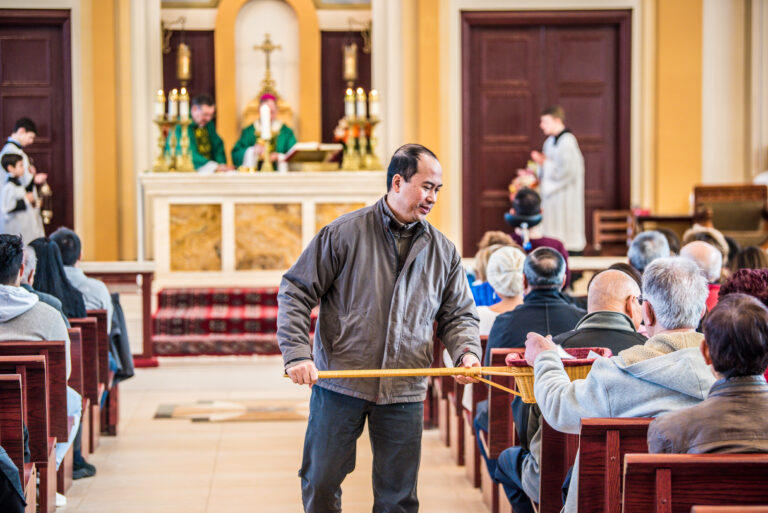
A caravan of volunteers pick up the members of the two Al Dakhil families to bring them to the 11 am Mass at Holy Redeemer every Sunday. The extended family sits together, passing the babies from lap to lap. Though they are Melkite Greek Catholics, Shadi’s family began attending Mass at Holy Redeemer as soon as they arrived.
All of them have been eager to integrate into Canadian life. Shadi works full-time at a restaurant and Kholoud is enrolled in an English language course to prepare her for a two-year program to qualify her to help children with special needs. Wedian and Wael are learning English and the two nephews, who learned English while waiting in Lebanon, are working and going to school.
“They have settled into Canadian life amazingly well,” said Hakansson.
The family’s resilience, mutual love and warmth are all the more remarkable considering what they have been through since civil war broke out in Syria in 2011.
They come from Daraa, a regional centre near the Jordanian border where the first demonstrations against the Assad Regime began.
Kholoud worked as a teacher; Shadi had a job as a shipper/receiver in a potato chip factory. Though they lived in a majority Sunni Muslim area, they were at peace with their neighbors. But after six months of demonstrations, “the Syrian people began to worry,” Kholoud said.
Then they began to see graffiti near the school warning, “We will kill your children” or “We will take your daughters,” she said. Messages also would appear on social media, warning of school bombings, which then occurred. Three times they had to move their children to new schools.
Gunfire broke out in their neighborhood; twice armed men stopped Shadi. Some were the age of his son, Yasar, 15. Men who were obviously not Syrian began to move in, representing ISIS.
The Al Dakhils decided to flee Syria after gunmen shot 40 holes in Shadi’s car as he was driving to work, wounding his leg. Shadi said he thanked God he was not killed.
Going to nearby Jordan was not an option because of Christian persecution in the refugee camps. They left everything behind so no one would know they were fleeing. The trip to Lebanon in April 2013, which normally would have taken four hours, took 11, including a six hour wait at the border.
Lebanon, however, had already accepted 1.5 million refugees, putting an immense burden on the population of four million. Christian refugees like the Al Dakhils had to compete for scarce jobs and resources. Shadi found a job at a restaurant, but after paying for rent, water and electricity there was little left over for food.
“It was so difficult,” said Kholoud. “The worst thing is you feel the people don’t like you and don’t accept you.”
Lebanon, a country of four million, has been strained to the limit by 1.5 million refugees.
After two years in Lebanon, they finally received word Canada had accepted them as refugees.
Their arrival in Canada and the love they brought and received at Holy Redeemer, enabled more of their extended family to come from exile in Lebanon a year later.
“Syria is destroyed now,” Husam Al Dakhil said. “It would be impossible to build your future.”
Husam and his cousin Bahaa Hraiz work at a nearby McDonald’s while making plans to finish their university studies.
The families look forward to welcoming Kholoud’s widowed sister and her two children soon.
Hakansson and Deogrades have also fanned out to persuade other churches to consider sponsoring family members. Two Catholic parishes have joined resources to sponsor another related family. The mission continues.