
Even before pandemic-fighting restrictions threw Canada’s economy into turmoil, the Canadian Conference of Catholic Bishops voiced concerns about the high level of poverty in the country.
The bishops’ Episcopal Commission for Justice and Peace said in a 2019 report on housing affordability that Canada’s “economic environment of precarious or part-time employment … perpetuates poverty.”
Pandemic-fuelled government debt, employment dislocation, soaring fuel and food costs, and sky-high house prices have made the economic outlook only more precarious, especially for those already in need.
The prospects may be worse yet for Catholic-owned and -operated businesses, says Langley business consultant Henry Kutarna, a member of Holy Family Parish in Vancouver. Kutarna said in an interview that mounting anti-Catholic prejudice, combined with government regulations that collide with Catholic values, are making it increasingly difficult for Catholic businesses to operate in the general economy.
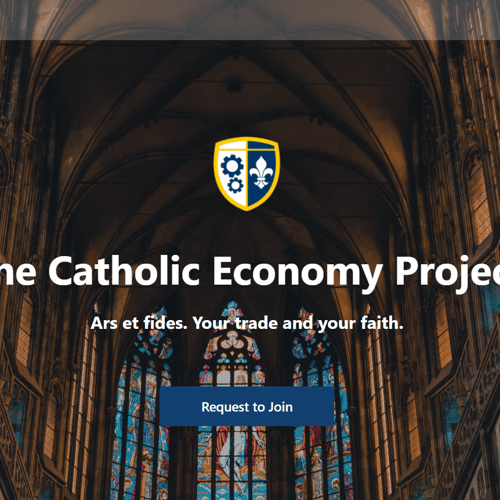
In response, Kutarna, a 68-year-old financial consultant, investor, and founder of the Catholic CEO, has launched a bold and unusual new venture he calls the Catholic Economy Project.
Its goal is to create an alliance of Catholics and Catholic businesses that, using parish-level connections and small businesses, will build each other up. Kutarna, who has held deputy minister roles in the Saskatchewan government, described it as a Catholic economy within the larger economy.
His vision is for Catholics to become “more self-sufficient, maybe start home-based businesses, family business.” The hope is the initiative could lead not only to greater Catholic prosperity, but also to greater Catholic influence on the culture.
Concurrently, the Catholic business operators will be able “to attain the eternal joys of heaven and build the kingdom of God through commerce,” Kutarna said in a promotional declaration. “We buy from each other. We sell to each other. We advise each other. We invest in each others’ business. We create a powerful economic force where we influence the culture and help others get to heaven.”
In the long term, the project will also help participants be better positioned to withstand any widespread economy catastrophe that may befall the country. “So, if civilization collapses, we would [not be] scrambling around trying to find solutions or invent solutions, but they would already have thought about it and made some preparations so each family, for example, could survive, or could know what specialty they would have [for] a family business.”
Kutarna said the idea is a practical response to a real possibility, not a “preppers” or “survivalist” fantasy. “When the economy collapses, and there’s a complete breakdown of things, and people lose their jobs and the currency loses its value, there would be people already building home-based or small businesses, and they would then be able to create income for themselves, keep on buying and selling,” he reiterated.
Kutarna’s vision will have to overcome some basic economic principles to succeed, however, says one of Canada’s leading free-market economists. Jason Clemens, who is a member of St. Clare of Assisi Parish, said in an interview that by limiting to other Catholics those with whom they would do business, project participants are dooming themselves to either higher costs or lower quality.
Economic studies have clearly shown “that there is a cost to discriminate,” Clemens explained. “So, the idea that you can get the same value, the same quality, the same selection and variety of goods and services if you, a priori, discriminate, is incorrect. In other words, people who make a decision that they are going to trade only with other Catholics are paying a price. Either the goods and services are going to have higher costs, or they’re going to be of lower quality, and they’re going to have less selection…”
The project also turns its back on a moral good associated with free markets, Clemens said. “Markets force us to interact with people that we may not otherwise interact with,” he said. “And that’s how we actually gain knowledge because, by interacting with people with different values, different religions, and different cultures, we learn from one another.
“On the other hand, the Catholic Economy Project is saying that ‘we largely want to interact with people who are similar to us.’ … The implication is you’re not going to interact with Muslims or Protestants or atheists – regardless of their morality and whether they are good people or not – simply because they are not Catholic.”
Clemens also said he believes that project participants would actually be less able to withstand an economic meltdown. “Anyone doing what they advocate will be poorer than they otherwise would be,” he said. “And it seems to me that both the idea of resilience and preparedness is premised on what resources you have available. And the [discriminatory] policy being promoted will inevitably make those who pursue it poorer.”
Kutarna said the idea for the project emerged from a forum held in January which dealt with “people who’ve lost their jobs for conscience reasons.” The forum was entitled Discerning the Sign of the Times – A Catholic Response for the Changing Economy.
“We then started to see that there’s a broader picture,” Kutarna said, “and the broader picture is that if we had a Catholic economy it would mean that we would buy from each other, and sell to each other, buy as a group, invest in each others’ business, create things at the parish level that would support, give ideas or mentoring, or support the people who are starting businesses in parishes. Every parish has people that are expert in business, so why can’t we help each other that way?”
He said the Catholic Economy Project’s initial “summit” meeting, to be held May 3, has already attracted 300 participants. Those interested can find details at www.thecatholiceconomy.com.