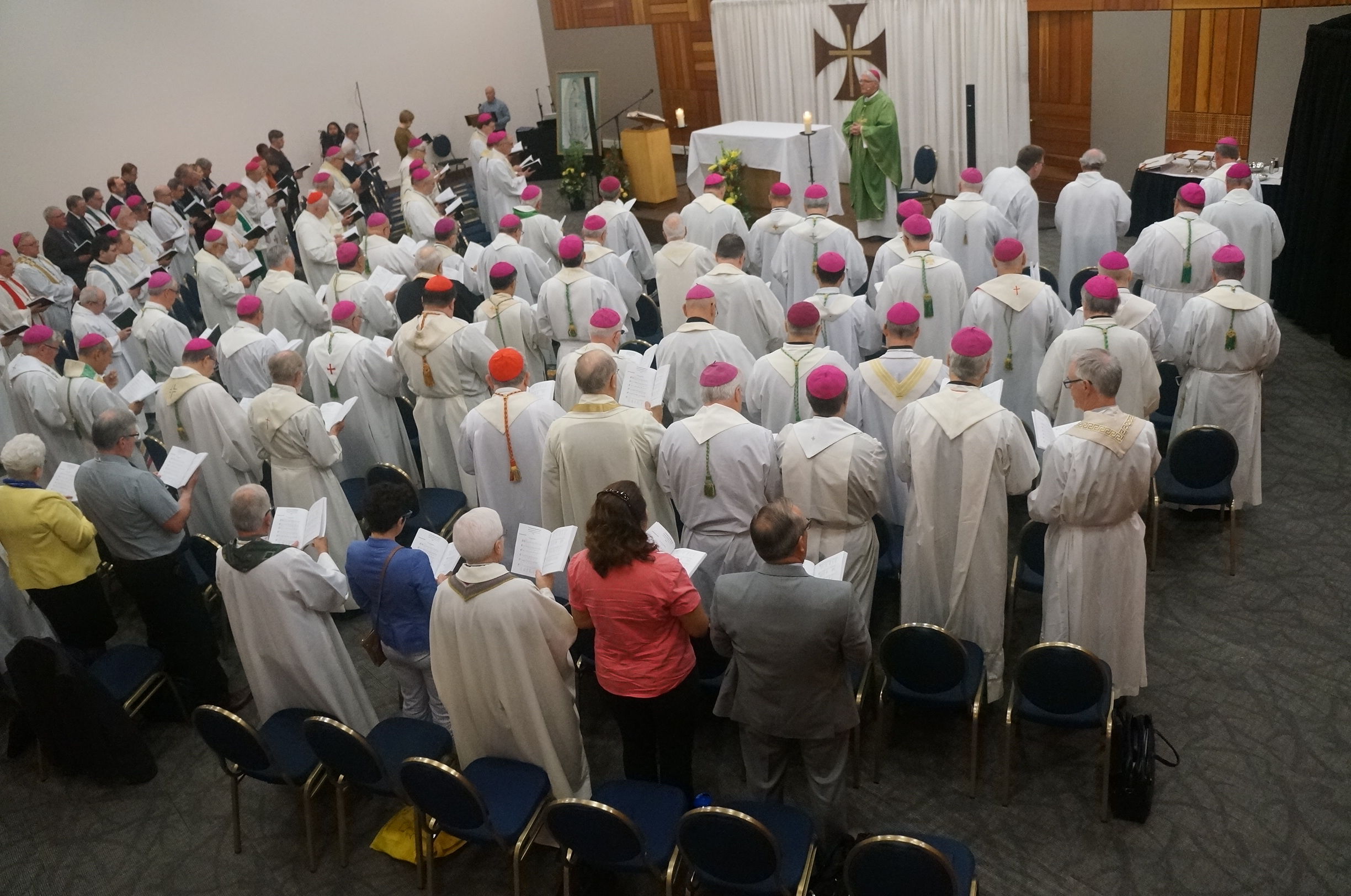

CORNWALL, Ont. (CCN)—Any decision about a papal visit will not come during the annual plenary Sept. 25-29 of the Canadian Conference of Catholic Bishops, said its outgoing president.
“Any discussion about inviting Pope Francis will probably be more focused on our ongoing response to the Truth and Reconciliation Commission, Bishop Douglas Crosby of Hamilton in an interview Sept. 25. “The issue of a papal visit we really have to look at seriously because it can be really expensive.”
“That’s why there is a lot of discussion with government and with other agencies,” Bishop Crosby said. “It won’t take place under my watch. It will be the responsibility of the next executive.”
While one of the TRC Calls to Action demands the Pope make an apology for Indian Residential Schools on Canadian soil, Bishop Crosby said he doubted Pope Francis would come “just for an apology.”
And while a vote on extending an invitation to the Holy Father was not on the official agenda for the five days of meetings, any papal visit would depend on the support of Canada’s bishops.
“The Pope would never come to a country unless the conference was in favor or supported it, or wanted him to come,” Bishop Crosby said.
While a vote was not on the agenda, Bishop Crosby expected the matter would come up in discussions about relations with Indigenous peoples, but in the context of the Catholic coalition of Our Lady of Guadalupe Circle – a Catholic coalition working to renew Church and Indigenous relations – and the Catholic Aboriginal Council, which advises Canada’s bishop son Aboriginal issues.
High on the agenda for the bishops was a pastoral response to Pope Francis’ post-synodal Apostolic Exhortation Amoris Laetitia, The Joy of Love, which has generated controversy and prompted divergent interpretations by some bishops conferences around the world on how far it opens the door to Communion for the divorced and remarried.
Cardinal Marc Ouellet, prefect for the Congregation of Bishops and Archbishop-emeritus of Quebec, gave two reflections on the document. He spoke against “alarmist” interpretations of the document, and said any opening for the divorced and remarried to receive sacraments of penance and the Eucharist were “exceptions” and involved no change in either the doctrine or the discipline of the Church.
He urged the bishops to read the document as a whole for its Christocentric and Trinitarian view of love, marriage and the family so that Chapter 8, which deals with the pastoral care of fragile families, can be read in context. Cardinal Ouellet was to give additional reflections on the pastoral dimension of Amoris Laetitia on Sept. 27 and on Sept. 28 when the bishops divide into small groups to look at implications of the document in their dioceses.
On Sept. 25, Bishop Crosby told the bishops the conference had received an unusual phone call from Prime Minister Justin Trudeau, asking for the bishops’ help in providing “a better understanding of Islam” in the wake of the Jan. 29 mosque shooting in Quebec City that killed six and injured another 19.
“I was able to say we had produced a pastoral letter on Islam, and in the Grade 11 program in the Catholic education system, we offer a whole section on Islam.
The CCCB plenary also had a panel discussion on “pastoral orientations for interreligious dialogue with Islam” as part of its public session Sept. 26.
Bishop Claude Champagne of Edmundston, who chaired the panel, spoke of the need to combat the “virus of anti-Islamic sentiment” that he said was “grounded in hate,” suspicion, and fear. “The Gospel is the greatest tool,” against this, the bishop said, because “we are called to love our neighbour as ourselves.”
Archbishop Anthony Mancini of Halifax updated the bishops on the progress of the document to replace From Pain to Hope, the 1992 document that responded to the clerical sexual abuse crisis.
The ad hoc committee in charge of the document consulted a range of professional experts and determined the document has become too large. The material needs to be condensed without losing any valuable content, he said, and will be published in 2018.
The CCCB plenary marked the 500th anniversary of the Protestant Reformation Sept. 25 with an ecumenical prayer service with Archbishop Richard Gagnon of Winnipeg co-presiding with Rev. Susan Johnson, National Bishop of the Evangelical Lutheran Church in Canada. The prayer service featured prayers of repentance for disunity in the Body of Christ.
In ecumenical greetings, Bishop Johnson told the Catholic bishops Sept. 26 she was concerned that “we will come to the end of 2017 and go back to business as usual.”
She said she hoped Catholics and Lutherans would build on the fruits of this year and 50 years of dialogue.
The bishops heard a presentation on human trafficking Sept. 26 led by Bishop Raymond Poisson of Joliette. Bishop Poisson spoke of the work of the Santa Marta group, an international coalition of police officers, bishops, and decision-makers launched by Pope Francis to eliminate human trafficking, which the Holy Father has called “a wound on the body of contemporary society.”
Sister Helen Petrimoulx, SNJM, co-founder of We Fight, a Windsor-based coalition against human trafficking, said human trafficking has been going on for decades, but Canadian society and institutions have been in a state of denial about its extent.
Organized crime is involved and “they are powerful because we do not know enough,” she said.
The first victims her group helped were some young men from Hungary who had been lured to Canada by the promise of work in construction in Toronto. They were confined in a basement, she said, until they were brought by van to Windsor. Organized crime in Hungary threatened the men and their families with violence, so they sought refugee status.
Sister Petrimoulx said her religious congregation was able to pay for airfare and emergency visas for the men’s families.
We Fight is focusing now on human trafficking and helping survivors within Canada. “The highways from the Maritime provinces all the way to Windsor are known as the human trafficking corridors where traffickers can move their victims far away from their families and supports,” she said.
She noted one woman had recruited her 17-year-old daughter to recruit into the sex trade socially-isolated girls in one of the local Catholic high schools.
Francine Cabana of CATHII (Le Comité d’action contre la traite humaine interne et international) said the group’s focus is sexual exploitation in Quebec, since police see Montreal as a hub of sex trafficking. It is also focusing on the sexual exploitation of native women, who are “the greatest victims of international exploitation.”
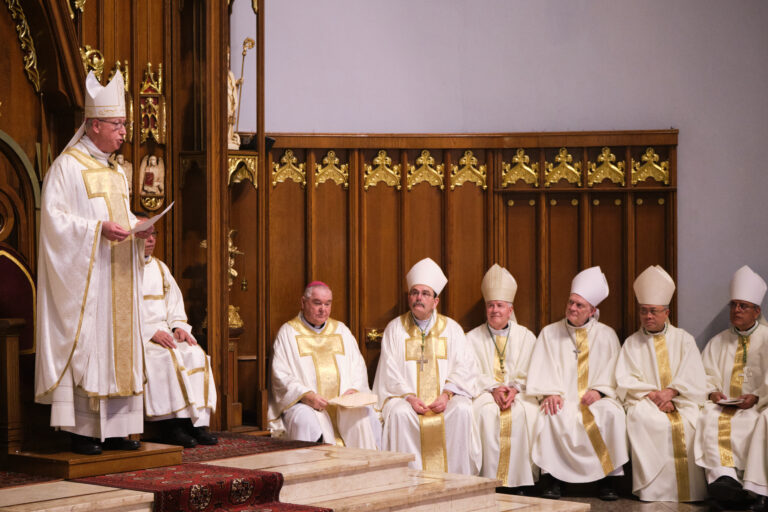
The bishops will elect a new executive and permanent council and choose new heads of various episcopal commissions during the plenary.
Bishop Crosby’s two-year term comes to an end Sept. 29 and he said he’ll be “glad to relinquish the title.” He recalled Archbishop Richard Smith of Edmonton telling him how much time serving would take up. serve. “I will gain back about three months a year of my life when I finish and I will be happy about this,” Bishop Crosby said. “The diocese of Hamilton is a big diocese and they have been very supportive and very patient.”