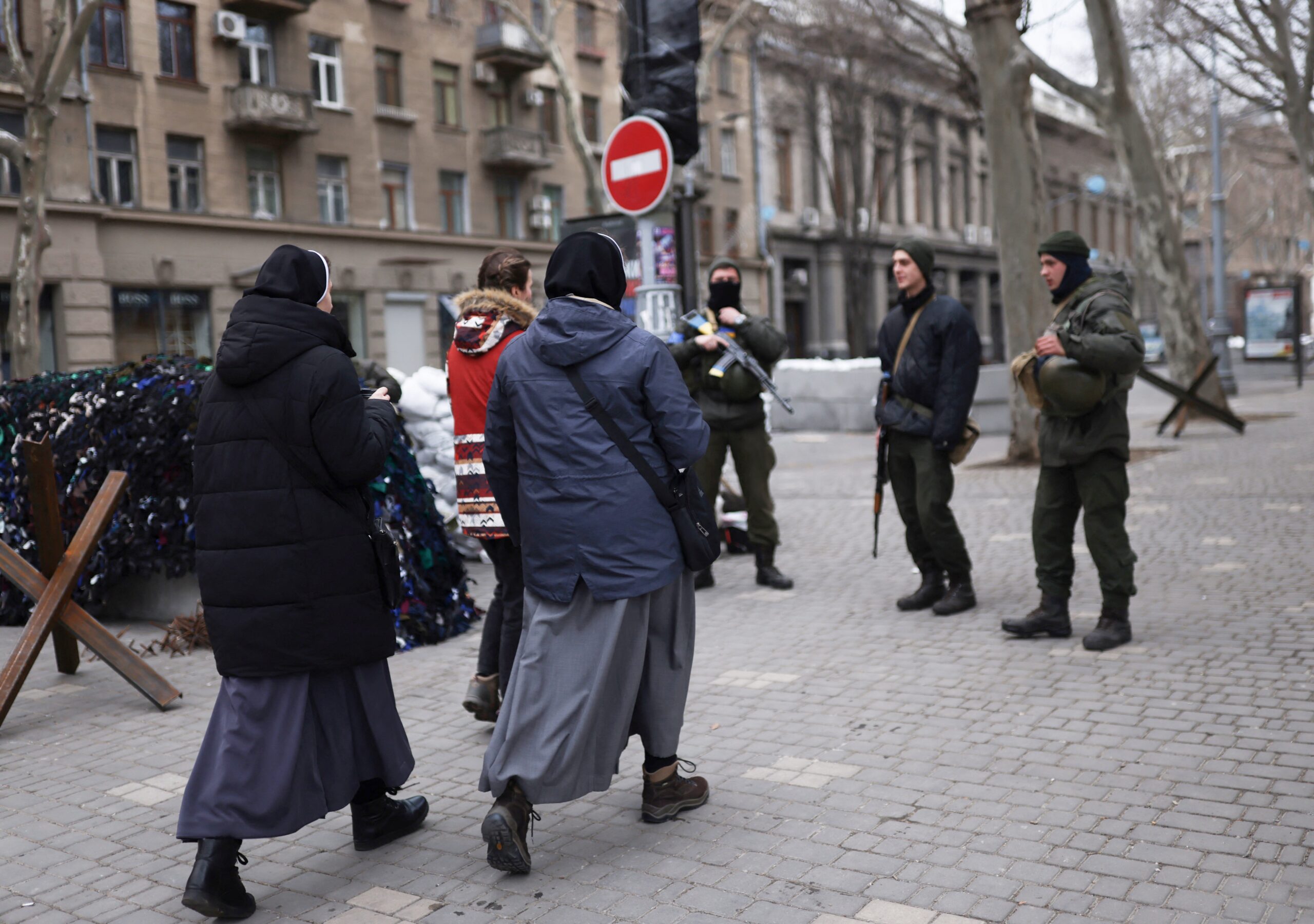

Any rational person is troubled by the ongoing war in Ukraine, which on its surface can appear to be a cut and dry example of a defenceless population defending itself against an unjust aggressor. By any standard it would appear the Ukrainians resisting invading Russian forces have an ethically legitimate position in doing so.
But the Catholic Church has a long moral tradition for determining when war is just and when it’s not, and it’s worth reviewing those moral principles that form the Church’s just war doctrine, particularly in a conflict where there are so many uncertainties.
The Church’s just war teaching goes back to the time of St. Augustine and Aquinas and establishes six criteria for just war: just cause, proper authority, right intention, last resort, proportionality, and probability of success. (See “Six principles of just war theory below.”)
Although the principles seem fairly simple on the surface, the Church’s just war theory is complicated by the relationship between facts and theories. Reality is messy and, as with most topics within Catholic moral theology, the devil is in the details – perhaps literally.
Dr. Andrew Willard Jones, director of the Catholic Studies Program at Franciscan University of Steubenville, Ohio, said when it comes to just war theory and the Russian invasion of Ukraine, “one of the problems is that it’s very difficult to get accurate information about what’s going on,” whether from Russian or Ukrainian sources.
In addition to the information problem complicating the ability to assess the conflict, other nuances make just war theory more than a simple black and white morality test.
“It’s not like you can look it up in a book and it says, ‘this is the right thing to do,’” said Jones. “It’s actually about prudence aimed at peace.”
Just war theory, for example, permits the use of force to defend oneself using means that are proportional to the threat. But the teaching is often presented as a “purely defensive” set of ideals allowing the use of force only to repel attack while condemning pre-emptive military action, said Jones. “Having a defensive posture is not the same as letting someone punch you in the face.”
Jones offers an analogy. “You are approached by a group of thugs while walking down an alley with your five-year-old son and they say, ‘give us your wallet.’ You should probably give it to them. You have responsibilities to your son, and the wallet is not worth it,” he said.

Then he changes a variable in the situation. “The thugs are armed and seem like they want to hurt you. A pre-emptive strike might be a just defensive move because the defensive posture is not simply to wait for someone to hit you.”
Jones then switches up the scenario again. Handing over the wallet to muggers may be the right thing to do when it’s a single incident, “but what if instead of a wallet they walk into your shop and want protection money – maybe $500 a month? You have to provide for your family, and you might have to say no, which could also involve a violent response.”
That type of thought experiment is a typical part of moral theology and can be helpful in breaking down complex moral problems into manageable parts. It also unveils the complicated relationship that Catholic moral teaching has with violence.
When discussing the use of force and just war theory, it’s important to consider the Church’s social teaching and its understanding of power, Jones said.
“Whatever power you have has to be used for the common good – use of power must be prudent.”
Rather than permitting you to defend yourself, he said, “actually the moral imperative is ‘if you have power, you have to use it for the common good.’ Justice compels you to do this.”
For example, if you witness a man mugging a child, you not only “can help … you must help. If you don’t help, even with proportional violence, you would be acting immorally.”
Since the atomic end to the Second World War the Church has shifted its perspective on just war doctrine. While still maintaining the right to self defence for the offended party, the principle of proportionality has led to growing understanding that the reality of modern war requires a modification of emphasis on individual bad actors and localized conflicts.
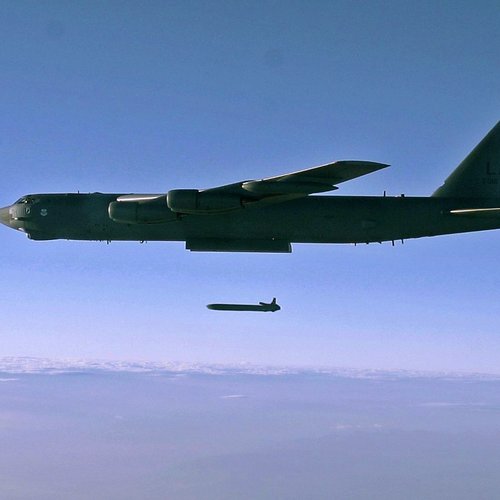
In his 2020 encyclical, Fratelli Tutti, Pope Francis wrote, “with increased globalization, what might appear as an immediate or practical solution for one part of the world initiates a chain of violent and often latent effects … opening the way to new and worse wars in the future. In today’s world, there are no longer just isolated outbreaks of war … since the destinies of countries are so closely interconnected on the global scene.”
Such a reality complicates just war theory’s principle of proportionality – that the good achieved through war must not be outweighed by the harm. For example:
- Should rising costs of oil and grain that adversely affect poor countries already battered by COVID be considered a cost of the current war? If so, does that justify foreign intervention in Ukraine, or does it make it untenable?
- How should Russia’s nuclear capabilities and the threat of nuclear war be taken into account?
- To what extent would non-intervention mean sacrificing the Ukrainian people for the common good of the globe?
- To what degree should a tyrant be confronted when the stakes are so high?
The answers are far from obvious and such difficult questions have led some to the view that war should no longer be considered a morally acceptable response to conflict under any circumstances.
Organizations like Pax Christi International and Pax Christi USA promote Catholic principles of non-violence and have lobbied the Vatican to change the Catechism’s presentation of just war theory. Their views have found support with figures like Father James Martin, S.J., editor of the Jesuit magazine America, who has defended Catholic pacifism by saying “the Church has always opposed war.”
The most coherent voice in support of Catholic non-violence was the 20th-century century Trappist monk and mystic Thomas Merton, who said, “I am against war, against violence … for peaceful settlement of differences, for nonviolent but nevertheless radical changes … violence will not really change anything: at most it will only transfer power from one set of bull-headed authorities to another.”
While it is technically accurate to say the Church abhors war in all its forms, Jones notes the importance of distinguishing “the ideal” from “the practical.”
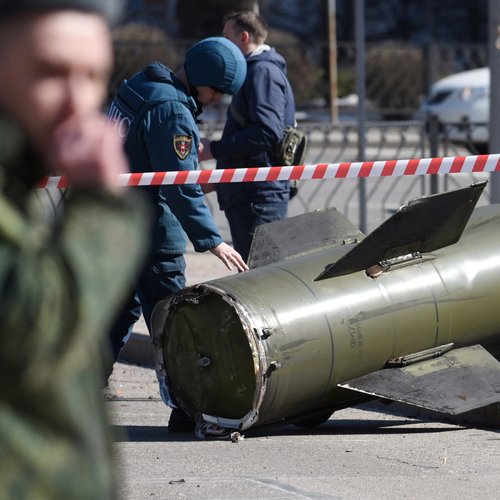
A member of the Emergencies Ministry inspects the remains of a Russian missile that landed in Donetsk, in the self-proclaimed Donetsk People’s Republic, March 14. The Church can oppose war while acknowledging we live in a fallen world where wars will happen. (CNS photo/Reuters)
For example, the Church might have no opposition to businesses existing for the common good, said Jones. “But instead people hear, ‘Facebook is good.’”
The same principle of conflating two opposing statements can apply to just war theory. The Church can oppose war, saying in the words of St. John Paul II, “No to war! War is not always inevitable. It is always a defeat for humanity,” while at the same time acknowledging that we live in a fallen world. Wars will happen, and just war teaching doctrine places needed restrictions on the proportional use of force in service to the common good.
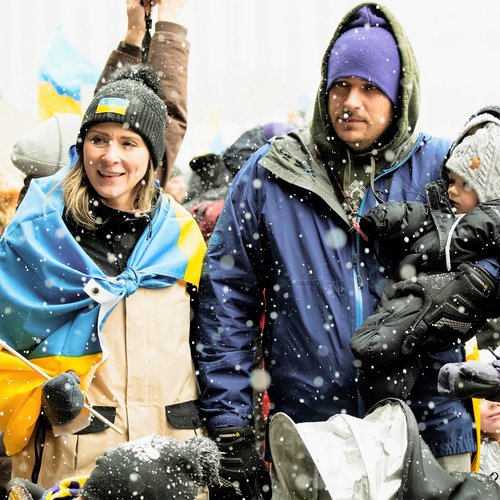
A protest in Toronto in support of Ukraine. Difficult questions about the proportionality of war have led some to the view that war should no longer be considered a morally acceptable response to conflict under any circumstances. (Michael Swan/The Catholic Register)
Perhaps the best description of this reality comes from the harrowing yet hopeful words of Saint Paul VI’s encyclical Gaudium et Spes: “insofar as men are sinful, the threat of war hangs over them, and hang over them it will until the return of Christ. But insofar as men vanquish sin by a union of love, they will vanquish violence as well and make these words come true: ‘They shall turn their swords into ploughshares, and their spears into sickles. Nation shall not lift up sword against nation, neither shall they learn war anymore’ (Is 2:4).”
In other words, pray for Ukraine, for the conversion of Russia and the international community, and for peace.
Six principles of just war theory
The Church teaches that six principles must be met for war to be considered “moral.” The principles are to be applied to each side of the conflict separately.
(1) Just cause — The war must confront an unquestioned danger. Were the claims of danger just, or exaggerated, or fabricated?
(2) Proper authority — The legitimate authority must declare the war and must be acting on behalf of the people. Did the proper authorities authorize the conflict or were they sidestepped in the rush to war?
(3) Right intention — The reasons for declaring the war must actually be its objectives, not a masking of ulterior motives. Was the governing intention to correct an injustice or were there mixed motives?
(4) Last resort — All reasonable peaceful alternatives must have been exhausted or have been deemed impractical or ineffective. Before engaging in war, the contending parties must strive to resolve their differences peacefully through negotiation, mediation, or even embargoes. Were reasonable non-military alternatives exhausted or was the judgment to take military action premature?
(5) Proportionality —The good that is achieved by waging war must not be outweighed by the harm. Were immoral means, or disproportional violence, used to accomplish objectives in the war?
(6) Probability of success — The achievement of the war’s purpose must have a reasonable chance of success. At the outset of the war, was there a reasonable chance for success?