
This story is being updated.
The words I’m sorry from the Pope were more than what either Canadian bishops or Indigenous delegations expected from this week-long encounter with Pope Francis.
“I ask for God’s forgiveness and I want to say with all my heart that I am sorry,” Pope Francis told all three delegations — Inuit, Metis and the Assembly of First Nations — gathered for a papal audience Friday.
The Pope named the harm done by residential schools and colonization as fundamentally a violation of the Gospel.
“Clearly, the content of the faith cannot be transmitted in a way contrary to the faith itself,” he said. “Jesus taught us to welcome, love, serve and not judge. It is a frightening thing when, precisely in the name of the faith, counter-witness is rendered to the Gospel.”
At a press conference, the Indigenous leaders welcomed the apology but said they looked forward to hearing from the Pope in Canada this summer. “Today we have a piece of the puzzle,” said Natan Obed, president of the Inuit Tapiriit Kanatami.
All week long both Indigenous delegates and bishops have been telling reporters that they came here asking for an apology in Canada on Indigenous land to fulfil Call to Action #58. With a papal trip to Canada already announced but not yet planned, that’s what they expected.
Apparently moved by three separate encounters with Indigenous people — including yesterday’s two-hour meeting with the Assembly of First Nations delegation, an hour over its scheduled time — and by the stories of survivors, Pope Francis made the apology his immediate response. There is no reason to believe that today’s apology precludes an apology on Indigenous land.
The Pope said he had been personally enriched by what he had heard from the delegations and the testimony of survivors.
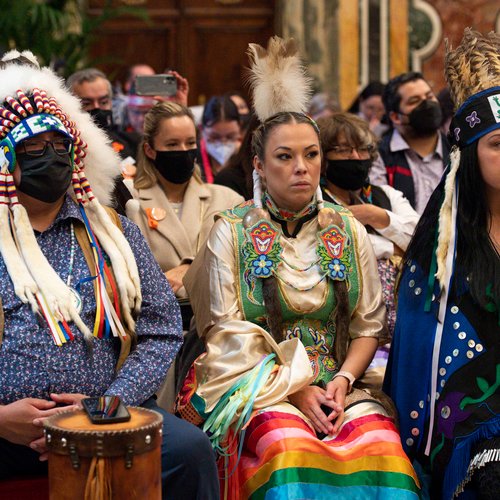
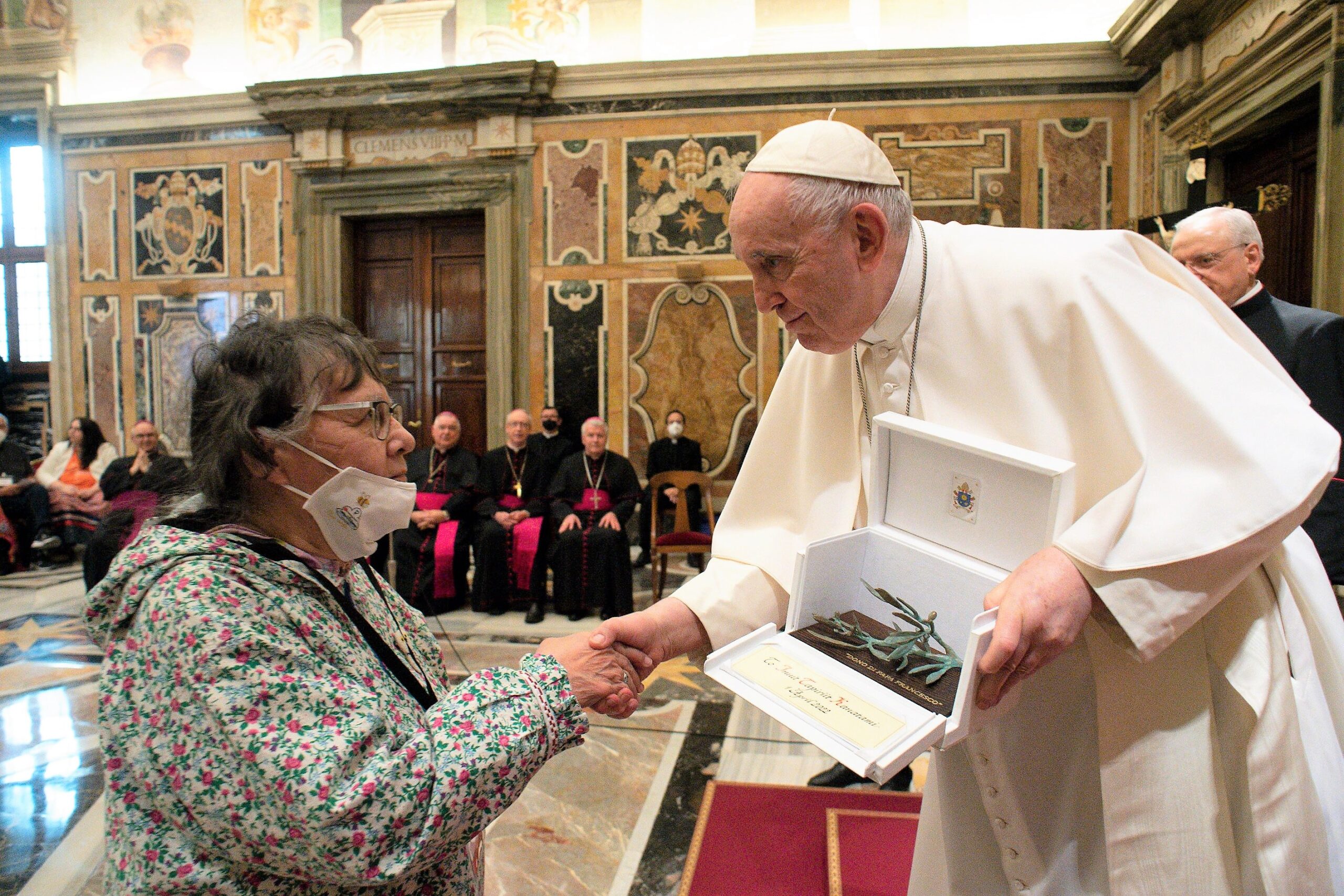
| Delegates representing Canada’s First Nations, Métis and Inuit in the Vatican’s Clementine Hall during a meeting with Pope Francis April 1. |
Francis also gave an indication of where and when he might visit Canada as he spoke about those “good and decent believers who, in the name of the faith, and with respect, love and kindness, have enriched your history with the Gospel.”
Praising Indigenous devotion to St. Anne, he expressed the hope of joining this year in the traditional July pilgrimage to Lac Ste. Anne in Alberta.
“I think with joy, for example, of the great veneration that many of you have for St. Anne, the grandmother of Jesus,” he told the delegations. “This year I would like to be with you on those days.”
Speaking about St. Anne he emphasized the importance of the elderly and future generations. “Nowadays, we need to re-establish the covenant between grandparents and grandchildren, between the elderly and the young, for this is a fundamental prerequisite for the growth of unity in our human family.”
Pope Francis clearly signalled that reconciliation is now the program and the goal of the Canadian Catholic Church. In issuing his apology he said, “I join my brothers, the Canadian bishops, in asking your pardon.”
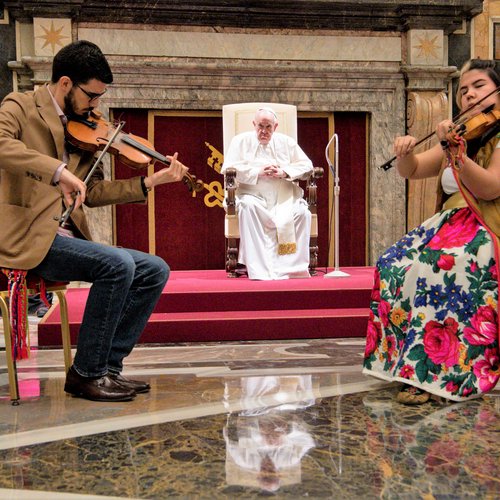
Mrtis fiddlers Alexander Kusturok and Brianna Marie Lizotte perform for Pope Francis in the Vatican’s Clementine Hall April 1.
“The Church stands with you and wants to journey with you,” Francis said.
Drawing his address to a close, Pope Francis said he had been enriched by their words and their testimonies. He also said he would be happy to benefit again from meeting them when he visits “their native lands, where your families live.”
And in another clue to a possible visit, he added, “I won’t come in the winter! So I will close by saying “Until we meet again” in Canada, where I will be able better to express to you my closeness.”
The Pope ended with a blessing in English: “God bless you all – the Father, the Son and the Holy Spirit. Pray for me, don’t forget! I’ll pray for you. Thank you very much for your visit.”
Pope Francis expresses ‘sorrow and shame’ for Catholic role in abuse against Indigenous peoples
Pope Francis on Friday expressed his “sorrow and shame” for the role Catholics have played in the abuse of Indigenous peoples in Canada, especially in residential schools.
During a meeting with representatives of the Metis, Inuit, and First Nations groups at the Vatican on April 1, the Pope condemned colonization, saying he was sorry for the historic evil committed against Canadian Indigenous peoples.
Pope Francis, who had private meetings with the Metis, Inuit, and First Nations delegations during the week, said “listening to your voices, I was able to enter into and be deeply grieved by the stories of the suffering, hardship, discrimination and various forms of abuse that some of you experienced, particularly in the residential schools.”
“It is chilling to think of determined efforts to instill a sense of inferiority, to rob people of their cultural identity, to sever their roots, and to consider all the personal and social effects that this continues to entail: unresolved traumas that have become intergenerational traumas,” he said.
He condemned the colonization which broke the Indigenous peoples away from their native land and ways of life, stating that “in this way, great harm was done to your identity and your culture, many families were separated, and great numbers of children fell victim to these attempts to impose a uniformity based on the notion that progress occurs through ideological colonization, following programs devised in offices rather than the desire to respect the life of peoples.”
The Pope said that learning about these situations made him feel deep indignation and shame, “because it is not right to accept evil and, even worse, to grow accustomed to evil, as if it were an inevitable part of the historical process.”
“I feel shame — sorrow and shame — for the role that a number of Catholics, particularly those with educational responsibilities, have had in all these things that wounded you, in the abuses you suffered and in the lack of respect shown for your identity, your culture and even your spiritual values,” he stated.
“All these things are contrary to the Gospel of Jesus Christ,” he underlined. “For the deplorable conduct of those members of the Catholic Church, I ask for God’s forgiveness and I want to say to you with all my heart: I am very sorry.”
“Clearly, the content of the faith cannot be transmitted in a way contrary to the faith itself: Jesus taught us to welcome, love, serve and not judge; it is a frightening thing when, precisely in the name of the faith, counter-witness is rendered to the Gospel,” he added.
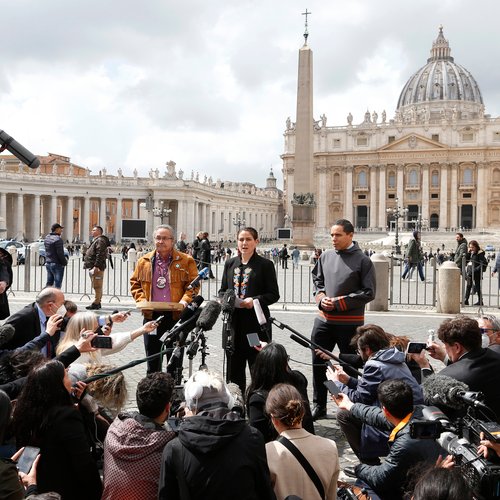
Canadian Indigenous leaders greet the media after meeting with Pope Francis at the Vatican April 1. From left are Chief Gerald Antoine, Northwest Territories regional chief of the Assembly of First Nations; Cassidy Caron, president of the Métis National Council; and Natan Obed, president of the Inuit Tapiriit Kanatami. (CNS photo/Paul Haring)
Pope Francis also said he was grateful for good Christians who, “in the name of the faith, and with respect, love, and kindness, have enriched your history with the Gospel.”
“It is my hope,” Francis continued, “that our meetings in these days will point out new paths to be pursued together, instill courage and strength, and lead to greater commitment on the local level. Any truly effective process of healing requires concrete actions. In a fraternal spirit, I encourage the Bishops and the Catholic community to continue taking steps towards the transparent search for truth and to foster healing and reconciliation.”
“Over the past few days, I have listened attentively to your testimonies. I have brought them to my thoughts and prayers, and reflected on the stories you told and the situations you described. I thank you for having opened your hearts to me, and for expressing, by means of this visit, your desire for us to journey together,” he said.
This journey, he noted, can help Indigenous peoples rediscover and revitalize their cultures, and the Catholic Church to grow in love and respect for their traditions.
“I wish to tell you that the Church stands beside you and wants to continue journeying with you,” Pope Francis said.
Canadian bishops welcome apology
Speaking after the audience with Pope, Bishop Raymond Poisson of St. Jerome, president of the Canadian Conference of Catholic Bishops, said, “We are deeply grateful to each of the Indigenous delegates who travelled with us to the Holy See to share their experiences and desires for a brighter future for their people.”
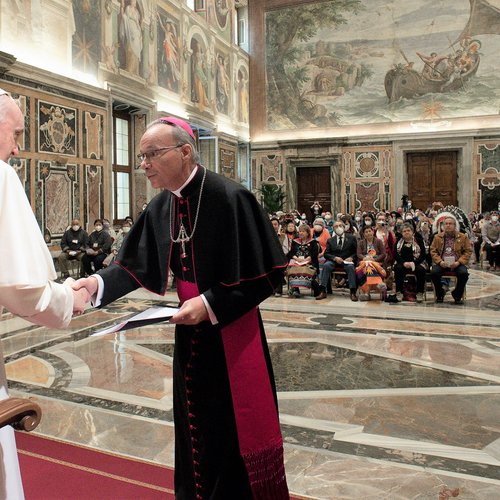
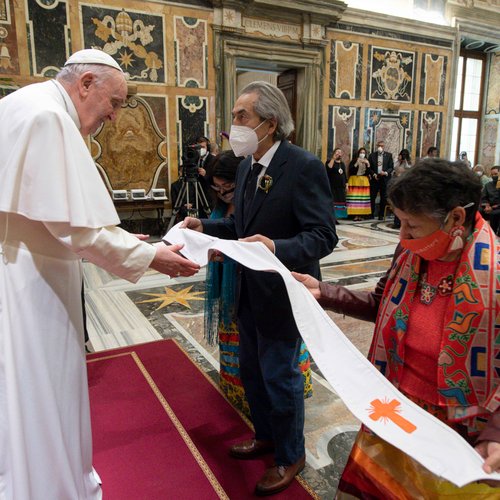
Pope Francis greets Bishop Raymond Poisson, president of the Canadian Conference of Catholic Bishops. (CNS photo/Vatican Media)
“The Holy Father,” the Canadian prelate said, “has heard first-hand the stories of those who suffered at the hands of Catholic Church members, and has responded with compassion, remorse, and a genuine desire for truth, justice, and healing.”
In a statement, the bishops said, “Through shared prayers, the exchange of gifts, and the telling of powerful stories, Pope Francis was moved by their courage, their commitment, and their resilience in the face of suffering.”
The statement added that the Pope, “emphasized his shame for the Catholic Church’s role in the residential school system, and re-committed to visiting with them on Canadian soil.”
CCCB Vice President Bishop William McGrattan of Calgary said, “As Catholics, we believe in the restorative power of apologies. But acknowledging wrongdoing is only one step of the healing journey. We all have a role to play in healing the wound that was opened up through a history of colonialism and must be deeply committed to this responsibility.”
Looking ahead to a prospective papal visit, he said, “As we prepare for the Holy Father’s eventual pilgrimage to Canada, the relationships forged this week and the lessons learned from Indigenous delegates will continue to guide and inspire us.”
CCCB Statement
“Today marks the conclusion of the Indigenous delegation to the Holy See, culminating with an historic apology from Pope Francis for the Catholic Church’s role in Canada’s residential school system.
The Holy Father expressed “sorrow and shame” for the abuse and lack of respect for Indigenous identities, culture and spiritual values in the residential school system. He said, “I ask for God’s forgiveness and I want to say to you with all my heart: I am very sorry. And I join my brothers, the Canadian bishops, in asking your pardon.”
“We are deeply grateful to each of the Indigenous delegates who travelled with us to the Holy See to share their experiences and desires for a brighter future for their people,” said Canadian Conference of Catholic Bishops (CCCB) President, the Most Rev. Raymond Poisson. “The Holy Father has heard first-hand the stories of those who suffered at the hands of Catholic Church members, and has responded with compassion, remorse, and a genuine desire for truth, justice, and healing.”
The Holy Father’s apology was informed by private encounters between March 28th and April 1st with 32 Indigenous Elders, knowledge keepers, residential school survivors and youth from across Canada.
Delegates shared a range of lived experiences including from their time in residential schools, the resulting loss of culture and language, and complex relationships with the Catholic faith that continue to this day. Through shared prayers, the exchange of gifts and the telling of powerful stories, Pope Francis was moved by their courage, their commitment and their resilience in the face of suffering. He emphasized his shame for the Catholic Church’s role in the residential school system, and re-committed to visiting with them on Canadian soil.
The delegation follows more than three years of dialogue between Canada’s Catholic Bishops and Indigenous partners, including the Assembly of First Nations (AFN), the Métis National Council (MNC), and the Inuit Tapiriit Kanatami (ITK), with a goal of learning and discerning how best to support them on the journey of healing and reconciliation. As this dialogue is ongoing, we have taken several important steps to support a more hopeful future, including a $30 million pledge towards healing and reconciliation initiatives, a commitment to ensure residential school documents are made available to survivors, and ongoing work to provide education for our clergy, consecrated men and women, and lay faithful, on Indigenous cultures and spirituality.
“As Catholics, we believe in the restorative power of apologies. But acknowledging wrongdoing is only one step of the healing journey. We all have a role to play in healing the wound that was opened up through a history of colonialism and must be deeply committed to this responsibility,” said CCCB Vice President, the Most Rev. William McGrattan. “As we prepare for the Holy Father’s eventual pilgrimage to Canada, the relationships forged this week and the lessons learned from Indigenous delegates will continue to guide and inspire us.”
We heard a call from Dr. Wilton Littlechild to walk where there’s no path and create a new one for people to follow. Every delegate who courageously spoke to their experiences has taken up this call, and we are grateful that Pope Francis responded in kind. We look forward to walking on this path together.”
The Catholic Register with Vatican News and B.C. Catholic files.