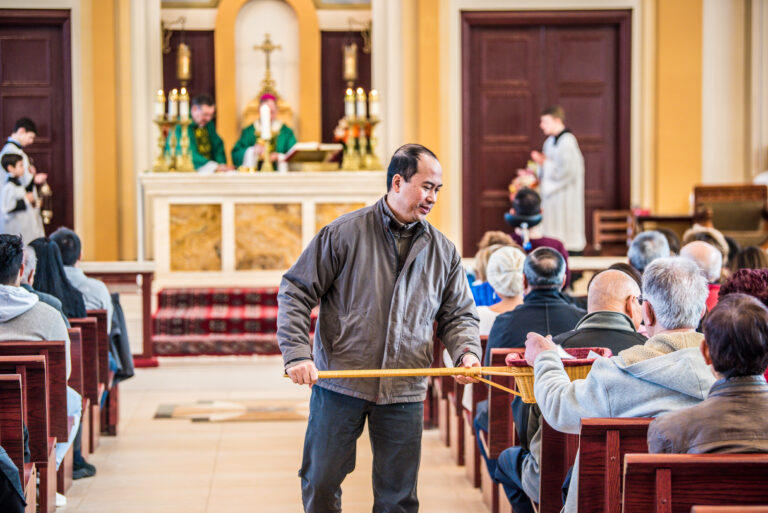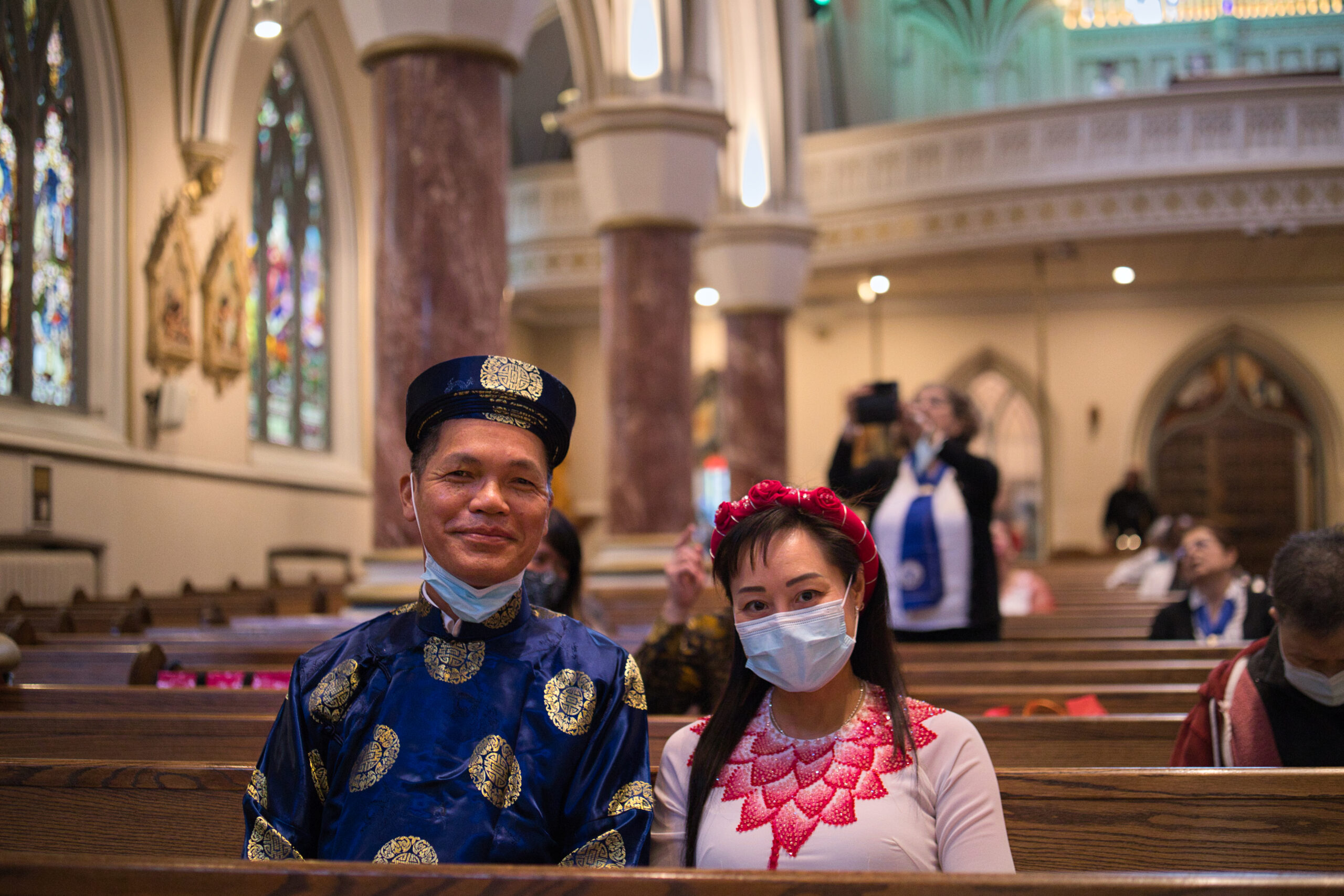

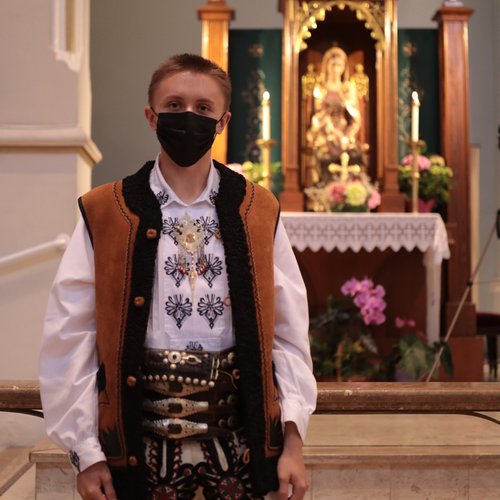
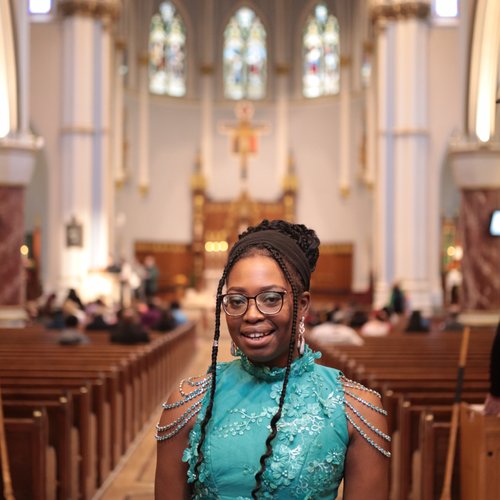
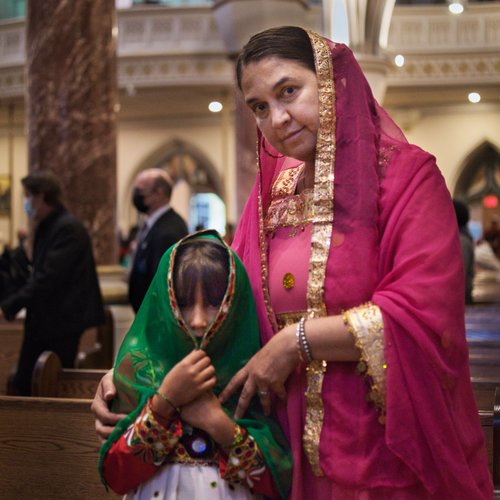
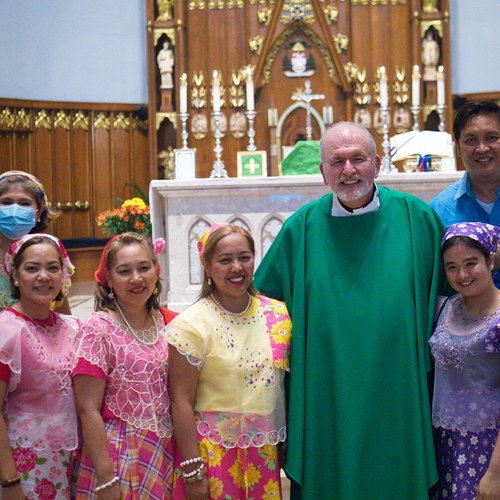
A colourful crowd gathered for the World Day of Migrants and Refugees at Holy Rosary Cathedral Sept. 26, their traditional clothing and folk costumes standing out brightly next to the stained glass, dimmed by a rainy Vancouver afternoon.
The Mass was a celebration of cultural difference and an offering of thankfulness for the freedom that many have found in Canada.
Before the liturgy began, Diane Chua, refugee program coordinator for the Archdiocese of Vancouver, shared a testimony on behalf of the father of one of the refugee families sponsored through the Private Sponsorship Program of the Archdiocese of Vancouver.
Names were withheld, but the father told a story of separation and loneliness, danger and inner turmoil. He left his family in his home country and spent two years searching for a path forward, fleeing authorities and civil war.
“All those years I desperately prayed to the Lord for protection and guidance for me and my family. My wife and my four children were still in my home country … It was hard for me morally and economically, for I was still new to the system in Canada,” the father wrote.
After four years and many trials, including the separation of his two oldest children from his wife, all of his family made it to Canada. “Finally we were united as a family and we are doing well.”
Mass readings and intentions were said in Polish, Vietnamese, Tagalog, Portuguese, and Tigrinya, representing a fraction of the many cultural groups that call Vancouver home.
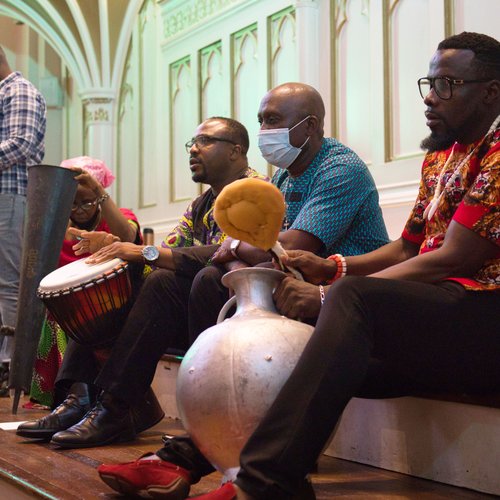
The Mass was accompanied by the voices and percussion of the St. Matthew’s African Choir, led by Augustina Obiwumma, and additional choral arrangements by Korean cantors Ji Won Kim and Yu Jin Cho.
The first World Day of Migrants was instituted in 1914 by Pope Pius X, who was inspired by the exodus of millions of Italians to America and elsewhere in the early 20th century. He called all Christians to pray for the wellbeing of migrants everywhere. More than a century later, the Church still celebrates this day of prayer and remembrance.
This year Pope Francis chose the theme “Towards an even wider ‘we,’” and in his homily, Archbishop J. Michael Miller connected this “we” to the unity of God in the Trinity.
“From the time of creation itself, humankind is a ‘we’ created in the image of a ‘we,’ of a God who is triune; [we are] not created just isolated and lonely. We are created as a single human family,” he told the congregation.
In his message for the World Day of Migrants and Refugees, Pope Francis wrote “this [‘we’] is the ideal of the new Jerusalem (Rev 21:3), where all peoples are united in peace and harmony, celebrating the goodness of God and the wonders of creation … we must make every effort to break down the walls that separate us.”
Building on themes he explored in Fratelli Tutti, Pope Francis bemoaned that our “we” is “crumbling and cracking” due to the twin threats of “nationalism and radical individualism.”
“The highest price is being paid by those who most easily become viewed as others: foreigners, migrants, the marginalized, those living on the existential peripheries.”
In Fratelli Tutti, the Pope warned that narrow nationalism can lead to a view that immigrants are “usurpers” with nothing to offer. “This leads to the simplistic belief that the poor are dangerous and useless, while the powerful are generous benefactors.”
For Pope Francis, individualism carries with it a similar danger, by making us believe we should be completely free to pursue our ambitions we can fall into the belief that in “pursuing ever greater ambitions and creating safety nets we would somehow be serving the common good.”
The danger lies in placing ourselves, rather than God, at the centre of community and life. “Fraternity necessarily calls for something greater.”
At the centre of Francis’ address was his call for us to build “A Church that is more and more ‘catholic:’ Indeed the Church’s catholicity, her universality, must be embraced and expressed in every age … The Holy Spirit enables us to embrace everyone … to unify differences without imposing a depersonalized uniformity.”
He continued, “all the baptized … are by right members of both their local ecclesial community and the one Church, dwellers in one home and part of one family.”
We are called to “go out into the streets” in order to “heal wounds and to seek out the straying … Among those dwelling in … existential peripheries, we find many migrants and refugees … to whom the Lord wants his love to be manifested and his salvation preached.”
Building on this message, Archbishop Miller concluded his homily with the offering that “today’s migration movements are a blessing because they offer us the opportunity to overcome our fears of the ‘other’ and they lend us the possibility of being enriched by the diversity of other people’s gifts.”