
Bruce Nolte remembers that hopeless day five years ago when he found himself homeless.
The Vancouver man’s 13-year marriage had collapsed. The divorce left him with feelings of anger and shame that led him to isolate himself from his family and move in with a friend.
Until the friend, who suffered from obsessive-compulsive disorder and was difficult to live with, one day threatened Nolte with physical violence. Nolte fled.
“I said to myself: ‘I’m not going to take this. I’m going to go somewhere that’s safe.”
With his parents deceased and no personal connections he thought he could trust, he turned to Catholic Charities Men’s Hostel. He spent 115 nights there.
“It was a place I could figure out some things in life and get back on track,” said Nolte.
Nolte doesn’t match the homeless stereotype many people might have. “I never did drugs, I don’t smoke, I don’t drink,” he said.
Before he lost every trusting relationship in his life, Nolte had a professional career in advertising and was working as a sportswriter for Sportswave.ca.
Catholic Charities director Scott Small said Nolte’s story shows how the word “homeless” often applies unfair labels and can dehumanize people.
“A lot of people look at the homeless and label them not just as ‘being homeless’ but in a generic sense of being addicted, lawless, disrespectful, smelly, bearded, and all of that.”
While there’s an element of that, said Small, most of the 125 men who stay at the Men’s Hostel on any given night are people facing a series of personal disasters.
About 10 years ago, Small spotted a man who looked familiar at the hostel. Small struggled to remember where he recognized him from, until he was sitting in his dentist’s office a short while later, flipping through year-old magazines.
“There on the front of a Vancouver magazine from a year ago issue was this guy. He had a successful restaurant. He was high society in Vancouver. Well known. Had everything you would imagine in a life,” said Small.
Within a year, the man had lost his business, family, and friends and was living in the Catholic shelter on Cambie Street.
“I had heard about people falling and had seen other people fall from other heights, but not that fast and not that far, and not here,” said Small.
Three years later, he again encountered the man, who was back working as a chef with a stable life, although without his previous success of restaurant ownership. “He came out of that tailspin but his life was never the same,” said Small.
Meanwhile, the hostel’s fastest growing population is seniors, with about 50 per cent of guests aged 55 or older. Small attributes much of that to “renovictions,” as seniors with low pensions are forced out of the below-market housing they’ve lived in for years and thrust into B.C.’s housing crisis.
Migrants, young people (aged 19+) who are new to the city or have run away from home, and others also find refuge in the shelter.
Small said for most individuals, even those who find themselves in difficult situations, are able to cope. “We have a savings account, we have a bus pass, we have a phone that works, we can pay these bills,” he said. “The wheels are on our bus of life.”
The men who stay at the hostel are those who “have suddenly had the wheels come off the bus of their life with no warning, or warnings they ignored.”
Stays at the Men’s Hostel are typically a maximum of 90 days. Staff were able to extend Nolte’s stay to 115 days, helping him find housing, save money, and fill out paperwork for disability assistance, all while treating him like family.
After he moved out into more permanent housing, Nolte stayed in touch with the Men’s Hostel and since October has been employed there part-time as a guest assistant.
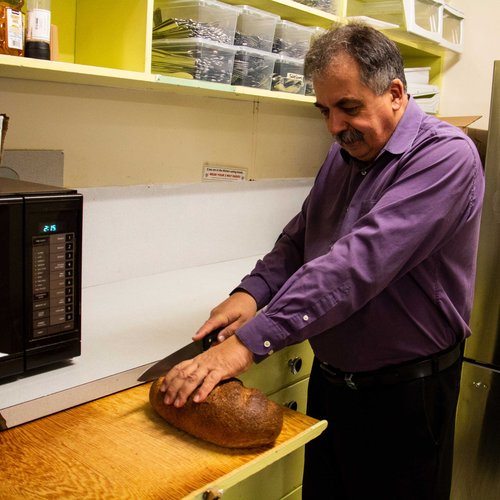
Nolte slices bread and puts out butter, jam, peanut butter, and coffee for the men who start arriving at 4 p.m. to spend the night. He folds towels, sorts dishes, and does any other work required of him while offering a cheerful smile to the men coming in, sometimes homeless for the first time.
“I’m always open with the people when they come up to the desk, if they need anything: a razor, toothbrush, towel, whatever, if they have to charge their phones. I always ask them how their day is going. It sends a message to them” that they are loved and they can overcome their situations, as he did.
“If someone comes in and they are feeling down, I take the time to sit down at the desk here and talk to them and just say, ‘it’s up to you, but you can do this too.’”
Related: