House of Commons approves a motion the Justice Minister send a letter to the Senate saying which amendments it accepts and rejects
OTTAWA (CCN)
The Liberal government has rejected a Senate amendment to its assisted suicide Bill C-14 that removes the requirement death be reasonably foreseeable.
In a 190 to 108 vote June 16 the House of Commons approved a motion the Justice Minister send a letter to the Senate regarding which amendments it accepted or rejected. The yeas included a number of Conservative MPs, including some staunch prolife MPs; the nays included other prolife MPs and NPD MPs who want the bill broadened.
The Senate passed an amended version Bill C-14 June 15 by a 64-12 vote, with one abstention. The upper chamber proposed seven amendments, with the most controversial being the Senator Serge Joyal amendment that replaced the reasonably foreseeable death requirement with language from the Supreme Court’s Carter decision that broadened eligibility to almost anyone who felt they suffered from an intolerable and irremediable medical condition.
Joyal and a majority of Senators were persuaded by the testimony of some constitutional experts the unamended bill was unconstitutional because its criteria were not as broad as those in the Supreme Court of Canada’s Carter decision.
The government response sets up a possible deadlock with the Senate or risks the bill being defeated.
The government’s position was good news to representatives of a range of groups advocating for persons living with disabilities, who were holding a national forum at an Ottawa hotel June 16 to stress the importance of death being reasonably foreseeable as an important safeguard for vulnerable Canadians living with disabilities and mental illness.
“Yes, we must respect the autonomous choices of people who are dying,” said disabilities rights expert Catherine Frazee who spoke to the conference via Skype. “For persons for whom natural death is not near, please let’s not make [suicide] easier.”
She warned “opening the doors wide” is a “form of inducement” and for some who struggle with lack of support and services, it will become “an invitation to seek an unencumbered death.”
“In a culture where frailty and dependence is so greatly feared people will die to avoid them, and die with the assistance of the state,” she said. “Frailty and dependence will become difficult to bear.”
She said those like herself who are frail and dependent can flourish, but “our ability to flourish would be extinguished.”
Present at the meeting, organized by the Canadian Association for Community Living, was Canada’s Minister of Sport and Persons with Disabilities Carla Qualtrough she had worked with the other cabinet ministers to ensure protection for disabled Canadians.
“We believe it is crucial to have ‘reasonable foreseeability’ in the bill,” she said.
“Death is not better than living with a disability,” she said.
Among the amendments the government accepted was one requiring a palliative care assessment. It amended the language slightly to read “assistance in dying after having been informed of the means available to relieve their suffering, including palliative care.”
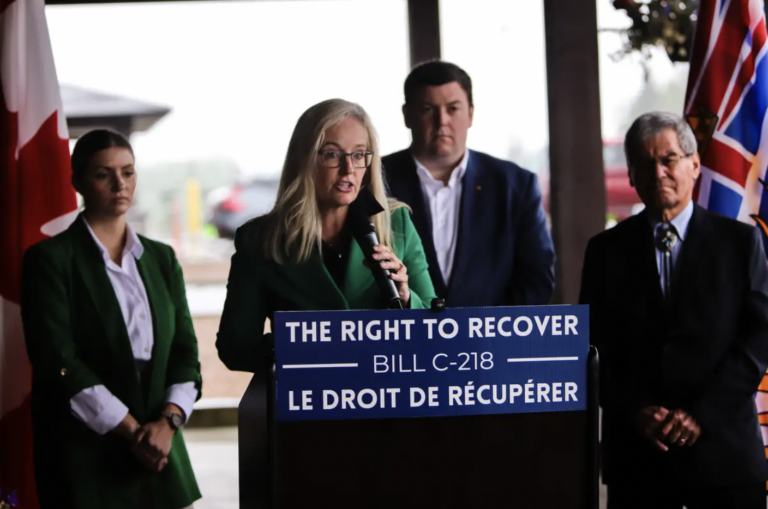
Wilson-Raybould said and the Health Minister Jane Philpott told journalists June 16 they”are confident that the original language in Bill C-14 strikes the necessary and appropriate balance in terms of medical assistance in dying, in balancing personal autonomy and eligibility for medical assistance in dying with the necessary and fundamental protections that need to be in place to protect vulnerable people.”
The third reading debate in the Senate preceding the vote saw impassioned speeches on all sides of the debate, especially from those opposed in principle to euthanasia and assisted suicide.
Senator Betty Unger said she spoke for the many who “weep that Canada’s moral fabric is being destroyed” and “dearly held values are being shredded.”
Unger also took aim at the Supreme Court of Canada.
“The Supreme Court has supplanted our elected parliamentarians by foisting judge- made law on Canadians,” she said. “Although parliaments across the nation could invoke the ‘notwithstanding’ clause to ensure that this decision receives its proper deliberation, they seem unprepared to do so.”
Rookie Senator and former Manitoba Justice and chair of the Truth and Reconciliation Commission Senator Murray Sinclair warned against too expansive a view of an assisted death as a constitutional right. He and several other Senators said they preferred the original wording of the bill.
Coming from the Indigenous community, Sinclair stressed, “life is sacred” and allowing someone to end their life with others’ assistance should be approached “very carefully and only incrementally.”
“We shouldn’t be too eager to rush forward and make it an expansive, all-embracing right that everybody can easily exercise,” he said.
Senator Sinclair said he had recently come from meeting with young people in Attawapiskat, facing a suicide crisis. He warned of the effect on these people “if they believe that Canadian society embraces the idea of suicide as a matter of principle, even if we say that you can only do it under medical supervision, they will see it as an acceptable alternative to living.”
Senator Andre Pratte said he was haunted by the question of what happens next if the House sends the bill back to the Senate “having rejected some or most of our amendments.”
“Should we defer to the house or stand our ground?” he asked. “I’m very much concerned about how Canadians will react in the case of a legislative deadlock.”
“Honourable senators, I would say cool off,” Joyal said. “Ask yourself who we are and where you come from. You have been appointed here to be independent of an electoral mandate.” He urged them not to be concerned about polls and the popularity of the new Liberal government.
He pointed out the Senate is dealing with constitutional rights. “We are dealing with people that the Supreme Court has said have the right to medical assistance in dying in a certain number of conditions,” he said.
“The government decides to blankly exclude a large group of them without any evaluation of minimal impairment; that is, how to frame a better system. On the basis of all the interpretation, we know there is a fundamental risk of constitutional failure.”