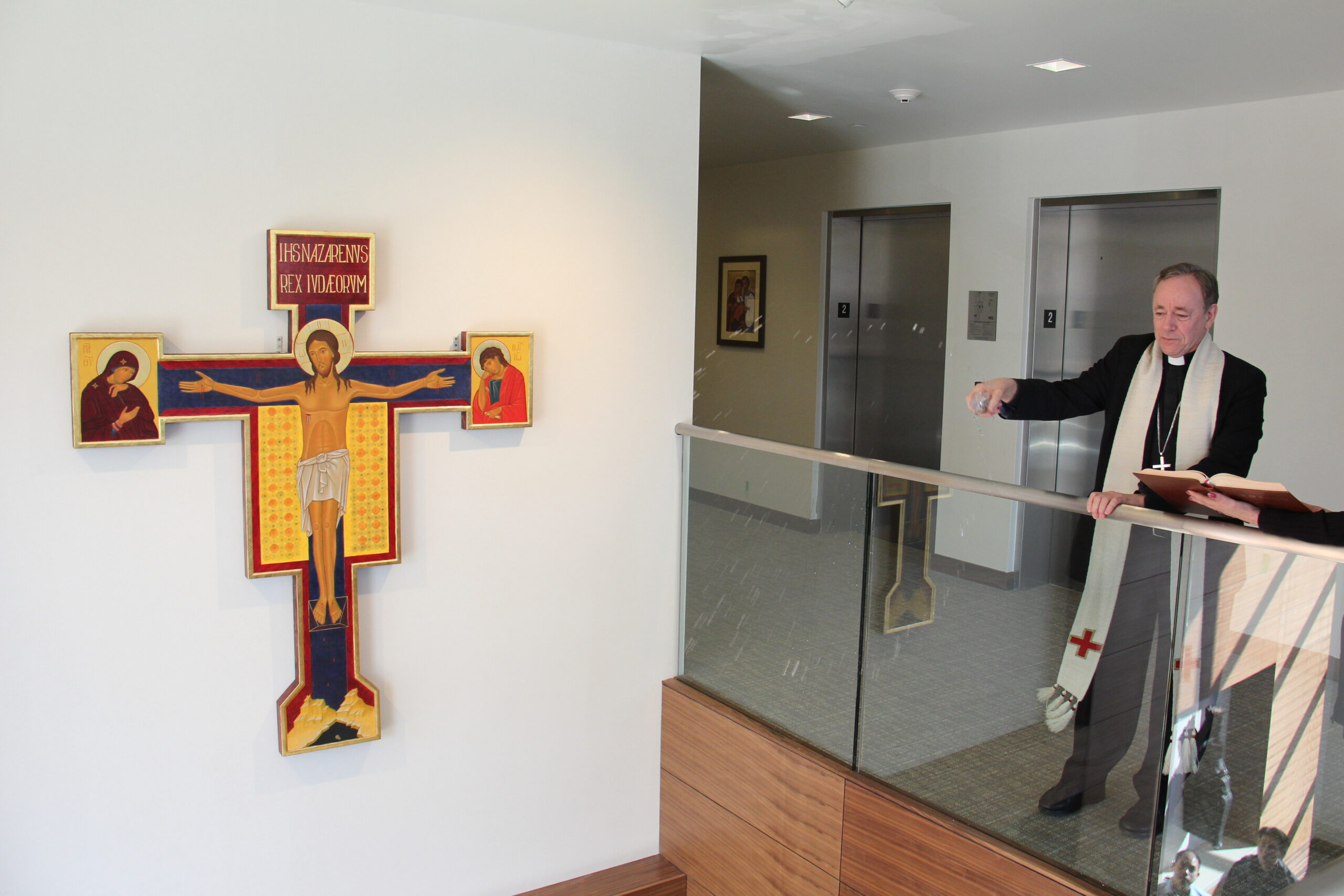

VANCOUVER—The first thing visitors see as they enter the new John Paul II Pastoral Centre is a brilliant, gold-lined crucifix.
The icon of Christ crucified, yet triumphant, took iconographer Frank Turner 18 months to write.
“As the inscription on the back of the crucifix says: ‘Through the grace of God, through the hand of the iconographer,'” he said. “We don’t do it all by ourselves.”
Archbishop J. Michael Miller, CSB, commissioned Turner to write the icon for the new building in late spring 2013.
“He spent an enormous amount of time on it, and I think it’s extraordinarily beautiful,” said Archbishop Miller.
“I think it tells right away that this is a different kind of building. We’re not a church, but this is a special place. It’s a pastoral centre and should be under the direction of Christ crucified.”
The artist consulted a number of pieces of religious art from about the 1200s as he sketched the crucifix and icons of Our Lady and St. John.
“In the Romanesque period, the corpus is awake: His arms are out, He is, in a manner of speaking, foreshadowing the Resurrection. He’s not the agonized Christ,” Turner said. “The archbishop is much fonder of this style.”
The iconographer began with a six-foot tall crucifix that was shaped in the style of a processional cross from Assisi and cut out of wood by a friend. He spent the first month applying layers of gesso, a mixture of chalk and glue, to make a white foundation.
He traced the outlines of Jesus, Mary, and John on the board. Wherever he was going to place gold: in their halos, for example, he first laid a base of bole: deep red Armenian clay mixed with glue. It would secure the thin pieces of gold to the board.
“Because of this big, very special project, I decided I would use 24-karat gold,” Turner said. “It’s quite wonderful! I get little thrills all the time.”
Turner applied two layers of gold in most places and up to five on Jesus’s halo, which he burnished to make it shinier. Then he spent most of last summer painting.
Inspired by pictures of icons by an unknown iconographer, he chose to paint the cross blue instead of a more realistic brown. “The blue is a mystical sign of the significance of the cross. It’s not just wood. This is a mystically important thing and it foretells the heavenly.”
At the top, he wrote Jesus Nazarenus Rex Judaeorum, or Jesus of Nazareth, King of the Jews. In Jesus’s halo, Greek letters spell Ho Oon, which means “The One Who Is” or “I Am Who Am,” signifying that Jesus is God, he explained.
Below the rocks at the foot of the cross, Turner painted Adam’s skull. According to tradition, Golgotha, a word which means “the place of the skull,” is where Adam was buried and where Jesus was later crucified.
Filmmaker Clayton Richard Long has made a 10-minute documentary about the crucifix, called Window to Heaven, which can be found on YouTube.
“It was an incredible, exciting experience because I got to watch the whole process from beginning to end,” he said. Long spent about an hour in Turner’s studio every couple of weeks to record the process.
“It was a learning experience,” he said. The icon “sucks you in and you know why: it’s because there are so many layers to it. It’s not just a painting.”
The work of art was hung Feb. 25, a few days before the John Paul II Pastoral Centre officially opened March 2.
“Something beautiful changes your life,” Turner remarked. “I think it’s beautiful, and I think it will change people’s lives. And it will be there for a long, long time.”