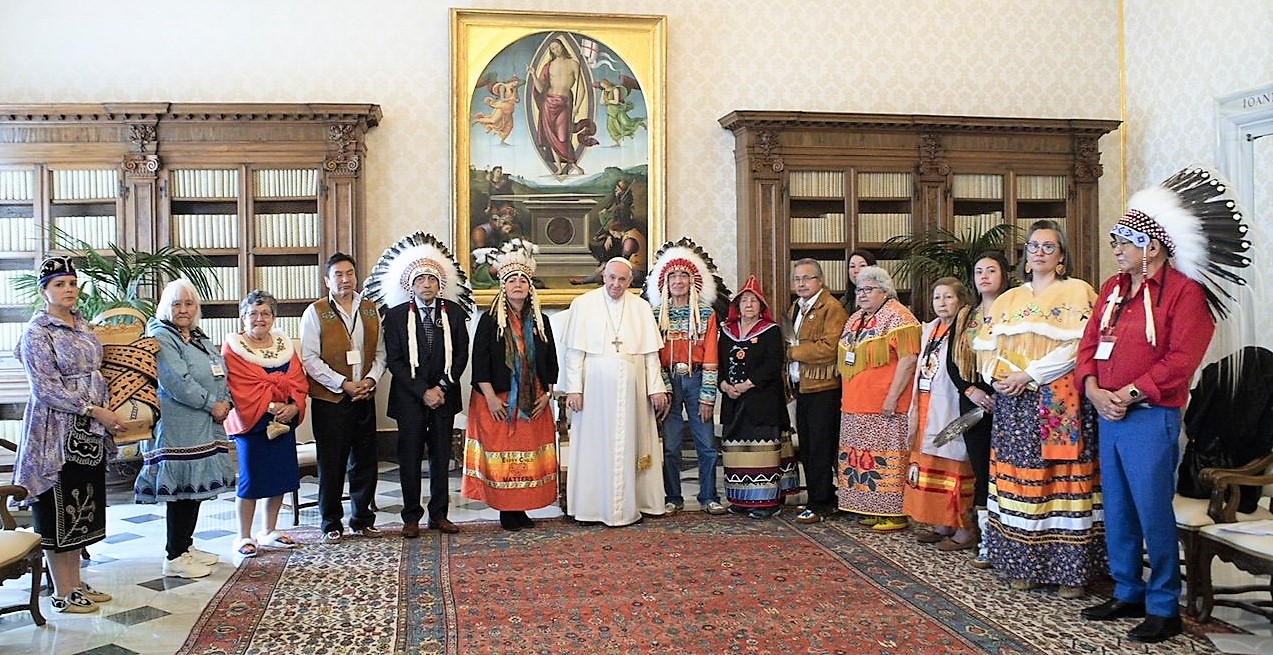

In a meeting Thursday with members of Canada’s Assembly of First Nations, Pope Francis received a “cradleboard,” a traditional baby carrier that the delegates asked the Pope to keep overnight to remember the Indigenous children sent to residential schools.
The meeting took place one day before the Pope holds a general audience with all the Indigenous delegates in Rome to share with him the legacy of residential schools and the impacts of colonialism.
Thursday’s meeting was marked by an atmosphere of listening and closeness,” said the Vatican press office, and was the Pope’s third visit with delegations of Indigenous Canadians.
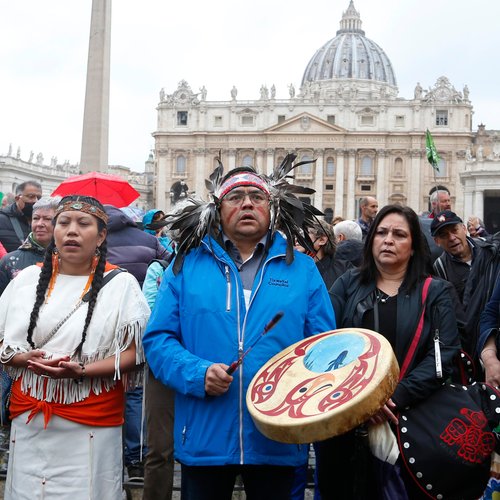
Representatives of the Assembly of First Nations perform music outside St. Peter’s Square as their delegates meet with Pope Francis March 31. (CNS photo/Paul Haring)
Earlier in the week the Pope met with representatives of the Metis and Inuit peoples in separate audiences.
Following the meeting on Thursday, First Nations delegates dressed in traditional attire met with members of the press outside St Peter’s Square to talk about their experience.
“It’s a special day,” said First Nations delegation leader and Dene chief-elect Gerald Antoine, noting that Pope Francis had listened attentively to their words. “The things that happened to us should never have ever happened…” he said.
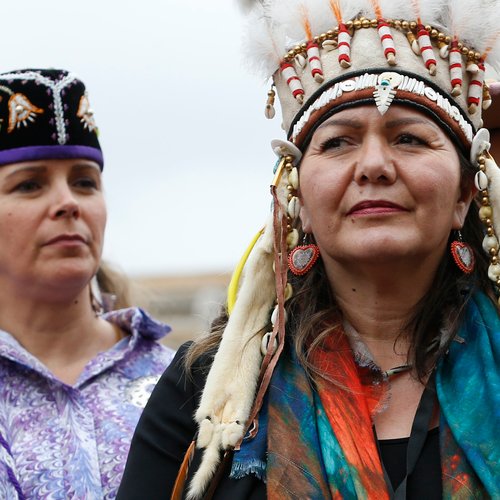
Rosanne Casimir, chief of the Tk’emlúps te Secwépemc in Kamloops, right, and Assembly of First Nations delegates meet with media outside St. Peter’s Square after meeting with the Pope. (CNS photo/Paul Haring)
Antoine also recalled the special relationship with “Mother Earth,” saying “Mother Earth is our home.”
He said it is necessary to hear the voices of Indigenous people, who can speak the truth about the earth and which must be protected. Everyone, he said, must “work together because we don’t have much time left.”
The delegates who met with the Pope Friday are still awaiting word on whether he will renounce the 1493 Doctrine of Discovery, the papal bulls that declared Indigenous lands were terra nulius, open to be claimed by Western explorers in the name of Western empires.
Ever since the Canadian Conference of Catholic Bishops announced the delegations to meet with Pope Francis this week, the Assembly of First Nations has made no secret of its expectation that the Pope renounce the doctrine that fuelled Europeans settling Canada.
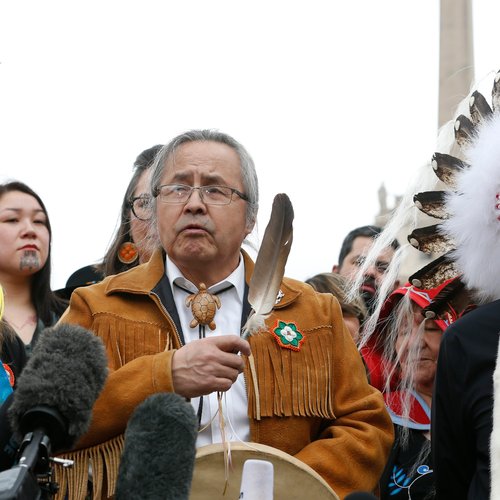
Chief Gerald Antoine, centre, Northwest Territories regional chief of the Assembly of First Nations, speaks to media after meeting with Pope Francis. Also pictured are Rosanne Casimir, chief of the Tk’emlúps te Secwépemc in Kamloops, and Phil Fontaine, former national chief of the Assembly of First Nations. (CNS photo/Paul Haring)
In Rome, Antoine addressed the issue, telling reporters “We need to right the wrong.”
A thorough repudiation of the Doctrine of Discovery by all churches is one of the 94 Calls to Action that came out of the Truth and Reconciliation Commission.
“We call upon all religious denominations and faith groups who have not already done so to repudiate concepts used to justify European sovereignty over Indigenous lands and peoples,” reads Call to Action #49.
With B.C. Catholic and Catholic Register files