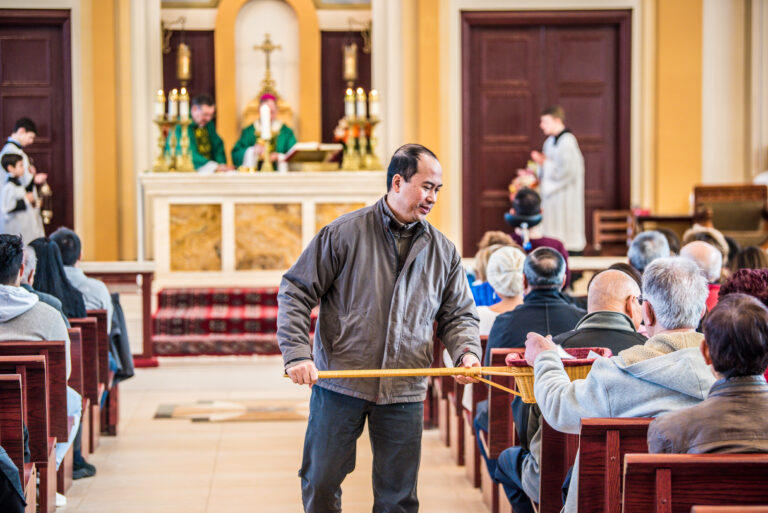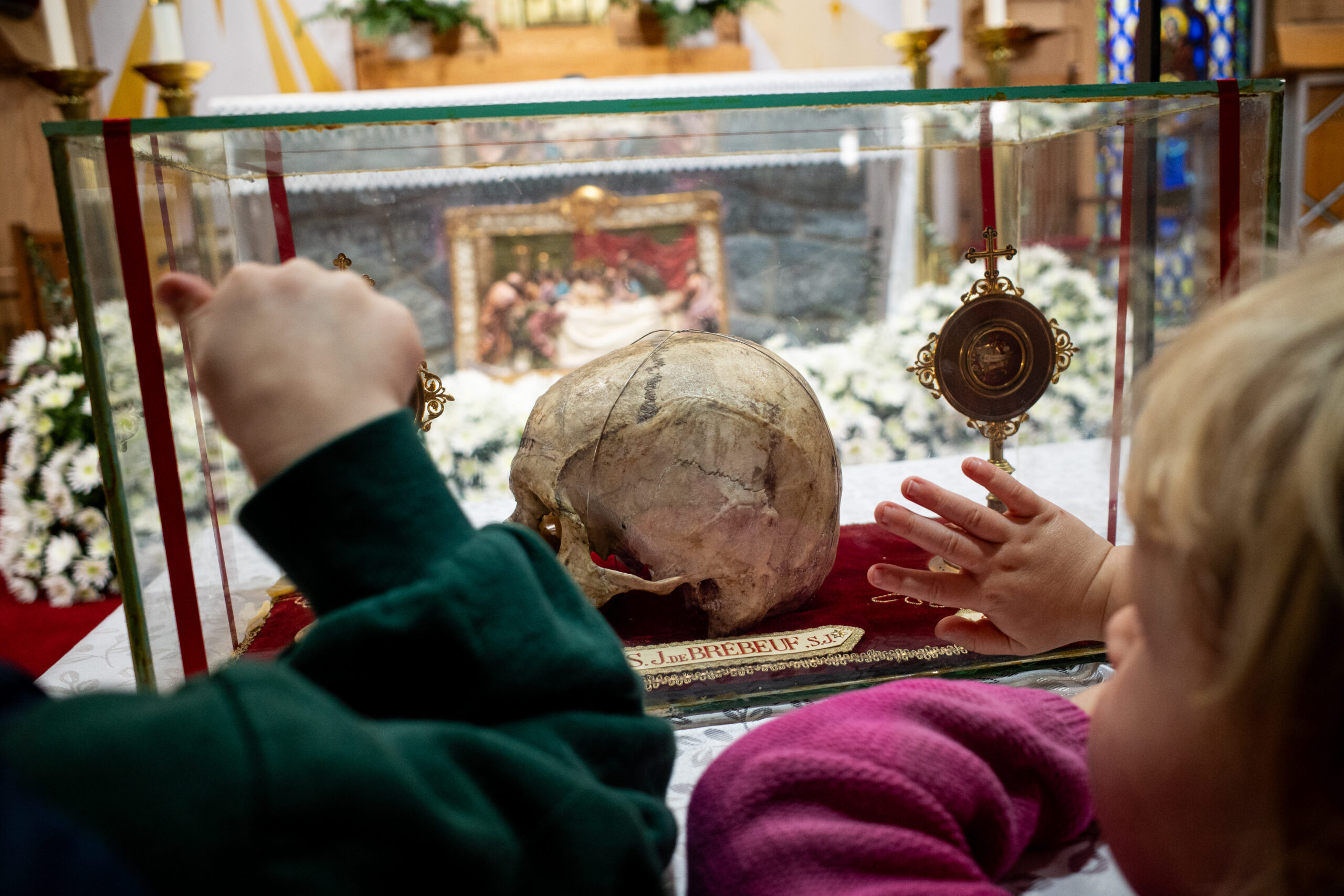

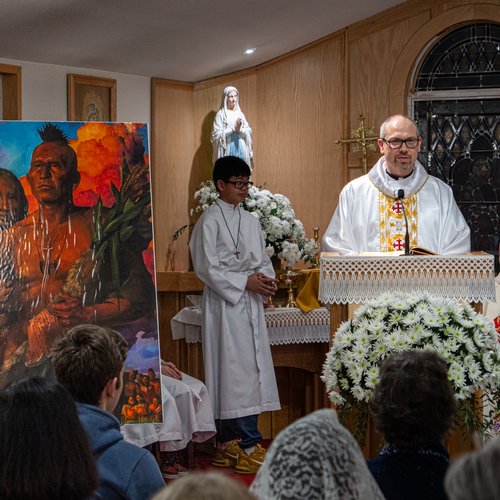
As hundreds of people filed through tiny St. Anthony’s Church in Agassiz to venerate the relics of the Canadian Martyrs and St. Kateri Tekakwitha, a portrait of Joseph Chiwatenhwa gazed from the side, his life a testament to the efforts of the first Jesuit missionaries to Canada, and the vitality of the early Canadian Church.
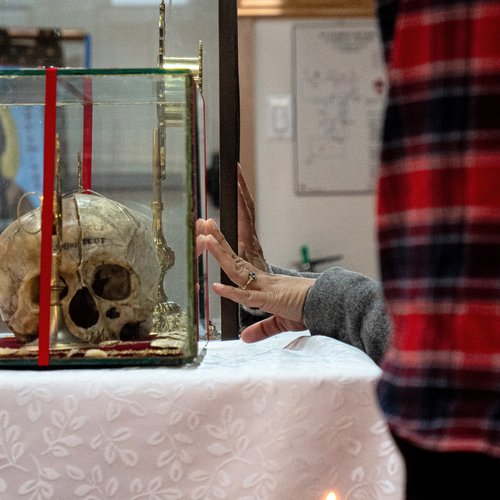
The major relics of the Canadian Martyrs that visited the Archdiocese of Vancouver from Jan. 9 to 13 included the skull of St. Jean de Brebeuf and bones of St. Charles Garnier and St. Gabriel Lalemant.
Joining them was a first-class relic of St. Kateri Tekakwitha, the first Indigenous North American saint and patron of First Nations peoples.
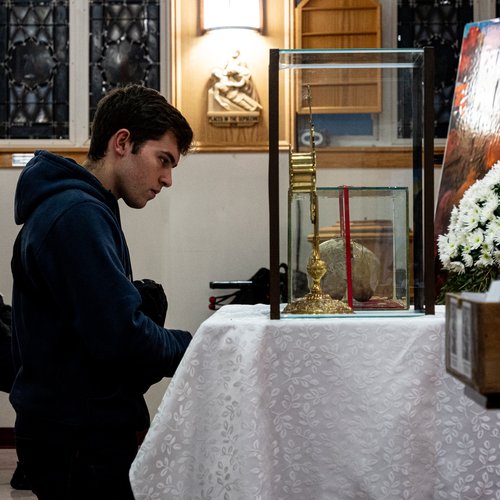
It was the first visit of the relics to Vancouver, with stops at St. Anthony’s in Agassiz and Holy Rosary Cathedral for public veneration, as well as St. John Brebeuf Secondary in Abbotsford and Westminster Abbey in Mission for private events.
The Shrine of the Canadian Martyrs has been designated as an official pilgrimage site for the 2025 Jubilee Year of Hope. The Western Canada tour was organized so Canadians across the country could make a Jubilee pilgrimage.
Father John O’Brien, director of the Martyrs’ Shrine in Midland, Ontario, along with fellow Jesuit Edmund Lo, travelled with the relics across the Prairies and British Columbia. He told The B.C. Catholic that in addition to the stories of the touring saints, he has kept Joseph Chiwatenhwa’s story front and centre.
Not only was Chiwatenhwa the first Aboriginal missionary to Canada’s first peoples, but he was one of the first catechumens to study with Brebeuf and the other Jesuits and be baptized.
When the Jesuits started their work with the Huron people, it was years before they recorded a convert.
“Nine years passed before their first catechumen,” said Father O’Brien.
After his conversion, “Joseph becomes this man on fire. He goes on ahead of the Jesuits,” said Father O’Brien. “He becomes the one explaining to his own people the Christian faith; that they have nothing to fear from it, and that Christ is the fulfilment of the knowledge they already have of the Creator.”
Speaking about Chiwatenhwa, it’s said that Brebeuf told his companions, “After God, all of our hope was in this one man.”
“It’s because of him that hundreds, and even thousands, eventually became Christians,” Father O’Brien said.
Ultimately, Joseph was killed for his faith in 1640 by two of his Huron kinsmen. He is now being considered for sainthood by the Church.
Chiwatenhwa’s legacy of missionary zeal was marked by his tireless efforts aiding the Jesuit fathers in their work of evangelization among the Huron. After the destruction of the Huron Nation by the Iroquois, Christian Huron refugees continued the spread of Christianity throughout the surrounding Aboriginal peoples.
“It’s one of those Paschal mystery things,” said Father O’Brien. “Out of Calvary [the genocide of the Huron people at the hands of the Iroquois] comes the fruitfulness of new life. The missionaries that followed found a strange receptivity to the faith.”
St. Kateri, he said, “is the fruit of all this,” he said. “She was born just eight years after the martyrdoms to the Mohawks, who were part of the Iroquois confederacy.”
Just as the blood of the Canadian Martyrs became the seeds of faith in Canada, Chiwatenhwa’s tireless work prepared the soil for St. Kateri, the Lily of the Mohawks, to flourish along with the faith of countless others.
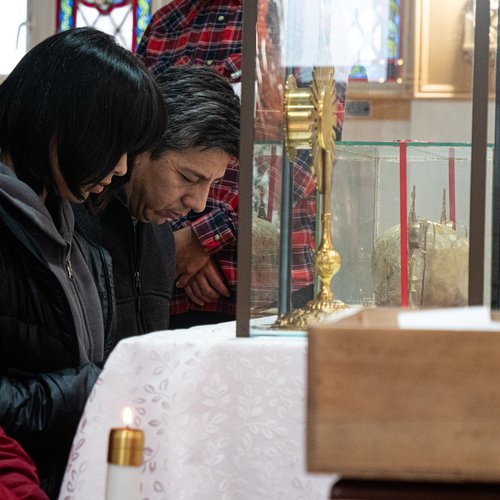
Chiwatenhwa’s story is an example of missionary faith that has resonated with many young First Nations people Father O’Brien has encountered during the tour. He believes their enthusiasm offers hope for the future of the faith in Indigenous communities.
One memorable encounter took place at Catholic Christian Outreach’s Rise Up Conference in Calgary at New Year’s.
“A young Cree student came up to me,” he said, “and shared with me how moved and excited he was to hear about Joseph Chiwatenhwa’s story.”
The young man wanted to go home and tell his friends and family all about it. “This signalled to me that there is great interest in this unknown, in the great Christian leadership of the First Nations people — it’s a part of the Church story.”
The power of the relics to open doors and hearts is something that Father O’Brien said he has observed during his time as director of the Martyrs’ Shrine.
“What we see is individuals, families, both Indigenous and non-Indigenous; they seem to be quite moved by their encounter,” he said. “I’ve been struck by their gratitude.”
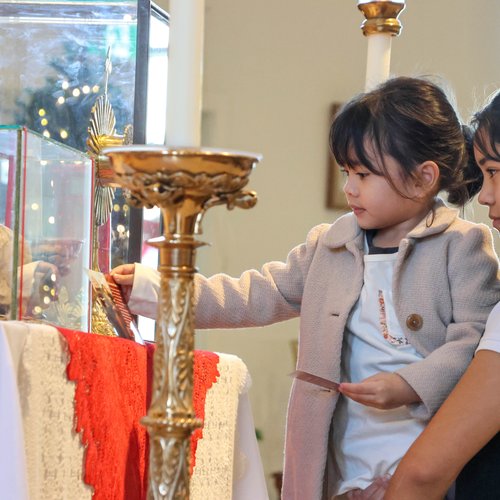
At St. John Brebeuf Secondary, the school community had the rare opportunity to venerate a first-class relic of their school’s patron alongside the other three Canadian saints.
The day began with a Mass at St. James, next door to the high school, concelebrated by Fathers O’Brien and Lo and joined by Father Ron Dechant, OMI, of St. James, and Father Gio Schiesari of St. Mary’s in Chilliwack.
In his homily, Father O’Brien shared stories of the lives of the saints. After the Mass, students and faculty were able to come forward to venerate the relics.
Your voice matters! Join the conversation by submitting a Letter to the Editor here.