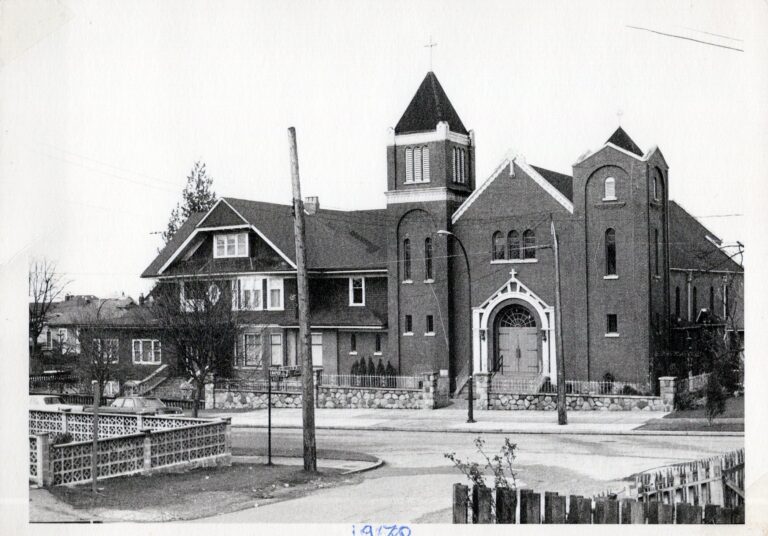
Religious sisters first built Rosemary Heights Retreat Centre in 1962 to be a convent and a school
The B.C. Catholic
A retreat centre built on a legacy of healing and conversion has closed its doors.
Rosemary Heights Retreat Centre, nestled in a wooded area in south Surrey on the bank of the Nicomekl River, ended its operations at the end of 2015 because of a major drop in retreatants.
“Jesus did the work. It was His place. It was His house,” said director Mari Lalana. “That to me was the most important thing.”
Diverse groups of people including troubled women, children preparing for the sacraments, and members of all faiths sought peace and solace there.
Building a legacy
The nuns who would build Rosemary Heights first arrived to B.C. in 1890. The Sisters of the Good Shepherd settled into a convent in New Westminster and opened an orphanage, then started a ministry to troubled women.
After fire destroyed their headquarters in 1900, the sisters moved to West 14th Avenue in Vancouver. Thirty years later they bought another property on West 16th Avenue, and their ministry grew.
By 1955 the sisters had opened St. Euphrasia’s School, a program for emotionally troubled girls ages 11-15. The sisters took them on field trips and employed social workers.
A few years later they sold their Vancouver convent, and a 30-acre property in south Surrey caught their eye. Construction began on a new convent and St. Euphrasia’s school; the sisters had moved in by 1962.
The school was renamed Rosemary Heights in 1973, apparently for their foundress’s baptismal name: Rose Virginie. That year the sisters opened a transition home for young graduates who needed support before entering the real world.
A few years later they saw a drop in demand and phased out their program. The space became a retreat centre.
“The Sisters of the Good Shepherd were always working to benefit the local community,” said Nitya Maharaj, who worked in building maintenance there for 40 years.
“The main focus has always been to help people find the comfort of Christianity in a warm and nurturing environment.”
After 106 years of serving in B.C., the sisters moved away in 1995, leaving Rosemary Heights in the capable hands of lay people.
Culture of care
Mari Lalana became the director eight or nine years ago. “Our mission was to provide a place where everyone could encounter Christ.”
She encouraged staff members to see it as more than a job and to build up a certain atmosphere, a kind of culture. “Culture of caring” became their catch phrase. Mario Ylanan, who worked there for seven years, said it “permeated everything we did.”
In recent history, he said, Rosemary Heights has seen many changes, including upgrades to its interior, grounds, and gardens. It played a major part in the formation of the archdiocese’s first class of permanent deacons; they were trained there for four years.
Until recently the retreat centre provided meeting spaces, clean beds, and meals. Within the last few years, a major milestone was a switch to planning whole retreats, including inviting speakers and hosting exhibits.
Ylanan said they received positive feedback and even had sell-out crowds.
“Seeing transformations during a retreat or a deepening of love during an exhibit, and being involved in that particular event, you feel so humbled by the fact that the Holy Spirit has decided to work through you to put it together.”
Michelle Gastaldo worked at Rosemary Heights for more than 11 years, most recently as event coordinator.
“I’ve always looked forward to coming to work. I don’t know if a lot of people can say that,” she said. “It’s like my second family.”
Touching hearts
One day retreat centre employee Frank Sharma was going about his duties housekeeping, answering phones, and planning events when a retreatant approached him.
The woman, of no particular faith, was a member of a group of people recovering from serious accidents or chronic illnesses who had come to the centre for an annual retreat.
“She asked me if she could go to the chapel,” Sharma recalled. As he led the way, she asked if he would sing her a hymn. Sharma obliged, intoning How Great Thou Art inside the chapel. “She started crying and said, ‘There’s something different here.’
“I saw the changes that took place in people’s lives, and how much we get an opportunity to witness to people.”
It was one of many opportunities for evangelization. Another woman had a profound experience while meditating on a display of paintings and statues of Mary.
“She started taking photos of the walls because she wanted to remember this experience forever. She was deeply touched,” he said.
Another Marian exhibit attracted a group of Anglicans. “They said, ‘We never thought about Our Lady this way.’ It was not a sit-down preaching moment, but it was a moment of evangelization in casual talk.”
The future
Rosemary Heights was the Archdiocese of Vancouver’s only retreat centre.
“Unfortunately, a number of factors worked against Rosemary Heights,” wrote Archbishop J. Michael Miller, CSB, in a letter in November. “Most critical was a decline in those seeking its services.”
James Borkowski, the archbishop’s delegate for administration, added that while no plans have been released, they hope to open another retreat centre in the future.
Lalana said declining numbers of retreatants is not a new challenge. “The problem exists in every retreat centre across the globe,” she said, reflecting on conversations with directors of other Canadian retreat centres.
She said the need to get away, rest, and find healing continues, even if the multitudes don’t realize it yet.
“Perhaps all retreat centres will have to follow in order for a new need to grow,” Lalana said thoughtfully. “Does something have to die for it to be reborn? Does something have to disappear before the next generation realizes they need it and want it?”