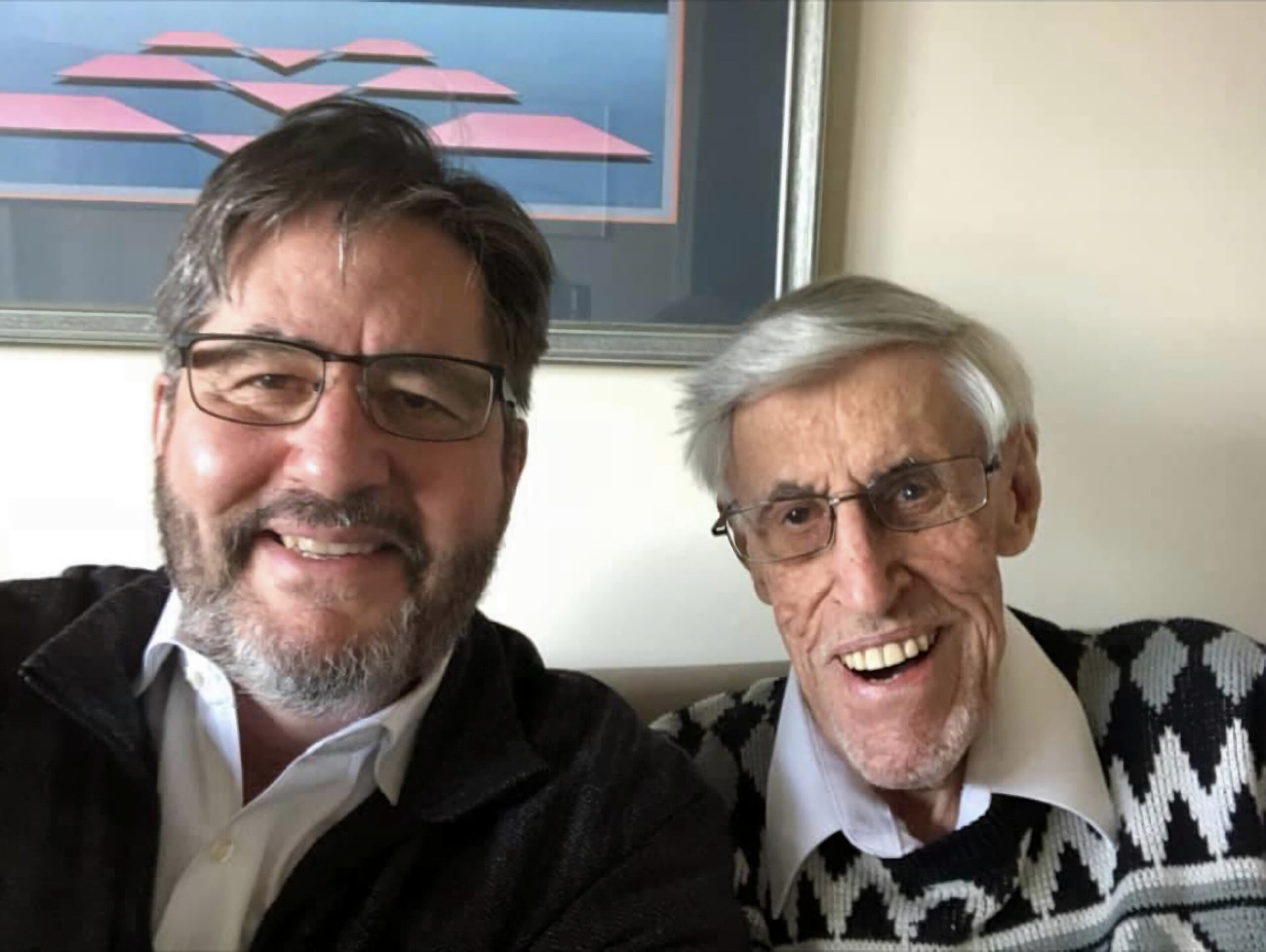

Visionary educator Dr. Gerald Sylvester died last month in Vancouver at the age of 90, leaving behind not only a legacy of unparalleled accomplishment in Catholic education in this province, but also a signal example of how to put faith into action.
“Dr. Sylvester was a true pioneer of Catholic higher education in B.C.,” said Archbishop J. Michael Miller, “first at Notre Dame University in Nelson and later through his engagement with the founding of Corpus Christi College in Vancouver.”
Moreover, Sylvester also played an important advisory role in the establishment of Catholic Independent Schools of the Vancouver Archdiocese, enabling it to qualify for provincial-government funding, said his son, David Sylvester.
As chronicled in a comprehensive obituary published in the June 1 edition of the B.C. Catholic, Sylvester taught at Notre Dame University in Nelson, became Dean of Studies at Vancouver Community College (Langara), was president of Malaspina College (now Vancouver Island University), and served as Corpus Christi’s executive director when it opened in 1999.
Before his position at Corpus Christi, Dr. Sylvester was a founder of the Advancement of Higher Education in the Catholic Tradition Society, whose explicit purpose was to establish Corpus Christi at the University of British Columbia.
“Dr. Gerry Sylvester was a remarkable higher-education leader in British Columbia for many years,” said Dr. Peter Meehan, current president and vice chancellor of Corpus Christi College, “and he brought wisdom, experience and energy to his role in the movement for Catholic higher education in Vancouver.
“It is a story that is so important for the Church and the world today – one rooted in the inspiration and efforts of the laity.”
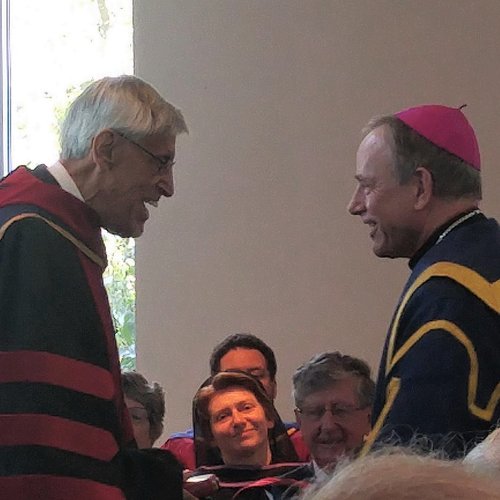
Meehan also noted, “Gerry created an incredible legacy that will continue to have a profound impact for generations to come. This community of faith and learning would not exist without his dedication to Catholic education and to the good of humanity.”
David Sylvester said his father’s passion, both for his faith and the transformative power of education, was ignited while attending Notre Dame College (now Athol Murray College of Notre Dame) in Wilcox, Sask.
“He did his high school and his first years of university at Wilcox, where the sacramental life intersected with the educational life, intersected with the social justice and politics – that was fair game for a thoughtful Catholic,” he said. “So, in many ways, it’s not just about a personal piety, it’s about putting your faith into action.”
He also cited as important influences on his father the education he received from Oblate priests at St. Paul University in Ottawa, where he studied to become a priest before graduating with a BA from the University of Ottawa, and from Jesuit priests at St. Louis University in Missouri, where he was awarded a master’s degree – paying his tuition with money earned by playing piano in nightclubs.
His father earned a doctorate at Simon Fraser University – this while raising five children with wife Marian (who predeceased him in 2017).
“He was super energetic,” David said, “but only when he had a job to do or some kind of vision that he was trying to forward. A lot of people accused him of having his feet off the ground – he was always talking what could be. But he delivered a lot.”
As marks of that success, he was awarded an honorary doctorate from St. Mark’s College (UBC) in 2006 and the papal cross, Pro Ecclesia et Pontifice, in 2017.
“He was a man of deep faith,” said David, who followed in his father’s career footsteps and is now president and vice chancellor of St. Michael’s College at the University of Toronto. “That’s central to everything he did, and it was part of who we were growing up. It is part of who I am now.”
That faith was also intrinsically linked with another of Sylvester’s lasting legacies, his commitment to reconciliation with Canada’s aboriginal people. This became clear two years ago when he was asked by an official at Vancouver Island University what Canadians can do to work toward reconciliation with First Nations.
“I believe the greatest power in the world is love,” he said, “so love your neighbour as yourself.”