‘God’s will’ led deacon through a long journey towards consecrated life despite various obstacles
The B.C. Catholic
From the depths of the ocean in a nuclear submarine, Deacon Terry McLaughlin could only receive up to 40-word “text messages” from his wife Anne.
“I could not reply to the messages,” he recounted. “We had to stay undetected by Russian submarines.”
The messages were sent by very low-frequency radio signals in a time before cell phones, and were allowed one-way only.
Deacon McLaughlin was born into a Catholic family in Scotland. One of 10 children, he grew up in the “ghettos,” though he was a “happy little kid.” The Catholic faith was always an important part of his life.
“As a teenager, I went to the junior seminary, so even then I felt the call to the religious life,” said Deacon McLaughlin. “However, I ended up leaving the seminary to attend a secular high school, before joining the navy.”
He was selected for service aboard the nuclear submarine HMS Resolution during the Cold War.
Deacon McLaughlin noted the large amount of screening before his service with Royal Navy of the U.K. “You had to have an in-depth interview with three officers, and they would also interview your parents and friends to get a good sense of what type of person you are,” he said. “They’d ask about your life, and then they’d want to find out how much you spend a month.”
He explained this was to avoid the possibility of bribery or blackmail from secret Russian agents. “They gave us names of known Russian agents, and we got lessons on how to avoid being approached and lured into a trap (by spies).”
After extensive interviews, studying, and prayer, Deacon McLaughlin served as an Ordnance Electrical Artificer 1st Class with the rank of Chief Petty Officer. “I looked after the nuclear reactor and electrical generation and distribution systems,” he said.
Before heading out to sea, the nuclear-powered craft had to undergo a deep-dive trial, and as a rookie, Deacon McLaughlin was given the job of watching water valves for leaks. “Every 200 feet (down), we would check to see if there was a trickle. The deeper we got the more my anxiety and faith grew,” he laughed. “I was praying to God: Please God, take us up again.”
A leaky valve ruptured, but the submarine was fixed without further incident and approved for patrols, to act as nuclear deterrent. As the submarine was to remain undetected, it would submerge until a prearranged date when they would radio headquarters to let them know they were still alive.
“There was this sense of war when you were out there on patrol,” said Deacon McLaughlin. “We could be sunk at any time on patrol, and no one would know about it. However, once you got used to it, it wasn’t that exciting. We cruised around very quietly,” with tensions only periodically rising when they approached ports or noticed other vessels.
After his experience with the Navy, Deacon McLaughlin wanted to “go on an adventure, and find a better quality of life.” He and his wife immigrated to Calgary, where he eventually found a career fixing and servicing computer systems for big companies.
There he met a Franciscan who had such a beautiful charism that Deacon McLaughlin and his wife both decided to join the lay Franciscan community. They have served in the formation program for 25 years, first in Calgary, then after moving to B.C.
“We’ve had a good journey as a couple in our spiritual life,” Deacon McLaughlin said. “My wife came to every single formation weekend” when he was attending the diaconate program.
Deacon McLaughlin’s call to religious life never went away, even after the birth of two sons, Kevin and Patrick. “I love my wife, I love my kids, but the call to sacredness was always there,” he said. “My spiritual director, Father (Craig) Scott, suggested the diaconate.”
At the time, the Archdiocese of Vancouver did not have a diaconate program. Deacon McLaughlin spoke with both Archbishop Emeritus Raymond Roussin, SM, and Archbishop J. Michael Miller, CSB, regarding instituting a permanent diaconate. However, before any program began, he and his wife had to move back to Scotland to care for her mother.
Before leaving, Deacon McLaughlin and his wife visited Westminster Abbey in Mission for Mass. While he was sitting in the abbey’s parlour, someone grabbed his shoulders.
“It was Father Scott,” Deacon McLaughlin said. “He asked me if I had sent in my application for the diaconate program yet! If he hadn’t done that, I wouldn’t have known, and simply have gone to Scotland.”
“The diocese agreed to hold on until he got back from Scotland because he would be gone for quite some time,” said Father Scott, now pastor of St. Clare of Assisi Parish in Coquitlam. “I knew Terry’s love for Jesus and the Church, and always thought the permanent diaconate was something that should be revitalized in the Church.”
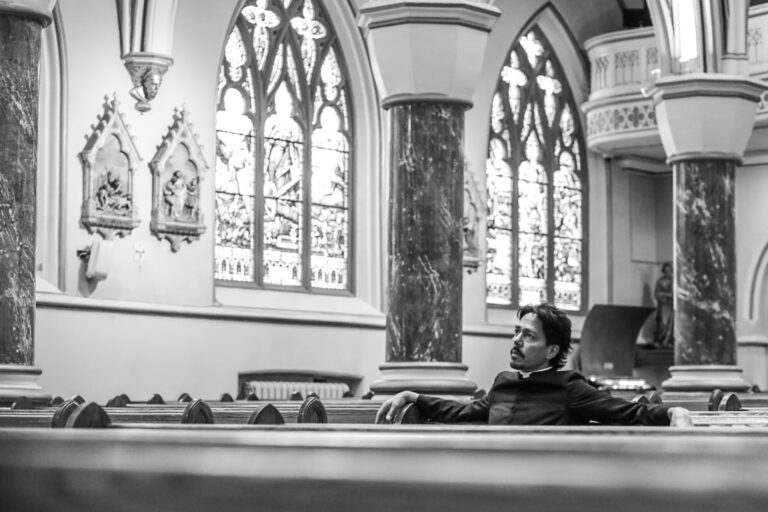
Deacon McLaughlin was ordained alongside 14 other men Dec. 8, finally answering the call to religious life. “I’m just the pawn of the Lord,” he said. “Everything just came together.”