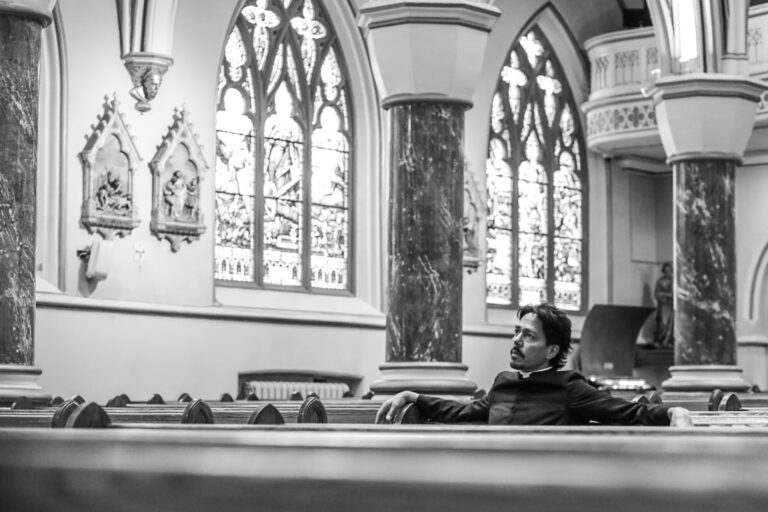
Philosopher Sam Rocha makes the case for beautiful evangelism
The B.C. Catholic
Artists make good evangelizers, says philosopher and musician Samuel Rocha.
For example, Pope John Paul II was a poet. Pope Emeritus Benedict XVI played the piano. Pope Francis loves Dostoevsky, Caravaggio, and Beethoven.
“When you think of the New Evangelization, we don’t often think of poetry,” Rocha said during a free public lecture titled, “God, Art, and the Way of Beauty,” at St. Mark’s College April 27.
“Why not? It was good enough for John Paul II, the guy who coined the term ‘the New Evangelization.’ It’s been good enough for countless mystics and writers.”
The Bible is full of parables, poetry, and a deep sense of eros that theology and dogma can’t describe, but art can, Rocha said. “Art can’t be absolutized or dogmatized. Art is in some sense a kind of eros.”
Pope Emeritus Benedict XVI “rehabilitated” eros by defining it not as merely the erotic, but the radically free and passionate. “There is a sense of passion that is not just erotic sex passion, but there’s another side of passion, I claim, that we really find in the face of death.”
Rocha said the retired Pope, when he was a cardinal, went so far as to use the phrase “the mad eros of the cross.”
Rocha rephrased it this way: “There is no Passion without passion.”
The love that led Jesus to the crucifixion was not just agape, a kind of love the philosopher described as that of a selfless and calculated good husband. Jesus’s love for His people is truly passionate as well.
“When we look at images, we can see that artists have this passionate imagination of the cross that, perhaps, the faithful don’t.”
The eros revealed in the crucifixion is truly beautiful. “Even the resurrection does not overcome the eros of the wounds of Christ,” Rocha said.
He pointed to Caravaggio’s “Incredulity of St. Thomas” on the chapel wall behind him. “This is the sign that Christ uses to confirm His resurrection. He doesn’t perform fireworks. He doesn’t fly. He says: ‘put your hand in My wounds.'”
This passionate imagination of artists such as Caravaggio and the Popes is what the Church in North America is lacking, he said.
“If we’re living and breathing apologetics, we are probably starving ourselves,” Rocha said.
“If you’re a musician, a poet, a writer, a dancer, a designer; if you cook, if you clean, whatever you do … we need Caravaggio and everything else.”
About 75 people attended Rocha’s lecture at St. Mark’s College. The event, part of a series of free events for students and the public, was streamed live on YouTube, and has been watched at least 100 times.
“Our lectures aim to engage the university, the archdiocese, and our whole community,” said Lynda Robitaille, the college’s dean.
“Through these public lectures, we hope that we can engage the community in talking about topics such as history, social justice, culture, and the arts; faith and science, sociology, and economics.”
She pointed out that Pope Francis wrote about having a passionate faith in Evangelii Gaudium: “To believe in and follow (Christ) is not only something right and true, but also something beautiful, capable of filling life with new splendour and profound joy, even in the midst of difficulties.”