Some historic cultural practices need change, archbishop says
By Deborah Gyapong
OTTAWA (CCN)
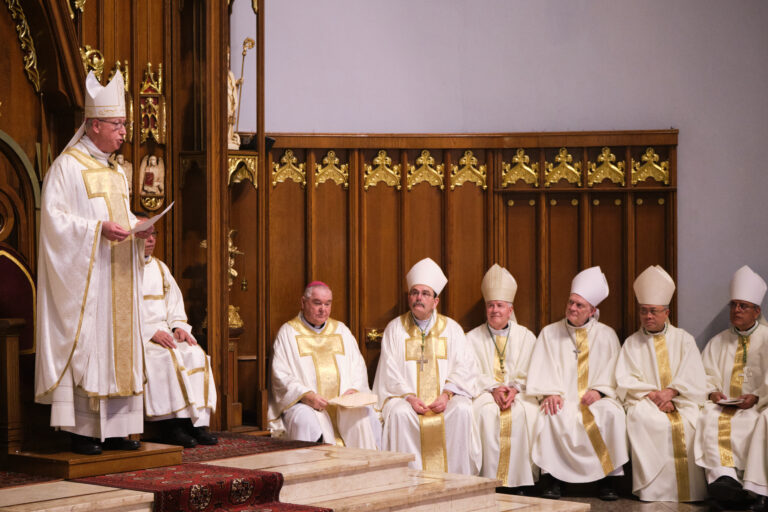
The Keewatin – The Pas archbishop says “some of the philosophies and cultural practices” that went into Canada’s founding did not make a “level playing field at all” for indigenous peoples.
Archbishop Murray Chatlain, who serves a diocese made up of 83 per cent First Nations and Metis peoples, said the issues raised by the Truth and Reconciliation Commission (TRC) and its Calls to Action have been high on their agenda for a long time.
Archbishop Chatlain said the response of Catholic groups the TRC’s Call to Action #48 March 29 on how their policies will line up with the 2007 United Nations Declaration on the Rights of Indigenous Peoples UNDRIP and a separate document repudiating the so-called “Doctrine of Discovery,” and Terra Nullius, that gave “first takers” or “discoverers” the right to seize land belonging to indigenous peoples put these issues “much higher on the agenda of the broader Catholic Church.”
“This is huge thing for us,” he said.
Archbishop Chatlain said he himself is grateful to know more about these doctrines as well as about the UNDRIP because of the research done by the CCCB’s Justice and Peace Commission. The CCCB, realizing it could not speak for all Catholic organizations, invited the other groups to sign on, he said. “I just hope more of our Church and Canadians in general educate themselves about these issues.”
The documents said the “central themes” of the UNDRIP already “resonate strongly” with statements made by the Catholic Church, either by the Holy See or the CCCB.
“These include the rights of indigenous peoples to self-determination, self-government, and to their own distinct institutions, the right to their traditional territories, the right to a fair process to adjudicate land claims, the right to their cultural traditions and customs, the right to practice and manifest their spiritual traditions and customs, the right to maintain their languages, the right to their own educational institutions, the right to improvement of their economic and social conditions, the right to guide their own development, and the right to the recognition and enforcement of treaties,” they said.
Regarding the right of indigenous peoples to their own spiritual practices, the report noted “the failure to uphold this right is a theme found throughout the TRC’s final report.”
“While the Catholic Church proclaims Jesus Christ, ‘the way, the truth, and the life (John 14:6), she also has a long, but scarcely known, history of forbidding religious coercion,” the response said. “Unfortunately, this teaching has not always been lived out by some of the Church’s own members, including clergy who had significant influence on the faithful.”
Though there were historical instances of forced baptisms, in 1537 Pope Paul III declared evangelization of indigenous peoples “should only take place ‘by preaching the word of God and by the example of good and holy living,'” the response said.
The response then brought up the abuses of the Indian Residential Schools outlined in the TRC’s exhaustive final report. “Although many priests, brothers, sisters, and lay people served in the residential schools with generosity, faithfulness, care, and respect for their students, this was not always the case,” the Catholic organizations said. “The TRC Final Report rightly observes that when Christians, through the residential schools, belittled indigenous students as ‘pagans,’ or ‘demonized, punished, and terrorized them into accepting Christian beliefs,’ this was in fundamental contradiction to the core beliefs of Christianity.”
“While Christians have at times failed to live up to the standard to which they are called by God, the glaring failures to respect the identity and freedom of indigenous children outlined in the TRC Final Report are particularly saddening and must never be repeated.”
“I think brought to our attention and made us hear stories we didn’t truly want to hear yet needed to hear,” Archbishop Chatlain said. This “forced us to come to terms with some of the darker parts of our history.
Our history has many parts and levels to it, many positive,” he said. “All have been brought to the light in lots of ways.”
The documents also outline several steps to guide their organizations and inspire all Catholics to right past wrongs by a “practical commitment to heal enduring injustices.”
These include efforts to make sure Catholic institutions tell a truthful history of the encounter with indigenous peoples, such as the effects of the residential school system, and the impact of ignoring or undermining treaties. The steps also include: making interaction with indigenous communities part of ecumenical and interreligious dialogue; acting to improve holistic health services; promoting a restorative justice model to combat the high incarceration rate of these communities; supporting the national enquiry into missing and murdered indigenous women; helping indigenous communities build educational programs to promote their culture and experience; and for the bishops and other Catholic faith leaders to invite lay Catholics to become reflect on the UNDRIP so it might be supported and implemented.
Archbishop Chatlain said the challenge is to “put into effect some of these clear goals.”
“It’s important for the documents to have clear goals and directions, but that is not easy,” he said. “It’s going to take time. I just pray we take genuine efforts in all of our dioceses to move forward in a positive way.”