
Catholic Cemeteries Director Peter Nobes is speaking out about an emerging burial methods called “teramation,” a form of human composting that is gaining legal traction in the U.S.
Teramation is currently legal in eight U.S. states and under consideration in Canada, which is why Nobes is drawing attention to the conflict such methods pose with Catholic values and practices.
As an alternative to traditional burial and cremation, composting lacks the reverence the Catholic Church requires for the deceased, said Nobes, who raised the issue at a recent Catholic Cemeteries Advisory Board meeting. Catholics need to be made aware of efforts by secular interests to legalize human composting in British Columbia, he said.
“Given that we are seeing pressure to legalize human composting in B.C., it’s imperative that we inform and engage our Catholic community,” Nobes told The B.C. Catholic. The topic is expected to come up at the B.C. bishops’ November meeting.
Pro-composting speakers have already been promoting the practice in B.C. At the April 2023 meeting of the BC Funeral Association, pro-composting speakers pitched “terramation” as the future of death care. “They’re seeking to influence regulators and win over public opinion, and we have to counteract this,” said Nobes.
The U.S. bishops’ doctrine committee recently reaffirmed the Church’s preference for traditional burial over newer methods such as alkaline hydrolysis and human composting, which they said do not respect the sanctity of the human body, an essential belief in Catholic doctrine.
The committee pointed out that Catholics are obliged to respect human bodies both in life and in death, aligning with traditional burial practices.
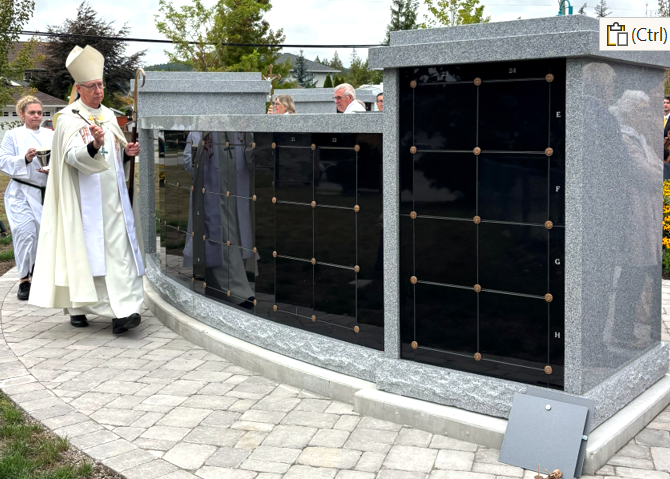
Although Catholic Cemeteries cannot inter composted remains, it might be able to offer an acceptable solution in response to the growing trend, Nobes said. One possibility is the creation of a natural burial area in the Gardens of Gethsemani. “Here, we can offer those interested in more sustainable practices a burial option that aligns with our faith” he said but has a lower impact on the environment,” such as using a shroud or basic burial without embalming or liner.
Nobes is offering Life Without End workshops in parishes aimed at correcting misunderstandings around end-of-life practices from a Catholic perspective. “God offers us eternal life, hope and light,” said Nobes. “And his Church offers a positive vision for the end of life through Christ’s Resurrection, the sacraments, Tradition, and localized support.
“If we don’t form people on Christian end-of-life issues, our community forms their opinion from secular sources, which often run counter to our teachings,” Nobes said.
He is acutely aware of the challenges facing the Catholic community. “I suspect it’ll become legal at some point, but that underscores the importance of proper formation of the community regarding end-of-life services,” said Nobes, who regularly sees the results of poor formation, such as parishioners who keep urns at home or consider scattering ashes — both practices at odds with Catholic teaching.
The practice of human composting—technically known as natural organic reduction—along with alkaline hydrolysis, is becoming increasingly popular in the U.S. In these methods, human remains are broken down either through accelerated decomposition or chemical processes, often leaving nothing to be laid to rest in a sacred space.
The U.S. bishops’ statement reiterated the Church’s preference for burial of the deceased and said alkaline hydrolysis and human composting do not show respect for the human body.
The Catholic Church teaches that at the final resurrection the souls of the dead will be reunited with their bodies. Catholics are “obliged to respect our bodily existence throughout our lives and to respect the bodies of the deceased when their earthly lives have come to an end. The way that we treat the bodies of our beloved dead must always bear witness to our faith in and our hope for what God has promised us,” the bishops wrote.
A traditional burial is “considered by the Church to be the most appropriate way of manifesting reverence and respect for the body of the deceased because it ‘honours the children of God, who are temples of the Holy Spirit,’ and clearly expresses our faith and hope in the resurrection of the body,” said the bishops.
Although the practices of cremation, human composting, and alkaline hydrolysis all involve the acceleration of the decomposition of the body, the latter two do not allow for all parts of the body to be “gathered together and reserved for disposition,” the bishops noted.
“There is nothing distinguishably left of the body to be placed in a casket or an urn and laid to rest in a sacred place where Christian faithful can visit for prayer and remembrance,” the bishops said.
The Catholic Church as a whole does not have an official teaching on the composting of human bodies but has weighed in many times over the years on the practice of cremation. While strongly discouraged, cremation can be permissible under certain restrictions; notably, the remains are not to be scattered and must be kept in a sacred place out of reverence for the Church’s teaching on the eventual resurrection of the body.
Bishops in states such as Texas, Missouri, and New York have expressed opposition in recent years to the legalization of alkaline hydrolysis.
With Catholic News Agency files