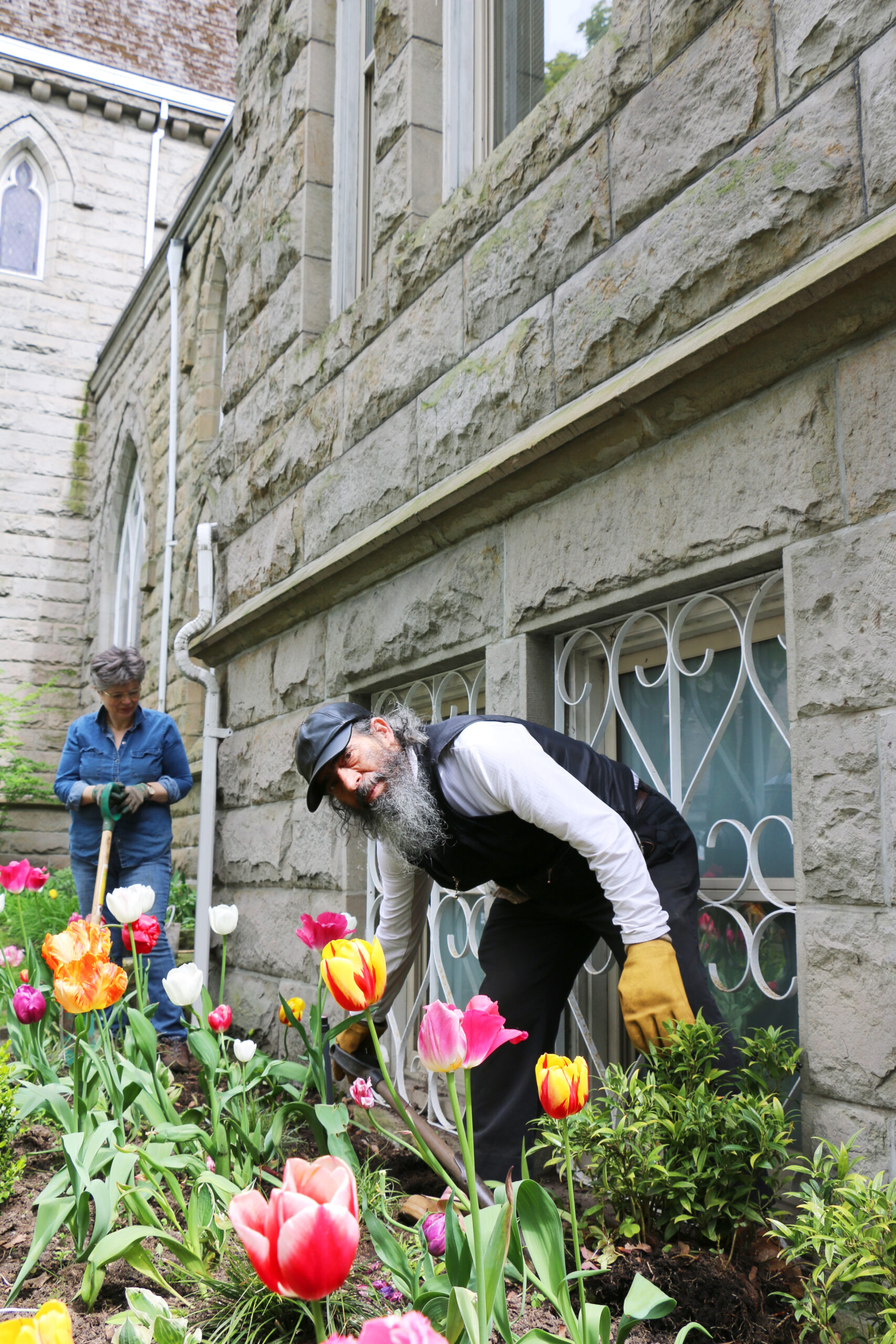

A gardener
at Holy Rosary Cathedral sports a cap and gloves as he carefully works the soil
around blooming tulips under the church’s towering spires.
There is more to Luis Velasquez than meets the eye; this volunteer gardener is a political refugee from El Salvador, a chemist, and he’s homeless.
“It’s hard. They don’t recognize work experience from El Salvador or education from El Salvador,” said Velasquez, 65, who fled his country during a civil war in the 1980s.
Archbishop Oscar Romero, a voice for human rights and a hero to Velasquez and many Salvadorans, was assassinated in San Salvador while celebrating Mass in 1980. As the civil war escalated, shots began to ring out even on the university campus where Velasquez was one semester away from finishing his chemistry degree.
Speaking up against unjust social structures cost some their lives. “The oppressed, the marginalized, the excluded, had a voice [in Archbishop Romero]. We, the Church, had a voice. That is the message that got him killed. Just three years as archbishop.”
Velasquez could not keep silent. “In a country when something’s wrong, the students are the first ones to complain: ‘This is wrong. We need more hospitals. We need more teachers, more hospital beds, more schools,’” he said.
“That makes you a dissident. You are not comfortable with the situation. You must be quiet. You can say nothing.” So what did Velasquez do? “Ask for more teachers, more doctors, more hospitals,” he said with a grin.
“The answer of the government was repression. If they could not get the person they were going for, they would go after the family.”
So, to protect his parents and nine siblings, Velasquez decided to disappear. He first landed in St. Boniface in Winnipeg more than 30 years ago, then made his way to Vancouver. Now, at 65 years old and with some chemistry studies and a few years of lab work in El Salvador under his belt, Velasquez is homeless and tending to weeds.
He’s not alone. According to Scott Small of Catholic Charities Shelter Services, the majority of guests sleeping at his men’s hostel a few blocks away from the cathedral are over 60 years old.
It’s hard for Velazquez to find a job. His degree is not recognized and, besides, “who will give access to radioactive material to a political refugee?”
An old workplace injury also left serious damage to his left hand that makes it difficult to do certain tasks. Under a work glove among flowering plants, though, it’s nearly impossible to tell.
“Gardening is beautiful. I’m close to nature,” said Velasquez, who has been volunteering in the cathedral garden for nearly three years. He’s something of an expert in the field, having learned how to tend to various flowers and fruit trees from his grandfather back in El Salvador.
Gardener Sarah Parry said he’s a vital part of the outdoor operation at the downtown cathedral. “It’s fair to say that I couldn’t do what I do without Luis.”
Other homeless men sometimes volunteer to help with small tasks in the garden, but Velasquez is the most reliable and skilled, coming in once a week to help make the area beautiful.
“Often when I’m gardening I interact with passersby, and sometimes those who are homeless help make suggestions. I let them. That’s part of it, from my perspective, to be that face of Catholicism and have conversations with people, especially the poor.”
Velasquez is “really productive and really humble. He does it for love,” Parry added.
When he’s not at the cathedral gardens, the political refugee can be found volunteering at the
Gathering Place Community Centre or the UBC Learning Exchange. He also sings as a tenor in two community choirs.
He’s still very interested in human rights and is happy the cathedral recently installed a statue of Homeless Jesus, a cloaked figure with pierced feet who lies on a bench on its front steps.
“When I see the sculpture, I think about the Vancouver Church. It is listening to the cries of the excluded and marginalized,” he said. “What caused those cries? Is the Church going to recognize the social destruction and marginalization?”
Velasquez stays positive as he pulls weeds, re-plants shrubbery, and re-arranges stones in the cathedral garden. For him, it feels a bit like home.
“It’s beautiful here. I tell my friends: ‘That’s my garden.’”