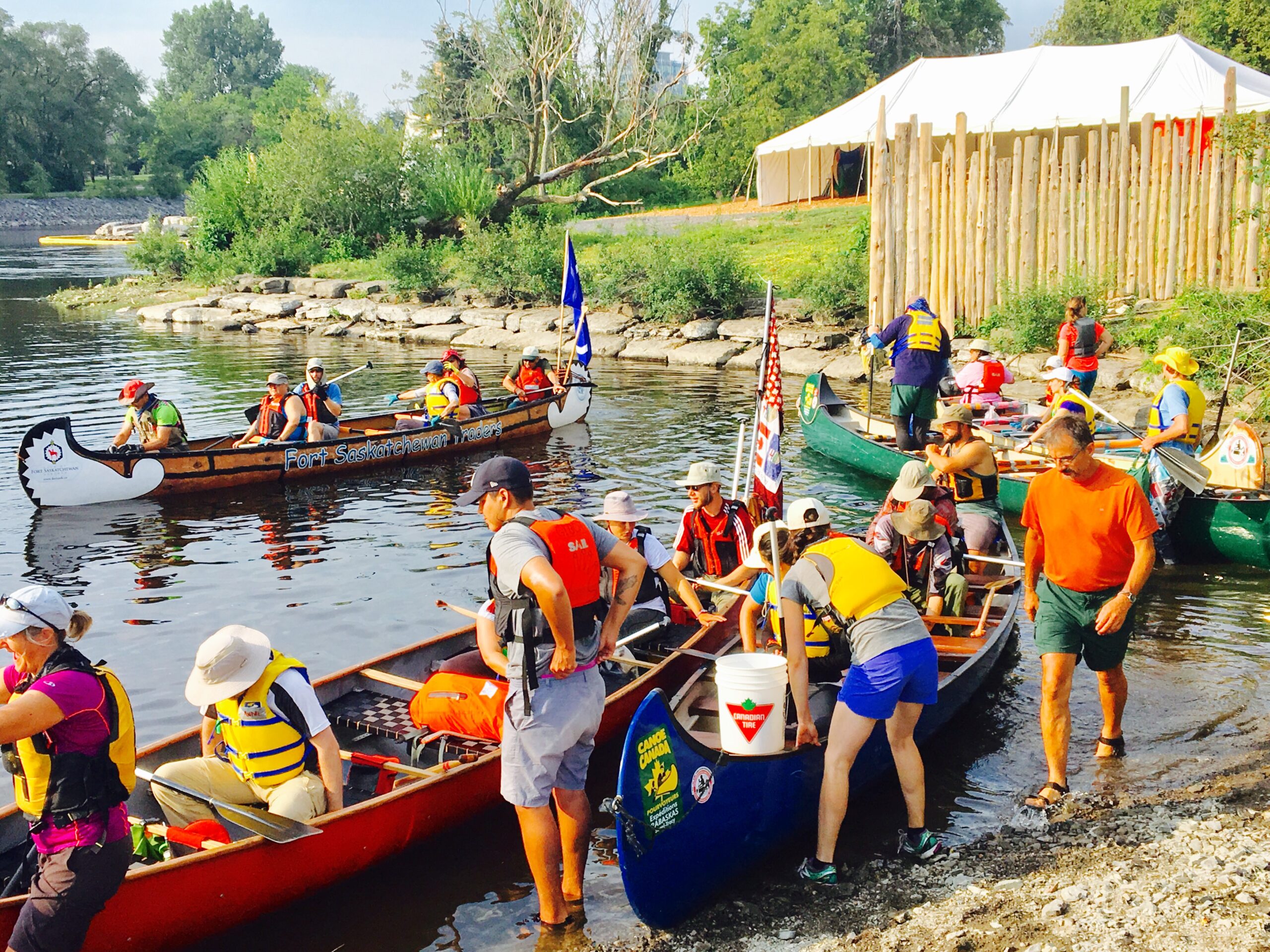

OTTAWA (CCN)—Jesuit scholastics who took part in the Canadian Canoe Pilgrimage July 21-August 15 say it fulfilled all their expectations and more.
“One of my biggest hopes for the pilgrimage was a sense of deep connection between the paddlers,” said Erik Sorenson. “That was there in spades in the end.”
Paddling together and enduring unexpected challenges helped the diverse group of about 50 paddlers– Jesuits, Indigenous people, religious, lay men and women engage in “deep relationships” and form “bonds that will last a lifetime,” he said. “What was unexpected was the sincerity and the depths we were able to go in the month. I knew there was going to be sharing and great participation but this went even farther than I thought it was ever going to be.”
Kevin Kelly agreed. “I would love to be doing this kind of work around Indigenous and non-Indigenous relations through pilgrimage. There’s something about the vulnerably of people on pilgrimage.”
You’re not in a place of security where you can kind of sit back and analyze and judge.
“When you are in a space where you are learning about yourself and with others in a similar space, there’s an ease in learning about the others,” Kelly said. “You’re not in a place of security where you can kind of sit back and analyze and judge.”
Instead “you’re in a place of vulnerability, where you’re struggling– and we all did– and you see them struggling. It really helps us understand how similar we are even when we come from very different places,” Kelly said. “It really does help you put yourself in the other person’s shoes.”
Sorenson said that while he had a good intellectual understanding of the history of the residential schools, and the impact of those schools on Indigenous peoples, listening to some of the fellow paddlers share about generational trauma took his understanding to a new level.
“To have someone whose mother was impacted, whose family is still working through impacts of residential schools, to hear how their own lives have been about healing from those experiences, it was really moving,” Sorenson said. “It’ not something out of a text book but someone with a name and a face, a person that I care about deeply now and am connected with.”
Both Kelly and Sorenson worked on logistics for the pilgrimage that began in Midland, Ontario on Lake Huron and ended in Montreal. That meant organizing the outreach in communities —the parishes, the First Nations, the religious communities—that welcomed the paddlers and provided food and a place to rest. Kelly said the outreach “exceeded all expectations,” and the communities were “unbelievably welcoming and incredibly hospitable.”

Sometimes things didn’t go as planned, or the arrival point proved especially challenging, so the pair might have to take a day off from paddling or ensure needs were met in the moment.
“You learn a lot about trust in those moments,” said Kelly. Many communities did not realize how much food 40-50 paddlers would need each day. “By the skin of their teeth, they would make enough food.” On other days, the two had to figure out where they could get more food, or how the available food could be stretched for paddlers expending thousands of calories a day, he said.
There were complicated scenarios every day, and every day they kind of worked out in the end, Kelly said. It took about two thirds of the trip before they trusted things would work out each day.
“Coming to that sense of trust was really important,” Kelly said.
As for the physical challenges, Sorenson said the pilgrimage was “definitely tougher” than they had thought it would be. Not only was paddling all day extremely demanding physically, Sorenson found being constantly wet on some days a trial.
“It would rain, everything would be wet, your gear wet, your clothes wet and nothing would dry for a couple of days,” he said. They would pray for sunshine. “Putting on wet socks in the morning is not a pleasant experience.”
“The weather is always a big one,” said Sorenson. “We were really blessed with really good weather; we had rainy and stormy days.”
One day, after a glance at the weather, they thought it was safe to depart, but after a couple of hours, the wind picked up, whipping up waves and the paddlers had to take cover, and wait it out, Sorenson said. “You realize how powerless you are when you are out in nature like that, how attuned and attentive you have to be to nature to be in harmony with it.”
Sorenson and Kelly have known each other for five years. They started out as Jesuit novices together.
Four years ago, they walked the famous Camino through France and Spain, and that experience provided the impetus for planning the canoe pilgrimage.
Sorenson returns to Regis College in Toronto to complete one more year studying philosophy. Kelly, who has been working on a special project in Montreal, will be back at Regis College in a year.
Though Sorenson doesn’t think he’ll do a 26 day canoe pilgrimage again, but doing pilgrimages has become part of his personal spirituality. He said he’d like to share this experience with others, but on pilgrimages of four or five days.