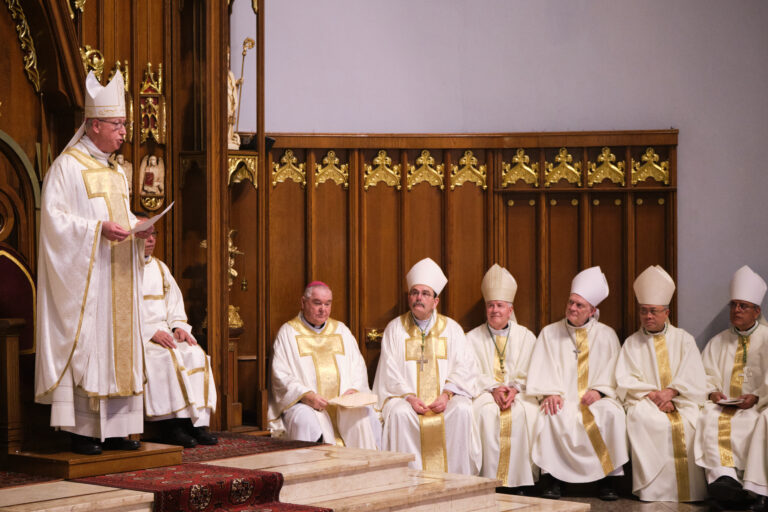
CCCB president Bishop Douglas Crosby of Hamilton will chair the week-long session
OTTAWA (CCN)
Cardinal Willem Eijk of Utrecht, a moral theologian, ethicist, and physician, will address the Canadian Catholic bishops’ plenary meeting Sept. 26 to talk about Holland’s experience with euthanasia.
The Canadian Conference of Catholic Bishops’ annual plenary Sept. 26-30 in Cornwall, Ont., will devote attention to the impact of Bill C-14 that legalized euthanasia and assisted suicide in Canada, said CCCB communications director Rene Laprise.
Another timely topic on the agenda is a discussion of the Truth and Reconciliation Commissions Calls to Action that specifically targeted churches and faith-based organizations. The bishops will look at the commitments made by Catholic parties to show how they plan to bring their policies in line with the 2007 United Nations Declaration on the Rights of Indigenous Peoples (UNDRIP); and on the repudiation of the so-called “Doctrine of Discovery” and Terra Nullius that gave “discoverers” or “first takers” the right to seize lands they said were empty, but belonged to Indigenous peoples.
The Calls to Action also asked Pope Francis come to Canada to apologize for Indian Residential Schools.
When Catholic entities and bishops responded to the Calls to Action last March, they pointed out Catholic policies are already in line with the UNDRIP regarding Indigenous Peoples’ rights to self-determination, self-government, their own institutions, and their rights to their cultural traditions and customs, including spiritual beliefs.
At the plenary, the bishops will also hear an update on the transition of six former missionary dioceses under the Congregation for Evangelization of Peoples to the common jurisdiction of the Catholic Church. Pope Francis decreed last January the northern dioceses of Whitehorse; Mackenzie-Fort Smith; Churchill-Hudson Bay; Moosonee; Grouard-McLennan; and Keewatin-Le Pas will now fall under the Congregation for Bishops as other dioceses do.
These dioceses with large territories that serve many Indigenous communities will now rely more heavily on other Canadians dioceses to support their parishes and missions. The bishops’ plenary will hear about the continuing outreach and reconciliation work being done with Canada’s Indigenous peoples.
The bishops will also discuss the 500th anniversary of the Protestant Reformation in a workshop led by the CCCB’s Episcopal Commission for Christian Unity, Relations with the Jews and Interfaith Dialogue. To mark this anniversary, Pope Francis will head for Sweden on October for an ecumenical commemoration of the Reformation.
The approximately 90 bishops and eparchs from across Canada will also hear from Father Michael Czerny, SJ, who worked for the Pontifical Council for Justice and Peace that Pope Francis has just been folded into a new Vatican department or dicastery for Promoting Human Development.
Father Czerny, a Canadian Jesuit, will speak on the Holy Father’s environmental encyclical Laudato Si’ in a workshop led by the Episcopal Commission on Justice and Peace.
Cardinal Thomas Collins of Toronto and Cardinal Gerald LaCroix of Quebec will lead a reflection on Pope Francis’s post-synod Apostolic Exhortation Amoris Laetitia.
CCCB president Bishop Douglas Crosby of Hamilton will chair the week-long session that includes reports from a range of Catholic organizations, from the Catholic Organization for Life and Family to the Canadian Catholic Organization for Development and Peace, which is in the process of seeking a new executive director and preparing to mark its 50th anniversary in 2017. The bishops will hear reports on the ongoing crisis in the Middle East and on the settlement of Syrian refugees in Canada.
The bishops will also hear reports on last July’s World Youth Day in Poland and January’s International Eucharistic Congress in Cebu, Philippines.
Canadian Catholic television network Salt + Light TV will broadcast the CCCB president’s annual report as well as the daily liturgical celebrations and news conferences as it has for the past four years.
In addition to the bishops, the first day and a half of the plenary welcomes about 20 invited observers from other faiths and organizations, and accredited media representatives.