Euthanasia Prevention Coalition helps explain Catholic position on physician-assisted death legislation
The Catholic Register
TORONTO (CCN)
Catholic bishops, pro-lifers, and doctors all know they’re not going to get what they want out of a court-mandated law regulating doctor-assisted suicide likely to be introduced this month, so they’re trying to limit the damage.
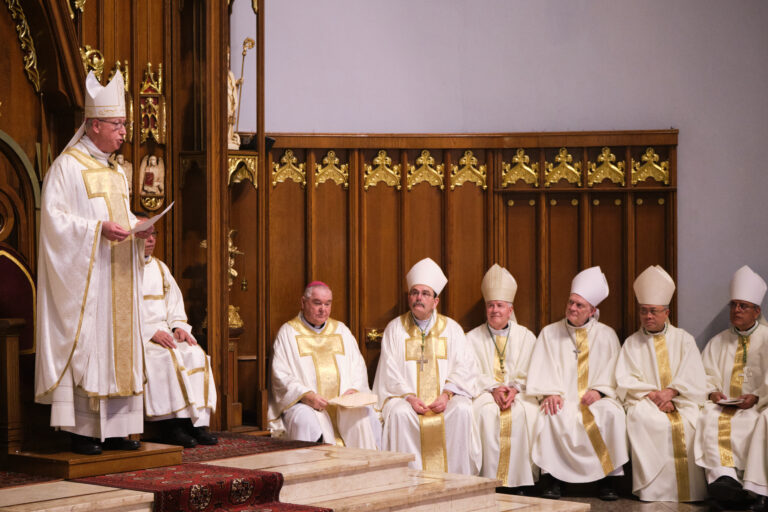
“We are trying roads of advocacy,” Bishop William McGrattan of Peterborough told an audience of more than 100 at Toronto’s University of St. Michael’s College March 30. “Elected officials are reaching out to me. I take that as a good sign.”
Bishop McGrattan represents the Church on the governing council of the Catholic Health Alliance of Canada, the national lobbying organization for Catholic hospitals, nursing homes, and hospices. The bishop, a moral theologian, teamed up with Alex Schadenberg, the executive director of the Euthanasia Prevention Coalition, to outline the Catholic position on physician-assisted death legislation which the Supreme Court of Canada says must be in place by June 6.
Assisted suicide “can’t take place in a Catholic facility,” said Bishop McGrattan, but he is realistic about opposition to the Catholic position. “I would guarantee there will be a test case,” he said.
The Catholic Health Alliance and the Canadian Conference of Catholic Bishops are lobbying hard to have the government recognize the conscience rights of doctors and health-care institutions. These rights include not referring a patient to another doctor or hospital for the sole purpose of receiving a lethal dose.
Even if the government can be persuaded to enshrine conscience rights in the law, said the bishop, a challenge can be expected.
Audience member Dr. Adam Krajewski didn’t like the political control over his conscience rights. “We’re at the beginning of a big problem,” he said. “As a physician, I am very unhappy that I may be facing this situation. It’s going to be tough.”
In addition to conscience rights for doctors and Catholic health-care institutions, Schadenberg and the Euthanasia Prevention Coalition are putting the threat to the poor, the weak, the lonely and other vulnerable populations front and centre. Schadenberg distributed postcards at the end of his talk asking the House of Commons to “reject lethal injection of people with dementia, and minors.”
“Obviously I’m not competent if I have dementia,” Schadenberg said.
Dementia patients are not necessarily unhappy, he pointed out, asking if doctors will kill happy dementia patients because of an advance directive they signed years before. “You’re not giving him a chance to change his mind.”
There can be no objective definition or measurement of psychological suffering: “I cannot look into your brains to know what’s going on,” he said.
It is the poor and the marginal who are most likely to reach for an option of death when they’ve never had any meaningful choice in their lives.
“There are a lot of people in our culture who are socially and culturally abandoned,” Schadenberg said. “When you introduce euthanasia into the culture, then somebody who is alone and lonely, who just needs a reason to live, they get euthanasia.”