
Archbishop Richard Smith offered introductory remarks at the start of Mass:
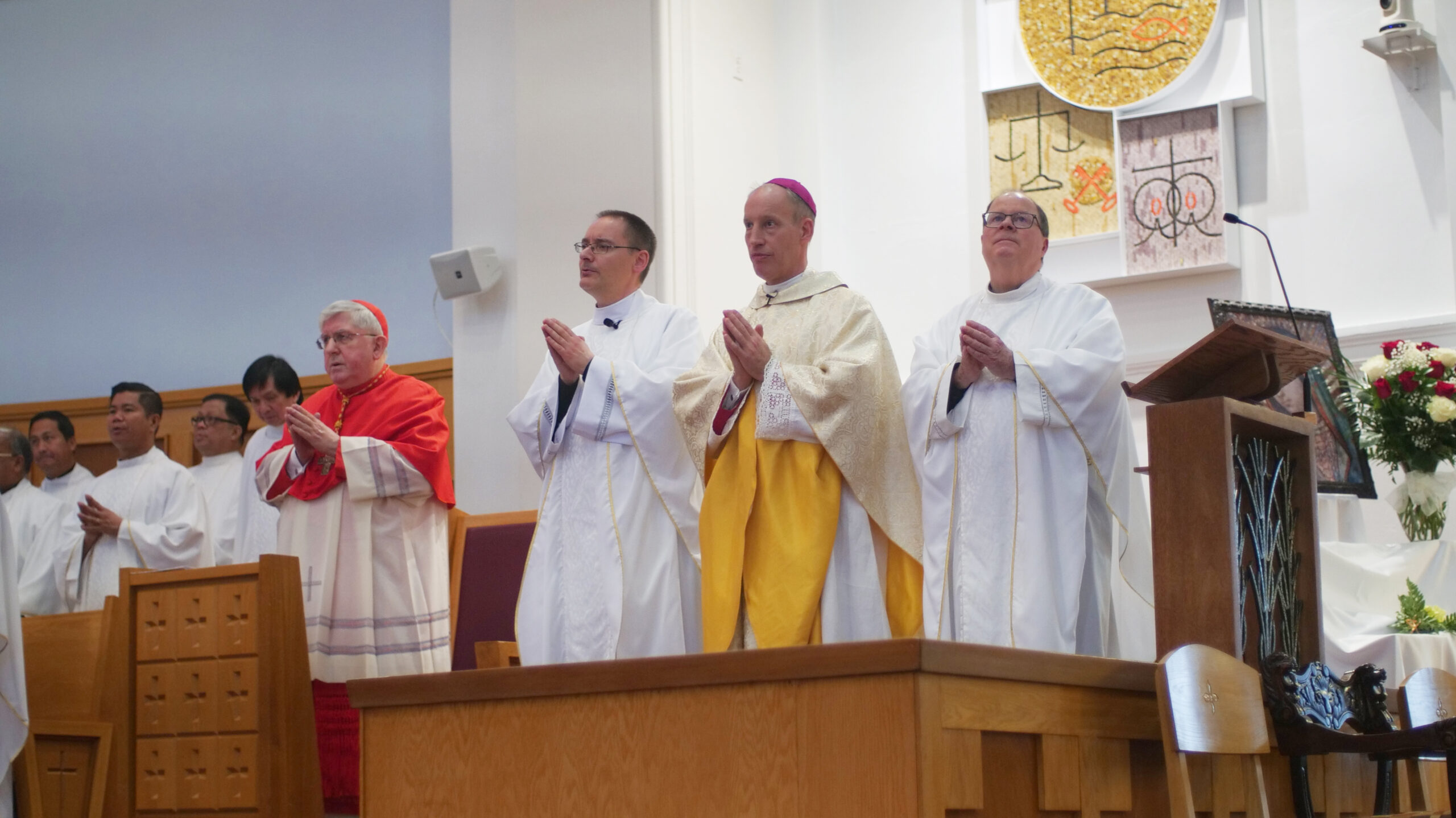
With what great joy do the people of God here in the Diocese of St. Paul gather as we welcome a new shepherd for the people of God, Bishop-elect Gary Franken. We are delighted to surround you today with our prayers first of all and the pledge of our support.
I am happy to welcome in a particular way my brother bishops that are gathered, and especially His Eminence Thomas Cardinal Collins, the Archbishop of Toronto and a former Bishop of St. Paul; his Excellency Archbishop Ivan Jurkovic, who is the Apostolic Nuncio here in Canada; the two co-consecrating bishops, Archbishop Michael Miller of the Archdiocese of Vancouver, former ordinary to Bishop Gary, and of course now Bishop-emeritus Paul Terrio who 10 years ago today was ordained Bishop for St. Paul and since that time has served this diocese so extraordinarily well with beautiful pastoral care.
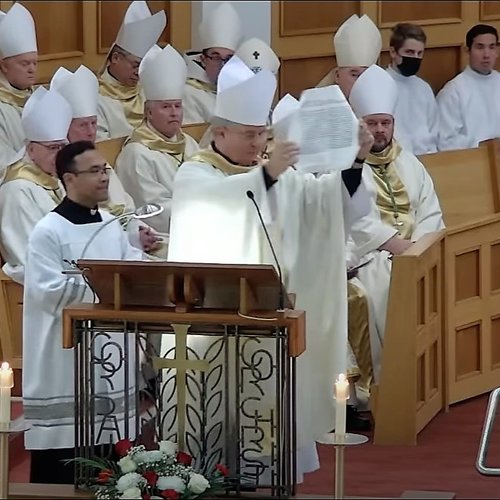
Canada’s Apostolic Nuncio, Archbishop Ivan Jurkovic, read the Papal Bull proclaiming Bishop Gary Franken’s mandate:
FRANCIS, Bishop, Servant of the Servants of God
To our beloved son Gary Anthony Franken, of the clergy of the Archdiocese of Vancouver, and therein until now Vicar General, and Pastor of the parish dedicated to St. Anthony, now appointed Bishop of St. Paul in Alberta, good health and Blessing. We hold in Our heart and mind the words of John the Apostle and Evangelist: “this is his commandment, that we believe in the name of his son Jesus Christ, and that we love one another, as he has commanded us” (1 Jn 3:23). Hence comes our solicitude, that we heartily proclaim to each of the faithful the saving and joyful paschal event. Thus, desirous that this mission should never fall short in the Church, we appoint Bishops to carry out this work with us. Now, since the community of St. Paul in Alberta has been left bereft of its Bishop on account of the resignation of our Venerable Brother Paul Terrio, we determine to assign to it a new Moderator for things of the Spirit. Since you, beloved brother, are endowed with the necessary priestly qualities, prudence, sound teaching, and expertise in administration, we have decided to entrust to you this very important ministry. So, having heard the advice of the Dicastery for Bishops, having given the matter due consideration, we appoint you and constitute you Bishop of St. Paul in Alberta, giving you all the necessary rights and imposing all the appropriate obligations, according to the norms of the Code of Canon Law. For what concerns your episcopal ordination, we gladly grant that you receive it away from Rome, from a Catholic Bishop, according to the liturgical norms; you must beforehand formally make your profession of faith and give your oath of fidelity to Us and to Our Successors. Finally, beloved Son, we urge you, that daily ardently committing yourself and your faithful to the intercession of the Blessed Virgin Mary, you strive to bring everyone to faith in the Son of God and obedience to the Lord’s commandments.
Given at Rome, at the Lateran, on the fifteenth day of the month of September, in the year of the Lord two thousand and twenty two, the tenth year of Our Pontificate.
Francis
Homily of Cardinal Thomas Collins
Very early in the morning of June 22, 1535, long before dawn, the warden of the Tower of London entered the cell of a prisoner, woke him up, and told him that the king, King Henry VIII, had decreed that he would be beheaded that morning. The prisoner, John Fisher, Bishop of Rochester, asked at what hour the execution would take place, and when told that it would be at 10 a.m., he requested that he be awakened in time, and then he rolled over and went back to sleep.
Now there was a man with a clear conscience. He had been faithful in fulfilling the sacred office that he had had been entrusted to him many years before at his ordination as a bishop. He was being executed because he had protested the King’s decision to reject his faithful wife and to use his power to seek to destroy the sacred bond of holy matrimony.
Earlier, Bishop Fisher had written brilliantly against the trendy ideology that was coming out of Germany at that time and was sweeping through the universities of Europe, dazzling the professorial, the cultural, and the political elite, and beginning to take hold throughout society.
Then as now the ever-shifting spirit of the age, the zeitgeist as it’s called in German, was blowing against the Gospel of our Lord Jesus Christ, which was found to be too constricting and out of touch with the demands of the times. The king did not want the objective – an unchanging law of God – to challenge him to conversion or to put limits to his subjective and fickle will.
Bishop Fisher, bishop of the smallest diocese in England, was the only bishop to resist the will of the King, as his friend Thomas More was the only politician.
Bishop John Fisher was not only faithful in the moment of his martyrdom, he founded his whole episcopal vocation on fidelity to the Lord and on a simple life of prayer, study, and pastoral action. He provided hospitality for guests but lived very austerely himself. He spent hours at prayer in his chapel and hours of study in his library and he kept a skull on his desk to remind him of the shortness of life. As the Psalmist says, “Lord teach me the shortness of life that I may gain wisdom of heart.” Such a man could not be bribed and he could not be bullied.
Knowing the abysmal state of preaching in England, he set up a program of homiletics at the University of Cambridge where he was the chancellor. He himself constantly preached to the people entrusted to his episcopal care. His diocese was on the Pilgrim Road to Canterbury and he imitated the pastoral zeal which Chaucer describes in the Parson of the prologue to the Canterbury Tales. He was a shepherd and not a mercenary.
He would visit the faithful throughout his diocese teaching them the good news and caring for them in their poverty and in their suffering. He had been anointed as priest and prophet and entrusted with the shepherd’s staff at his ordination, and he fulfilled in his whole episcopal life the words of Isaiah from today’s First Reading which Jesus himself, the Good Shepherd, our great high priest, read out in the synagogue of Nazareth as the program for his mission amongst us: The Spirit of the Lord God is upon me because the Lord has anointed me; he has sent me to bring good news to the oppressed, to bind up the broken-hearted, to proclaim liberty to the captives, and release to the prisoners, to proclaim the year of the Lord’s favour.
No wonder Bishop Fisher’s parishioners shed tears and crowded around him when he was taken away from them to the Tower of London. As Chaucer said of the Parson in the Canterbury Tales, “Christ’s teaching, and his apostles twelve, he taught, but first he followed it himself.”
Several years ago I was at the installation of a new bishop. He looked at all of us bishops who were presented, resplendent in miters and pectoral crosses and episcopal rings, and he challenged us. He said that we all looked like bishops but what was important was that we be bishops and act as true bishops. Like the great bishop saints such as John Fisher, Ambrose, Augustine, Charles Borromeo – who had a portrait of John Fisher on his desk – and Francis de Sales who brought people to Christ through the irresistible combination of clarity and charity, we who are ordained to the episcopate need not just to look like bishops but to be bishops, through and through, faithful and true. As the prayer says when the episcopal ring is received, “receive the ring, the seal of fidelity, and adorned with undefiled faith preserve unblemished the Bride of God, the Holy Church.”
And at the bestowal of the crozier, “receive the crozier, the sign of pastoral office, and keep watch over the whole flock in which the Holy Spirit has placed you as bishop to govern the Church of God.”
The external active pastoral ministry symbolized by the pastoral staff must not be mere ecclesial busyness, but it must arise out of a life of prayer. Like all Christians, bishops are called to nothing less than holiness. The prayer on receiving the mitre refers to this, as do the accounts of the life of deep prayer of the bishop saints: “receive the mitre and let the splendour of holiness shine in you so that when the Chief Shepherd appears you may merit to receive an unfading crown of glory.”
The primary mission of the bishop is to proclaim faithfully the Word of God in preaching and in action and in personal example. In a most significant ritual at an episcopal ordination the Book of the Gospels is held over the head of the new bishop at the prayer of episcopal consecration. Someone once observed that it looks like the roof of a house – the house of the Gospel – which is the true home of the bishop from which he goes forth to preach the Good News and to which he daily returns to receive the strength to be fruitful in his mission.
As another great bishop, Bishop Sheen, recommended, every day spend an hour of adoration before our Lord in the Blessed Sacrament immersed in the prayerful reading of the Word of God. That life of prayer is the spiritual foundation in which the vision of faith is received and in which the hope rooted in the Providence of God is nourished amid all the troubles of life, but that faith and hope must bear fruit in practical love. Today’s Gospel is that of the Visitation. The Annunciation, the life of prayerful encounter with God in which Mary received her mission, led to the practical charity of the Visitation as she set out to help Elizabeth. Practical love in action is the essential fruit both of Christian life and of episcopal ministry.
At roughly the same time that the holy Bishop John Fisher was martyred in England, Our Lady of Guadalupe appeared in Mexico to St. Juan Diego. She appeared in 1531 and he was martyred in 1535 – on different sides of the Atlantic the two great saints.
The mystic image that she left on his cloak is a sign of her care for those Isaiah speaks of, the poor and the marginalized, and also of the cosmic struggle which with evil revealed in the readings from the Apocalypse at today’s Mass: the woman clothed with the sun is Mary the mother of God, bringing forth Jesus into a hostile world. But she is also the mother of the Church, our mother the Church, which is always called to bring forth Jesus into a world in which the power of the great dragon will seem dominant until the second coming of Christ. In this chapter of the Apocalypse, just after the passage read today, we see the great battle in which Michael defeats the power of Satan, the seemingly invincible dragon in the society and culture of the time of Juan Diego, and in that of John Fisher, and in our own society and culture. The forces of evil were and are resilient and are for the moment powerful. They seem irresistible. In the battle against them we all must rely not on mere human action alone, not on our own strength which is too weak for the task, but on the grace of God and the intercession of Our Lady and of the saints, especially St. Michael. In view of the cosmic nature of the powers underlying the evils which we face in our own time, as John Fisher and Juan Diego did in their time, in some places after Mass is finished people pray the apocalyptic prayer to St. Michael.
“St. Michael the Archangel, defend us in battle, be our protection against the wickedness and snares of the devil. May God rebuke him we humbly pray, and do thou our Prince of the heavenly host by the power of God thrust into hell Satan and all the evil spirits who prowl about the world seeking the ruin of souls.”
In St. Juan Diego we see one of the many saintly indigenous Catholics who have been at the foundation of the life of the Church for centuries. I remember when I was bishop of St. Paul what a great source of spiritual strength there was and there is in the Kehewin pilgrimage, as also the one at Lac St. Anne. It is certainly the commitment of the Holy Father and of the bishops of Canada to work together with the Indigenous peoples of this land as we journey forward, and in a particular way we must all recognize and celebrate the vital role of the Indigenous Catholic spiritual tradition in our life in Christ.
The sacraments of spiritual consecration – baptism, confirmation, matrimony, ordination – remind us all of the commitments before God which each of us has made, holy covenants which shape our lives and challenge us to holiness. They take us beyond ourselves in all of our weakness – a weakness and a need for divine grace and saintly intercession that is symbolized when just before ordination the one to be ordained lies flat on the floor as we all pray for him. Each of us is frail and sinful but by the fire of the Holy Spirit, God takes that natural frailty and transforms it through supernatural grace and sends us on our mission.
Many many years before his martyrdom, a young Bishop John Fisher composed a prayer for bishops which with appropriate adaptation can be applied to each of us in our own particular Christian vocations. It is however particularly appropriate at the ordination of a new bishop to encourage and inspire him and to challenge all of us who are already bishops not just to look like bishops but to be bishops in the imitation of Christ the Good Shepherd.
Here is the prayer of St. John Fisher for holy bishops:
Lord, according to Your promise that the Gospel should be preached throughout the whole world, raise up men fiting for such work. The Apostles were but soft and yielding clay until they were baked hard by the fire of the Holy Ghost.
So, good Lord, do now in like manner with Thy Church militant; change and make the soft and slippery earth into hard stone; set in Thy Church strong and mighty pillars that may suffer and endure great labours, watching, poverty, thirst, hunger, cold, and heat; which also shall not fear the threatenings of princes, persecution, neither death but always persuade and think with themselves to suffer with a good will slander, shame, and all kinds of torments, for the glory and laud of Thy Holy Name. By this manner, good Lord, the truth of Thy Gospel shall be preached throughout all the world.
Therefore, merciful Lord, exercise Thy mercy, and shower it indeed upon the Church.
Amen
Remarks by Bishop Franken at the end of Mass.
In the program, I’ve already written a message in reference to a number of things, especially my family. I want to greet by livestreaming all those who are joining us near and far: my parents, my two sisters and families, relatives even in the Netherlands, other friends, and of course the parishioners back home at St. Anthony’s, and any others joining us livestreaming; glad you could follow us (and) be with us this way.
When we recite the long version of the Nicene Creed we have that beautiful phrase, the one holy Catholic and apostolic Church. It’s a phrase we often skip through very quickly, but what we’ve enjoyed this afternoon by the work of many different people and ultimately God’s grace has been one holy Catholic and apostolic church in action.
One, in the plan of God and in the faith we share.
Holy, by way of Jesus and his grace.
Catholic, in that as we continue to live the grace of the sacraments, we live the fullness of our faith and mission.
And we are united by our apostolic foundation that continues as we have all our bishops here today.
I want to especially thank our Nuncio Archbishop Jurkovic for being with us today representing Pope Francis. I want to especially thank Cardinal Collins, former professor and spiritual director from the seminary; thank you very much for your time and your beautiful words. I want to thank Archbishop Smith. I look forward to getting to know you and working more with you here in Alberta. Thank you very much. And Archbishop Miller, Cardinal Collins mentioned clarity and charity in teaching, and that is you in your ministry, and I have been blessed to be with you and work with you and under you. Thank you.
And Bishop Paul, just a few days in October and a few days now and already I’m very blessed by this saintly man. Thank you very much for your welcoming me as a brother and for being with me.
Brother bishops, (for) all this travelling at this time of year, thank you very much. And priests from far and from not as far, my new brothers and deacons, and, yes, all of you Christ’s faithful … we live our ministry because of you and for you and with you.
It’s my years in Vancouver learning serving and loving that have helped me grow and become whatever it is God has wished me to be, and I now look forward to living here in St. Paul in central and northern Alberta, learning, learning, and more learning. And yes, serving and ultimately loving, and in that way continuing to grow as was mentioned by way of the symbolism of the mitre in more holiness as a priest of Jesus Christ.
I have a few people that I need to especially thank that I didn’t mention in the program. The beautiful ceremony that we’ve just enjoyed would not have happened without the help of certain people back in Vancouver, so Barb (Dowding) joining us by livestreaming, and Justine (Goco) who is here, and Msgr. (Gregory) Smith for your work behind the scenes, thank you very much.
I think everyone in St. Paul already knows this, and I’m discovering it very well: things happen very well because Marie-Anne Hebert takes care of them. Thank you very much, Marie-Anne.
And of course, Patricia (Gervais) and the choir, thank you very much for leading us in music ministry.
We now end with our final blessing and yes our going forth to continue living that one holy Catholic and Apostolic Church, building each other up in love.
Click here to send us a letter to the editor about this or any other article.