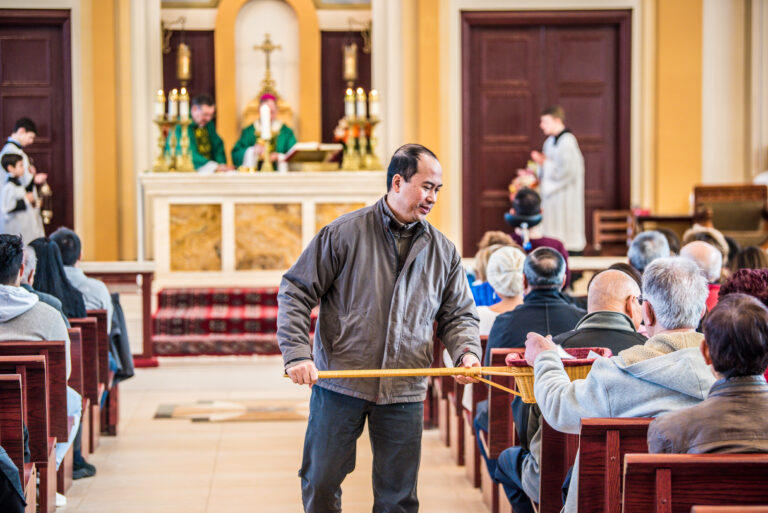

As political polarization increasingly challenges schools, both public and independent, Our Lady of the Assumption Parish in Port Coquitlam decided to offer some education of its own. It put together a debate to assist parents in navigating the challenges surrounding B.C. schooling.
The event, organized by the parish and the Young Adult Group of Our Lady of the Assumption in Coquitlam, had one goal: to help parents make informed decisions for their children by providing insights into the merits of different educational systems and philosophies.
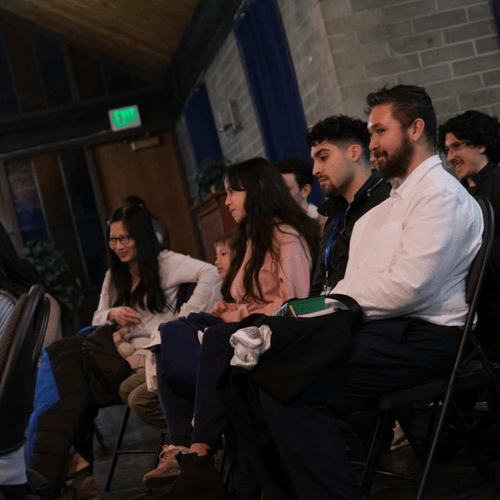
Representatives advocating for public, Catholic, and home education were allotted time to present their perspectives on the relative strengths of their systems. The debate, held at Our Lady of the Assumption, was structured to be non-confrontational, with no provision for panelists to respond to their peers’ comments.
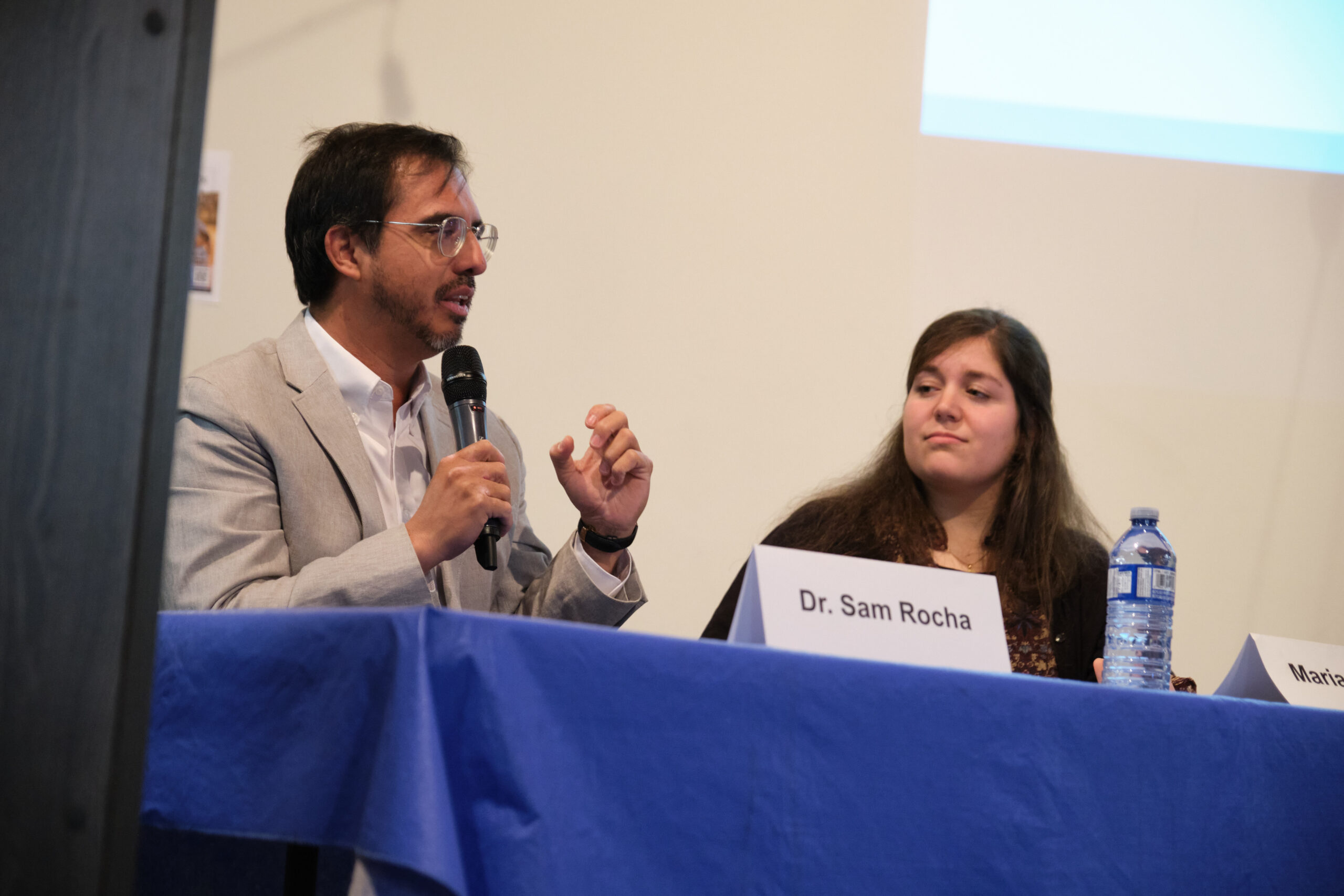
Defending public schools were Dr. Sam Rocha, a professor of educational philosophy from UBC and parent to homeschooled children, and Maria Farinha, a public-school teacher in Maple Ridge.
Relying on definitions from Cardinal John Henry Newman, Rocha made it clear that he and Farinha would only be defending the idea of public education as it applied to schools as places of knowledge.
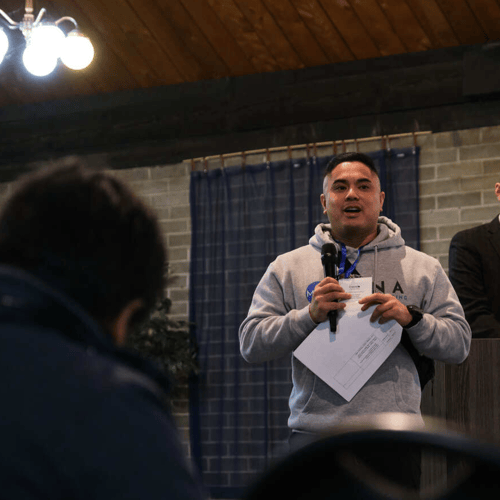
He said there is no real distinction in B.C. between public and private schooling, given that both Catholic schools and homeschooling parents have access to at least some government funding, and considering most teachers in B.C. are educated at government-funded institutions.
The duo defended public education, broadly, arguing for its contribution to the common good so often prioritized by Catholic political thinkers.
When questioned about the controversial SOGI (Sexual Orientation and Gender Identity) initiative being promoted by the province and the B.C. Teachers Federation, Rocha and Farinah said SOGI was not intended as curriculum, but rather a promotion of inclusion and diversity within British Columbian schools.
Rocha also pointed out that Catholic concerns within the social sphere overlap considerably with other religious stakeholders in B.C. education and he told parents that there are policies to at least notify parents if questionable resources or activities are planned for their child’s public school classroom.
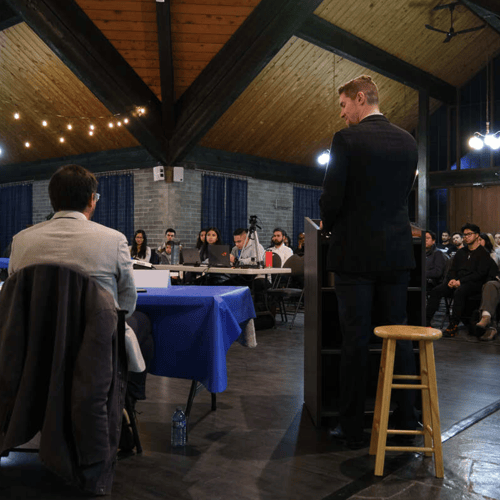
The potential worldliness of public schools was presented by Rocha as a positive, observing that we are “in the world” even while seated in a church. Accordingly, we grow in faith when we are engaged with, and encounter, the world. Within certain boundaries, he said, , Catholics should “delight in the world.”
The pair didn’t directly address whether B.C. public schools, as individual institutions of learning, are the best choice for parents and students in 2023.
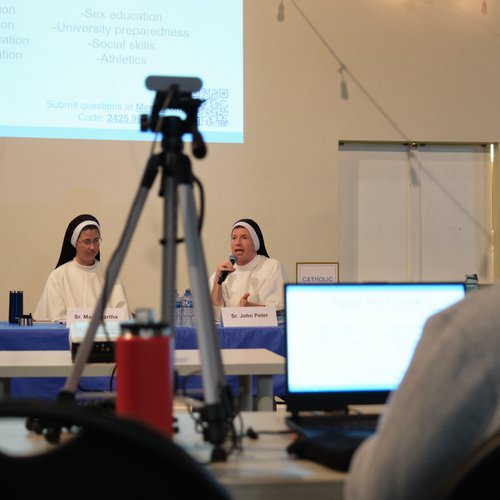
Catholic schools were defended by two Dominican Sisters, Sister Mary Martha Hetzler, a graduate of local Catholic schools, and Sister John Peter Clarke, both of whom teach at Archbishop Carney Secondary in Port Coquitlam.
Focusing on the end toward which Catholic education is oriented towards being with with God in heaven, Sister Clarke told the gathering that Catholic schools create an important boundary within which religious formation can occur.
Likening Catholic schools to a garden where students can grow in good soil, she emphasized that Catholic schools “are not greenhouses.” Rather, they are safe spaces to cultivate engagement with the world and help students grow in virtue and faith as a consequence of this engagement.
Rather than sheltering students from social issues like gender ideology, Sister Clarke said, Catholic schools “give students the resources to talk intelligently about every issue.”
Affirming that good teachers and well-meaning people can be found in public education, Sister Hetzler spoke about the value of the Catholic worldview that permeates every aspect of Catholic education.
“All involved give credibility to the education through their life in Christ,” she said.
Responding to a question regarding Catholic tuition, Sister Hetzler acknowledged that sacrifices might be needed to send a child to Catholic schools. Whether the tuition is worth it is ultimately up to parents, but the sisters cited access to the sacraments and the opportunity to build relationships with other Catholics as reasons to consider the money well spent.
“There is a richness to the totality of Catholic life on offer through Catholic education,” said Sister Clarke.
They also noted that financial aid can help parents with tuition.
The sisters were asked about the high number of Catholic school graduates who stop practicing their faith after graduation. Sister Hetzler said there are many factors, but family support and involvement in faith formation play the largest role in outcomes regarding religious participation.
Sister Clarke noted that a graduate’s faith life immediately after high school is not always indicative of their long-term religious participation, and many students return to the faith years later after they find value in Catholicism that wasn’t obvious to them in their youth.
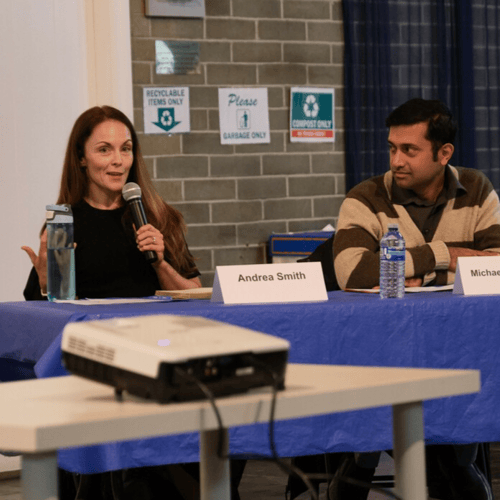
Homeschooling was defended by Andrea Smith, an educator at Traditional Learning Academy, a distributed learning organization based in Surrey, and Micheal Mendonca, a teacher at St. Thomas More Secondary in North Vancouver who has worked with the Catholic online learning organization ASCEND.
They said homeschooling offers a flexible educational environment tailored to individual needs, with benefits such as access to specialized educational aid and a low student-teacher ratio.
According to Mendonca, homeschooling benefits students of every ability, because subjects can be sped up or slowed down as needed to accommodate the learner.
Smith took issue with the equivocation of online learning and homeschooling, instead presenting homeschooling as “formally distributed learning” to emphasize that it is merely one piece in of the larger whole that makes up a child’s education.
Addressing questions surrounding access to physical education, socialization, and whether parents have the training to teach, the response was that homeschooling is not for the faint of heart; parents will get out of homeschooling what they put into it.
They pointed out that access to trained educators can be found through various online and distributed learning organizations that offer circular advice and instructional aid if parents need it.
Smith gave perhaps the most insightful comment for parents about education generally, saying that educational outcomes are always highest when parents are engaged intellectually and emotionally in their children’s learning, regardless of institution or educational style.