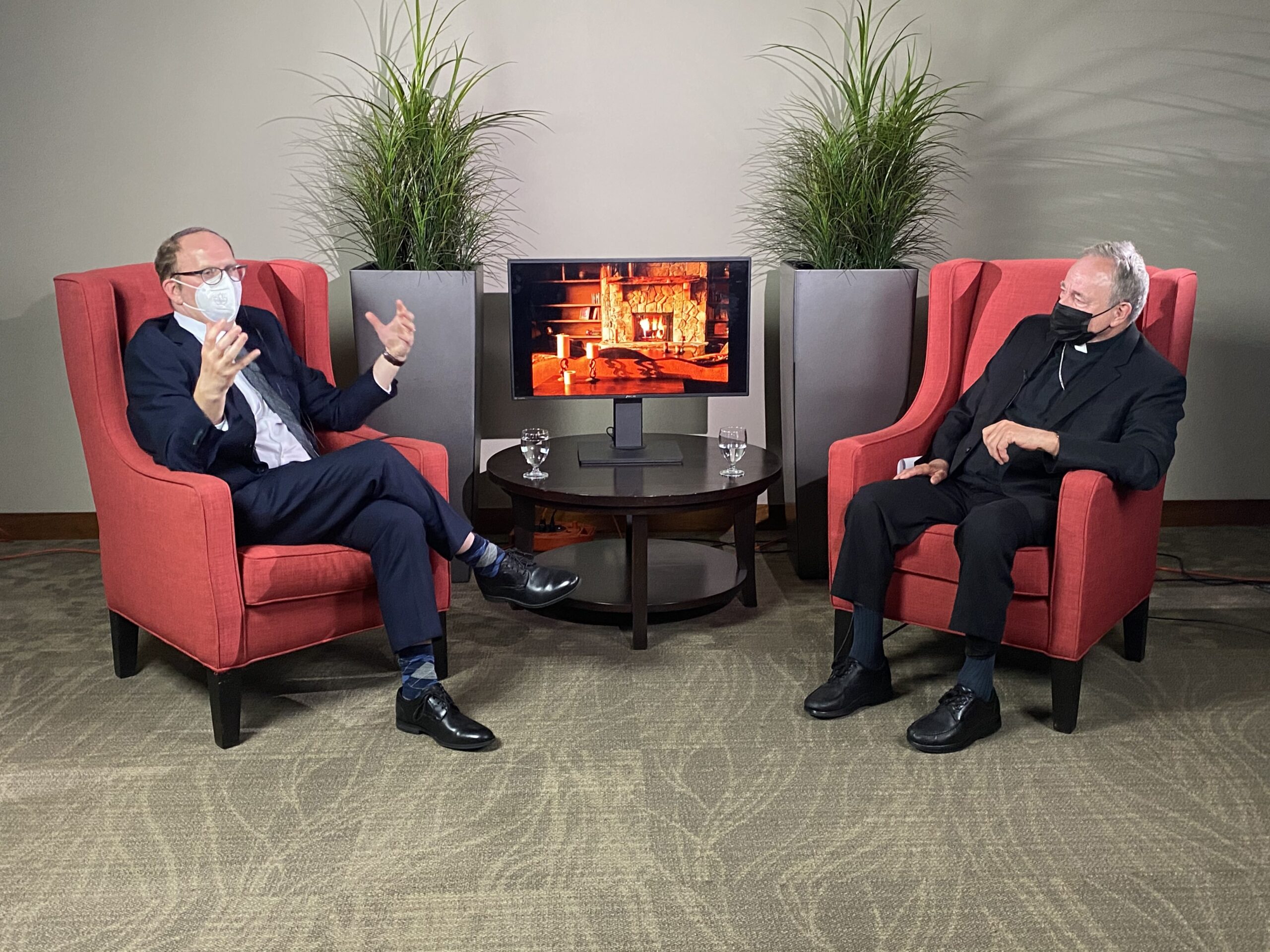

It didn’t take long for Archbishop J. Michael Miller and Rabbi Jonathan Infeld to find common ground as they sat down to discuss COVID’s impact on their respective faith communities.
At Congregation Beth Israel, Jewish children who usually celebrate bar mitzvahs and bat mitzvahs at age 12 or 13 have already been delayed a year, and now families who postponed last year’s celebrations are finding themselves in an awkward place.
“People are delaying if they can,” said Rabbi Jonathan Infeld, “but the people who delayed from last spring, they are going ahead because you can only delay for so long.”
Likewise, Archbishop J. Michael Miller said Catholic 12 and 13-year-olds preparing for confirmation are facing the same problem. Parishes that put off last year’s sacraments, believing all restrictions would be lifted by 2021, are now asking themselves if they should wait another year, or go ahead with small celebrations.
“In one parish, they have to have six different ceremonies, so they can (confirm) 10 kids,” Archbishop Miller said. “It puts a big strain on the community, but they are afraid now to put it off.”
Weddings are also being postponed at large rates in both communities.
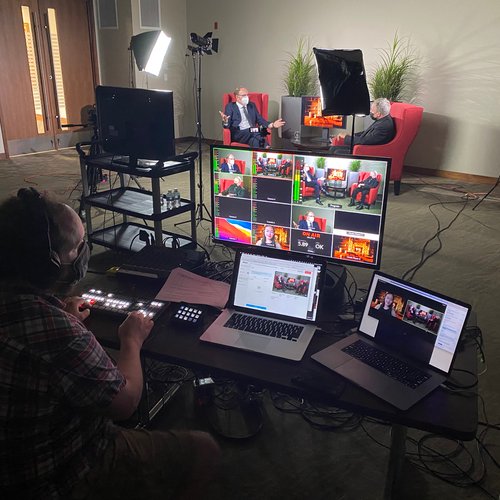
Rabbi Infeld and Archbishop Miller got together May 12 at the John Paul II Pastoral Centre for a fireside-style chat about ways the pandemic has affected their congregations. About 100 participants tuned in to the event when it was streamed live, and over 300 have viewed it since it was posted online.
Archbishop Miller said the current limit of 10 participants has strained people of faith at baptisms and funerals.
In the last year or so, several priests who died received intimate funerals rather than the well attended liturgies deceased clergy customarily receive, the archbishop said.
“Usually, we have 70, 80, 100, priests (at the funeral) concelebrating, and now, it would be me and two or three others,” he said. At a recent funeral for a 92-year-old priest who had dedicated his life in service to the Church, only two mourners could be present.
“It seemed almost disrespectful to the deceased,” the archbishop said.
Rabbi Infeld said provincial health officer Dr. Bonnie Henry told one of her first meetings with clergy that the pandemic is “not going to be a time for in-person shivas,” the seven-day Jewish memorial that involves gathering, honouring, and remembering the deceased together.
“That’s been one of the major challenges of the time: respect of the one who has passed, and also being able to provide proper comfort to mourners,” said Rabbi Infeld.
Instead, he has officiated at online shivas, which have turned out to be an unexpected blessing. In one case, a member of his Vancouver synagogue was grieving the death of a family member who lived in South Africa, so the rabbi officiated at an online shiva that united families across continents.
Both religious leaders said they don’t have hard feelings against government officials for imposing limits on religious functions during the pandemic.
“I don’t think that this was a malicious decision on part of government or something against religious communities. It has been a difficult and challenging one for us though,” Rabbi Infeld said.
After restrictions on religious worship were introduced last year and Beth Israel began offering Zoom services, one of the first sessions was hijacked by neo-Nazis shouting hateful slogans. Since then the congregation has had to take security steps to protect the community, he said.
Rabbi Infeld also took exception to comparisons of lockdowns to religious persecution. “We know persecution in general, historically, and this isn’t it,” he said.
Instead, he sees the limits on worship as instances of “governmental overreaching” or “political calculation,” adding, “we know that leaders don’t always make the best decisions, especially in difficult moments, pressed against the wall, trying to save lives.”
Congregation Beth Israel is presenting Henry with its Keter Ha’Bri’ut award at the congregation’s annual fundraising gala May 30. The award’s name means “Crown of Health” and is given annually to someone who works hard for the betterment of fellow citizens. Partial proceeds will go to the B.C. Centre for Disease Control Foundation.
Archbishop Miller agreed that restrictions on public worship that left places like restaurants open for a time were more likely an “oversight” by government that was straightened out with the most recent B.C. public health order.
“I’m very much anticipating that anything that comes forward, when things become relaxed, that we be coupled” with activities such as in-person dining at restaurants.
“I think we have every reason for hope,” he said. “I think Canada is poised as a nation to return to a period of more normalcy and, from a religious point of view, we will open up gradually as other places will also open gradually.”
He expressed hope that by the Feast of the Assumption, Aug. 15, more than 10 people will be allowed to celebrate in church.
Indoor, in-person religious worship has been banned since Nov. 19, with exceptions for baptisms, weddings, and funerals limited to 10 people. Outdoor worship is allowed, with a limit of 50 persons, and churches can allow up to 10 people to enter at a time for private prayer.
Current restrictions are set to expire at midnight May 24. It’s unclear if they will be extended or amended at that time.
Archbishop Miller and Rabbi Infeld shared some ways they have continued to stay in touch with their religious communities. The Beth Israel congregation ramped up online services and increased their programming, now offering 30 minutes of Jewish ethics study five days a week.
“This has been a challenging time but with every challenge come blessings, and certainly we have had an opportunity to grow as a synagogue,” said the rabbi.
Catholics have also reached out in many ways with social justice initiatives such as a free meal distribution service called All Were Filled and continuing to run shelters, food banks, and making flower deliveries to care homes.
A silver lining noted by the religious leaders is a sense of closeness developing among immediate family members.
“One of the blessings of this experience has been family life” as people were “forced” to be together, Archbishop Miller said.
“I had any number of people say, ‘We’ve never had so many meals with our children together!’”
Rabbi Infeld agreed he’s seen immediate families strengthened, even while extended families have never felt farther apart. “We haven’t seen our family in the U.S. in over a year and a half,” he said.
Archbishop Miller said regular visits to his family in Ottawa are something he “misses the most.”
“As soon as we’re over this, I’ll be on a plane.”
The archbishop and rabbi have jointly hosted several public events to discuss subjects relevant to their communities, beginning with the origins and value of Christmas and Hanukkah in 2018, and Easter and Passover in 2019.
They also hosted about 200 people of various faith backgrounds in a discussion on the significance of the Book of Esther in early March 2020, just weeks before bans on large gatherings in B.C. were first introduced.
Related: