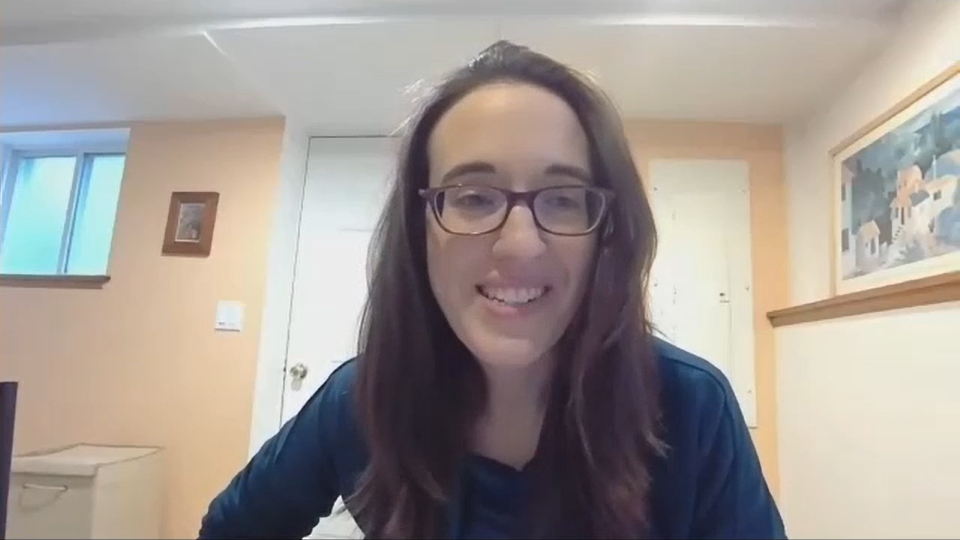

Claire Siebert had no idea it was unusual to attend two church services every Sunday morning.
She and her four siblings and parents would get up early for Sunday Mass at the Catholic church, come home and have breakfast, then continue their Sunday routine at a Methodist church.
“I thought it was completely normal,” she said. “When I was young I was very surprised to find out that my friends did not do the same.”
Siebert’s mother is Catholic and her father Methodist. When she asked her mother why they attended both churches every Sunday, she replied, “because we’re a family and we go to church as a family. Our love and unity as a family are important.”
Baptized and educated Catholic, Siebert found she appreciated the Catholic solemnity and reverence but also the Methodist comfort and family-like atmosphere. Both churches felt like home.
“Unity is not uniformity,” she said. “We can embrace our diversity and work toward being united, work toward the fullness of unity that God has in mind.”
Siebert shared her family’s story during Ecumenical Faith Break, an annual event jointly hosted by the Archdiocese of Vancouver and the B.C. Synod of the Evangelical Lutheran Church in Canada. More than 50 people tuned into the livestreamed event the week before Pentecost to share their experiences of ecumenism and discuss ways Christians of various denominations can find common ground.
Eric Krushel, pastor at Good Shepherd Lutheran Church in Coquitlam, said Pentecost has always spoken to him of “the joy of unity within diversity in the family of God.”
He compared ecumenical gatherings that unite people who “speak in different theological accents” to Pentecost, where people of various cultures, ethnicities, and languages were able to “bring their gifts together in common praise of the God of creation.”
Archbishop J. Michael Miller shared that he, too, grew up in an ecumenical family. His mother was a member of the United Church with a Methodist background, while his father came from a Catholic background although with an Anglican grandmother.
“There was no doubt that we were all Christians, and thus united, though we didn’t use that word,” he said.
“At table, for example, in our home we took turns saying grace before the evening meal. My mother got to say it one in four times, but there was never any hint or thought that somehow hers counted less.”
It was an imperfect unity, Archbishop Miller admitted. He remembers his mother would only come to Mass on special occasions, and never received Communion there. Due to societal norms at the time he and his sister were never brought to a United service.
Still, he said while unity in the Eucharist “might be generations away,” some unity can already be found in families of mixed Christian traditions who show their love for each other by respecting and honouring their beliefs in practical, daily ways.
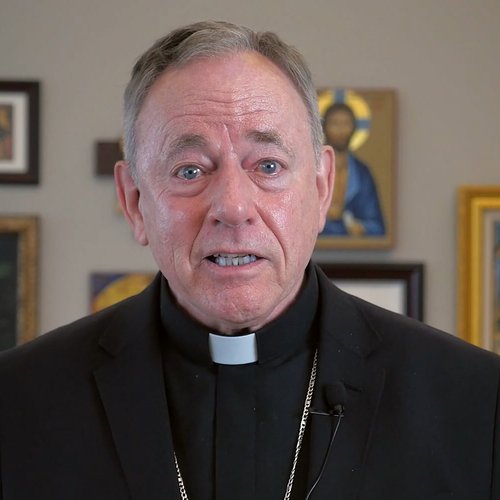
“Visible unity in faith, though it has certain doctrinal and theological ramifications, which are important, must also be lived concretely,” he said.
“I think we should honour such widespread experiences of true visible unity when neither partner is absorbed into the faith of the other against that person’s will … The visible unity of ecumenical families in homes can already express, and express truly and well, the Lord’s desire that all may be one.”
Lutheran Bishop Gregory Mohr added this kind of concrete unity has a wider impact. As a newly ordained bishop he was sent to serve in Airdrie, AB, a town with about 10,000 people and 10 Christian churches at the time.
“What I re-learned in those days were two key things,” he said. The first was respect, and the second, setting aside the desire to be right.
“We set aside competition because we were all small (churches) hoping to grow congregations,” he said. In a spirit of collaboration, the churches banded together and “tried to be a witness for the community by working together.”
“Our working together, our sharing together, our dialogue together, and things like this, stand as a witness to the world. I really believe that.”
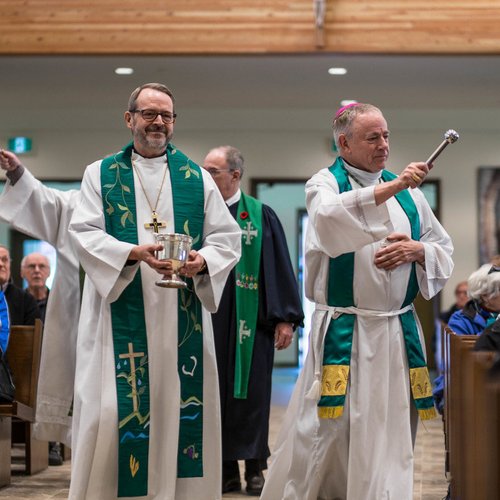
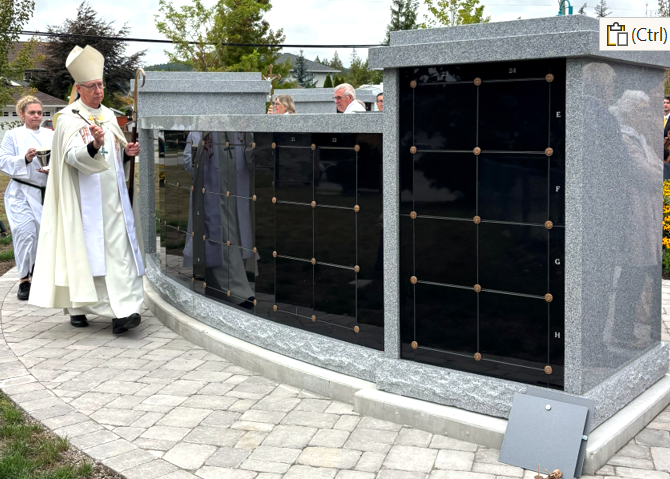
Lutheran Bishop Greg Mohr and Archbishop J. Michael Miller bless attendees at an ecumenical event at St. Clare of Assisi Church in Coquitlam in 2019. (BCC file photo)
Official relations between local Catholics and Lutherans in the Lower Mainland have been going strong for the past several years. Archbishop Miller, Bishop Mohr, and many local churches have gathered for several joint events, including the annual Week of Prayer for Christian Unity and the 500th anniversary of the Reformation in 2017.
They also celebrated the 20th anniversary of a joint declaration between Catholics and Lutherans, which brought the two groups into agreement on the doctrine of justification by faith, at a prayer service in 2019.
The Ecumenical Faith Break event this month was the third of its kind. Organizers from both traditions have hosted two virtual gatherings like this since May 2020.