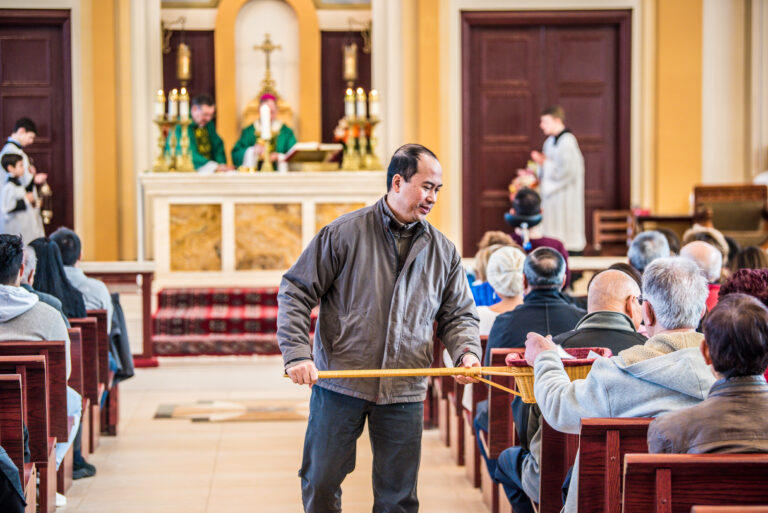

Archbishop J. Michael Miller offered words of encouragement to members of the legal profession at their annual Red Mass Oct. 18, saying, “Yours is not an easy task under the very best of circumstances,” especially amid “the ruthless polarization that has so seized Canadian society.”
Noting those who work in law have “a task that has only grown much more difficult,” Archbishop Miller acknowledged “there are moments when you must feel overwhelmed by the burdens of your profession.”
The Red Mass, like the White Mass for health workers, is important, he said, in helping lawyers to support each other through mutual prayers and the Eucharist.
The Red and White Masses “are blessings for our Archdiocese and for the wider Church, because they gather together for prayer, fellowship and learning those who exercise their noble professions in a world so in need of their distinctive presence and witness.”

In the case of the justice system, the archbishop noted justice is a divine characteristic of God himself, as is mercy. “That’s why those of you who are engaged in administering justice should never remove these qualities from your professional life. You are to work to ensure that justice, which is ultimately grounded in divine Wisdom and which is the foundation of any genuine reconciliation, will prevail in the world.”
Today’s culture is “calling into question the bedrock realities that are foundational for society: the natural law, the common good, and even the very notion of truth itself,” he said. As a result, institutions are “under growing pressure and stress to upend many values that we have long held to be foundational.”
For all of society’s promotion of tolerance and pluralism, he said growing numbers of people “want to impose upon the law a doctrinaire secularism that threatens Canadian society’s spiritual and cultural foundations. It will take real courage on the part of the law and judiciary to resist these influential voices.”
The freedoms and tolerance that allow people to take different positions on legal arguments and serving the common good “can’t be premised on moral relativism,” he said. “On the contrary, they must be based on respect for the rule of law, and on certain non-negotiable rights, duties, and principles that cannot give way to ideological fashion, powerful interest groups or even, sometimes, majorities.”
The archbishop addressed the recent rise in anti-Catholic hate crimes in Canada in the past year, saying “As painful as this situation is for Canadian Catholics, ours is but a drop in the bucket when compared to the persecution of Christians in many parts of the world.”
The appropriate response of Catholics in the legal profession to discrimination and persecution, he said, is to “honour the truth and the moral law that the Creator has hard-wired into human persons.”
Catholics must be “anchored in the Church’s understanding of the importance of freedom of religion and of conscience,” he said, noting religious freedom “is not only that of private thought or worship. It entails the liberty to live one’s faith, both privately and publicly. Freedom of conscience and religion is an intrinsic right inherent to human nature itself, and not a concession from any state authority.”
The archbishop thanked the St. Thomas More Catholic Lawyers Guild for their help in addressing government-imposed church shutdowns during COVID-19 so “religious worship could continue without undue government interference” during the pandemic. “Their work, largely carried out behind the scenes and without fanfare, but also most effectively, is a great tribute to what members of the Guild can accomplish when they work together.”