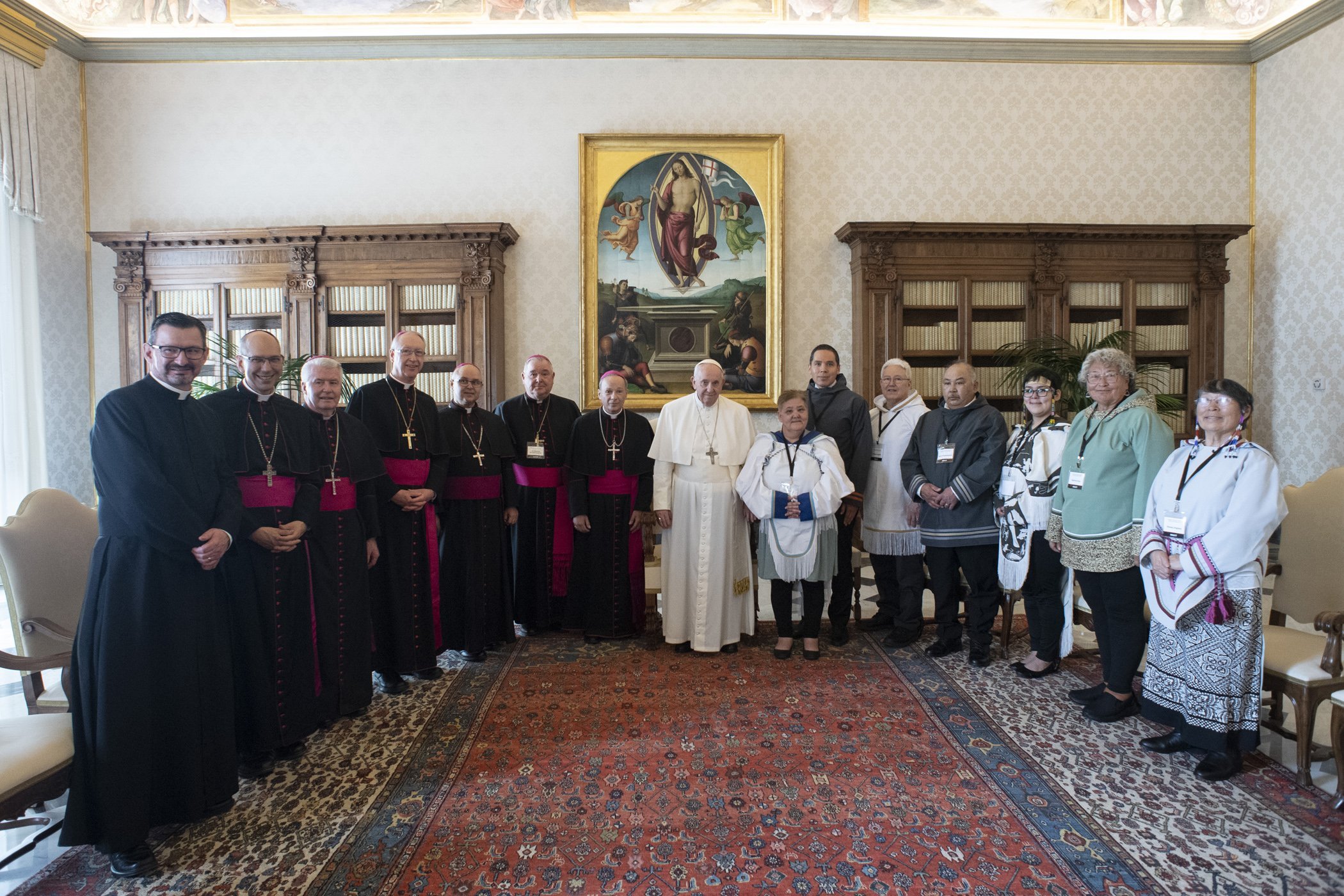

If Pope Francis is going to broaden or deepen the apology he offered April 1 in Rome, then it’s going to happen at Maskwacis, 70 kilometres south of Edmonton, site of one of the largest Indian residential schools in Canada.
“His principle statement would take place at Maskwacis,” Edmonton Archbishop Richard Smith told media on a Zoom call June 23, after the Vatican had released the official itinerary for the papal visit.
Pope Francis is scheduled to meet Indigenous people at Maskwacis July 25 — his first full day in Canada. The meeting will be followed by a formal address.
Gilda Soosay, chair of the Our Lady of Seven Sorrows parish council in Maskwacis and a member of the Samson Cree Nation, has no doubt the Pope’s apology will be deep, broad and historic.
“It’s a step forward on the path of healing for the Indigenous people,” she said. “For myself as an intergenerational survivor, it’s hopeful. We have to look forward to what’s coming for our future, for our grandchildren and the children coming after that.”
The Ermineskin Indian Residential School was begun as early as 1877 by Oblate missionaries. It didn’t become a full-fledged, government-funded residential school until 1911. The Oblates turned over ownership of the school to the government in 1955, but continued to teach at and manage the school until 1969. The school closed in 1973.
National Indigenous organizations and a consensus among Indigenous people from coast to coast have all called on Pope Francis to address the Doctrine of Discovery while in Canada and to apologize on behalf of the whole Church, not just individual members.
Archbishop Smith has no doubt that Pope Francis is speaking for the whole Church when he apologizes to Indigenous peoples. But further details about the content of Pope Francis’ three major addresses and four homilies scheduled over the five-day trip, July 24 to 29, will have to wait for the actual event, Archbishop Smith said.
“What his final words will be — we all have to wait to hear what those words are,” he said.
The most important thing to remember about the Pope’s journey is that he comes as a pilgrim Pope leading a pilgrim Church, said Lac Ste. Anne Pilgrimage spiritual director, Fr. Garry LaBoucane. LaBoucane is Metis and grew up near Lac Ste. Anne. He began a new appointment as pastor at Seven Sorrows in Maskwacis July 1.
“The Holy Father leads us in healing and reconciliation,” LaBoucane said. “That’s really an image and a model for all of us to undertake and follow.”
In Edmonton, where Pope Francis will visit and bless Sacred Heart Church of the First Peoples, he’s going to see a parish that does the sort of field hospital ministry he has advocated during his pontificate.
“We serve not only the Indigenous people, but the people who are downtrodden, don’t have no homes, live on the streets. We serve them on a daily basis here,” said Sacred Heart elder Fernie Marty.
Marty said he was “excited and nervous” about the prospect of meeting Pope Francis.
“We have a unique history happening here. It’s important to myself, for my own personal healing to continue,” he said. “I’m grateful that the Pope has chosen Sacred Heart to come and visit.”
For the Missionary Oblates of Mary Immaculate who ran the vast majority of Catholic residential schools scattered across Western Canada, that Pope Francis will be present at a residential school site is of great importance, said OMI Lacombe Province provincial superior Fr. Ken Thorson.
“The Holy Father will have the opportunity to witness and respond to the tragic residential school legacy, and the intergenerational trauma and suffering caused by those who lived and worked in the schools,” Thorson said in an email.
Thorson also pointed to the significance of Pope Francis’ appearance as a pilgrim at Lac Ste. Anne.
“We feel it is particularly significant that Pope Francis is set to visit Lac Ste. Anne, where the Oblates first apologized for our role in the residential school system, more than 30 years ago,” he said.
While speculation about just what will happen while Pope Francis is in Canada is inevitable, the most important thing may be that it will happen.
“We are glad to see the Vatican and the CCCB reaffirm their commitments,” the Metis National Council said in an email.
That the Pope’s public commitment to visit Indigenous people in Canada has been confirmed with an hour-by-hour itinerary is a measure of how important this trip is to Pope Francis, Archbishop Smith said.
“This is clearly something he wants to do. He’s determined to do it,” Archbishop Smith said.
But Archbishop Smith cautioned that nothing that happens on the papal visit will instantly, automatically or finally resolve a troubled history.
“The Pope’s visit to Canada will be an important step, although one step among many in this ongoing journey of healing and reconciliation between the Church and Indigenous peoples,” he said. “It’s also one moment… in the broader context of the entire desire of the Canadian population to move this forward, to move ahead in healing and reconciliation among all of us.”
The Catholic Register