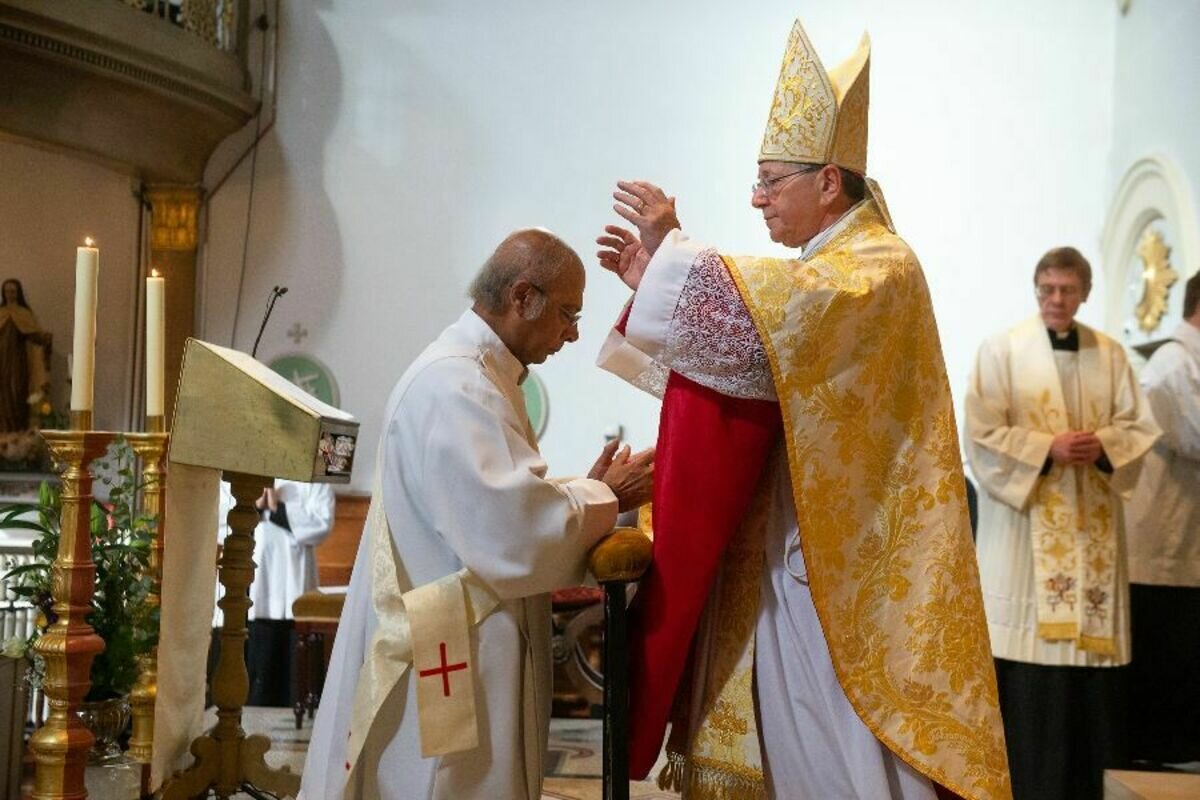

A former Anglican bishop from Wales will be received into full communion with the Roman Catholic Church next month and serve as a priest with the Anglican Ordinariate, which was set up by former Pope Benedict XVI in 2011.
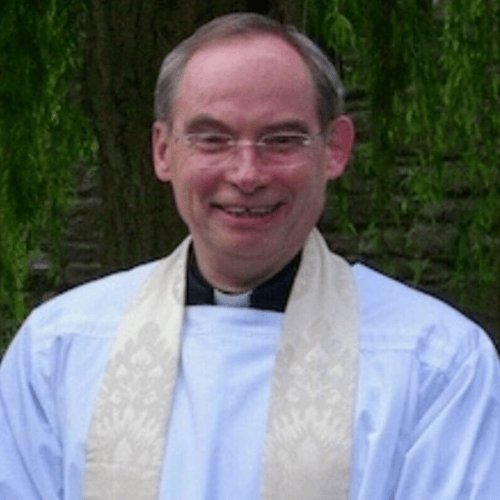
The Right Rev. Richard Pain, who served as the Anglican bishop of Monmouth, will join the Catholic Church on Sunday, July 2, at St. Basil and St. Gwladys in Rogerstone, Wales. He is the first Welsh Anglican bishop to convert to Catholicism through the Personal Ordinariate of Our Lady of Walsingham.
“We are delighted that after much prayer Richard has asked to be received into the full communion of the Catholic Church,” Monsignor Keith Newton, who serves as the ordinary of the ordinariate, said in a statement.
“He will be the first bishop from the Anglican Church in Wales to be received into the ordinariate since its creation in 2011,” Msgr. Newton said. “Richard has a long and distinguished ministry in the Church in Wales. He has many gifts which he will continue to use to proclaim the Gospel of Jesus Christ to the people of Wales.”
The ordinariate is structured similarly to a diocese and allows former Anglican priests and bishops to enter into full communion with the Catholic Church while maintaining certain Anglican traditions. It has its own eucharistic liturgy, which is distinct from the standard Roman Rite liturgy, and incorporates elements of the Book of Common Prayer that do not conflict with Catholic doctrine.
In the U.S. and Canada, the ordinariate is known as the Personal Ordinariate of the Chair of Saint Peter and welcomes Anglican and Methodist converts.
Through the ordinariate, an Anglican priest or bishop can enter into full communion with the Catholic Church and serve as a priest even if he is married. Rev. Pain married his wife, Juliet, more than 40 years ago, and they have two sons.
In a statement, Rev. Pain said the Benedictine understanding of obedience and hearing the Lord was significant is his personal formation and ultimate conversion to the Catholic faith.
“The call to conversion which follows has led me to becoming a convert to the Catholic Church through the ordinariate,” Rev. Pain said. “I have much to be grateful for the experience gained over a lifetime as an Anglican. Yet the call to Catholicism seems natural and spiritual at the same time. To start afresh will be a welcome challenge and I come — as we all do — as a learner and a disciple. The ordinariate, through the vision of Pope Benedict, provides a generous pathway to walk a pilgrim way and I ask for your prayers.”
Rev. Pain was born in London in 1956 and ordained a priest in the Anglican Church in Wales at Newport Cathedral in 1986. He was ordained the bishop of Monmouth in 2013 and retired in 2019. During his time in the Anglican Church, he assisted with the discernment and training of clergy.
At least 15 Anglican bishops have converted to Catholicism through the Anglican ordinariate since its inception, which included four bishops in 2021.
One of the 2021 coverts, Msgr. Michael Nazir-Ali, had been a prominent member of the Anglican hierarchy. He was considered to be a future contender for the role of the archbishop of Canterbury, which is the highest-ranking position in the Church of England and in Anglican communion.
Earlier this year Msgr. Nazir-Ali described Benedict XVI’s famous initiative enabling Anglicans to convert to Catholicism as “prophetic.”
Reflecting on the life and legacy of Pope Benedict XVI, Monsignor Nazir-Ali told CNA in a phone call that the birth of the Personal Ordinariate of Our Lady of Walsingham was a “prophetic step to take” because it provided those involved in ecumenical dialogue with “a concrete example of what unity could look like.”
The Personal Ordinariate of Our Lady of Walsingham was established in 2011 by Pope Benedict XVI to allow Anglicans to enter into full communion with the Catholic Church while retaining much of their traditions and heritage.
Although the Ordinariate was still not fully developed, Pope Benedict’s inspiration had offered a clear outline for future ecumenical endeavours, Msgr. Nazir-Ali said.
Msgr. Nazir-Ali served as the 106th bishop of Rochester from 1994 to 2009. His reception into the Catholic Church in 2021 was widely reported due to his considerable contributions to religious, academic, and political discourse in the U.K. and beyond. He is now a priest of the Personal Ordinariate of Our Lady of Walsingham.
In the year in which Nazir-Ali converted to Catholicism, three other Anglican bishops also did the same.
Msgr. Nazir-Ali spoke about Benedict’s “terrific” impact on his life, beyond the creation of the Ordinariate. “The reason I have been so influenced by him was his analysis of the cultural situation in Europe, which I think is beyond comparison because he saw that the absence of God was going to impoverish every aspect of European life, not just religion or spirituality, but culture, literature, and so on,” he observed. “There was no one who understood this as well as he could.”
Among those Anglicans who felt moved to embrace the vocation that the Ordinariate offered were 12 Anglican nuns who were received into the Catholic Church on Jan. 1, 2013.
The 12 were originally part of the Community of St. Mary the Virgin, based in Wantage Oxfordshire, but through their entrance into the Catholic Church under the patronage of the Ordinariate, they are now the Sisters of the Blessed Virgin Mary and reside in Birmingham, U.K.
In a statement on the community’s website, issued following the death of Pope Benedict XVI, the sisters wrote: “We join with the rest of the Catholic world in prayer for the soul of Pope Emeritus Benedict XVI, who died yesterday. May he rest in peace, ‘good and faithful servant’ that he was.
“On this day 10 years ago, on 1 January 2013, we were received into the full communion of the Catholic Church at the Oratory in Oxford. How many blessings and graces have flowed from that day! We thank God for them all.”
Father David Palmer is also a member of the Personal Ordinariate of Our Lady of Walsingham and serves the Diocese of Nottingham in the U.K. He was received into the Catholic Church during the papacy of Pope Benedict XVI.
He told CNA in a statement on Jan. 3 that Benedict XVI’s legacy in bringing Anglican patrimony into the Catholic Church was “inestimable” and that the late pope understood the “Anglican soul.”
“Benedict seemed to just ‘get’ the English tradition. His love for St. John Henry Newman is well known, but more than this he seemed to understand the English tradition. Witnessing him at Westminster Abbey for evensong and again at Westminster Hall during the 2010 Papal Visit to the U.K., it was clear for all to see that he understood and appreciated the Anglican ‘soul’ or perhaps, more accurately, the historic English religious soul,” Father Palmer said.
“He was able to recognize in the Anglican Church that which was beautiful, and indeed those bits that still reflected something of Catholic England,” he continued.
“In England there has often been peddled the idea that Catholicism is somehow ‘foreign’; Benedict reminded us that in reality England was a Catholic country, and even after the (so-called) Reformation, Anglicanism, at its best, remained shot through with Catholic sensibility,” Father Palmer noted.
“The Ordinariate, so close to Benedict’s heart, was a prophetic move, a realized ecumenism that says that those who become Catholic do not have to abandon all that went before, but rather all that is good and noble from their previous community can find its fulfillment in communion with the one holy Catholic and apostolic Church,” he said. “In other words, there is nothing ‘foreign’ about Catholicism.”
Reflecting further on the legacy of the late pope emeritus, Father Palmer said: “We no longer have Benedict alive on earth to be our ‘protector’ (as it were) but I have every confidence that he will be interceding for us in heaven, alongside St. John Henry Newman.
“We in the Ordinariate are deeply grateful for all that Benedict did to bring us home; we will miss him immensely — he was like a grandfather to us, and we entrust him to the maternal arms of Our Lady of Walsingham, and her Son, the only name under heaven by which we can be saved.”