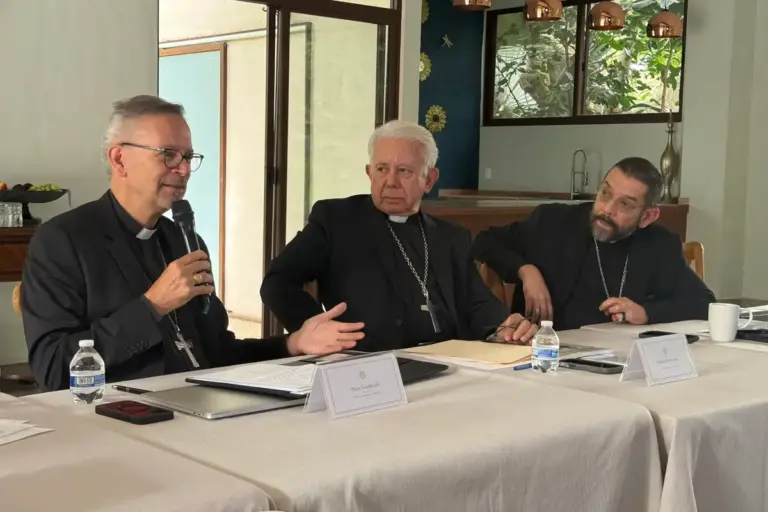

Drawing on examples from Canada and Oregon, the Catholic Bishops’ Conference of England and Wales is warning that evidence from other jurisdictions shows “there can be no safe or limited assisted suicide law.”
The Catholic bishops in the U.K submitted written evidence in January to Westminster’s Health and Social Care Select Committee Inquiry into Assisted Dying, opposing legislation that would introduce “assisted dying” as part of end-of-life care.
Life Issues spokesperson Bishop John Sherrington warned in an executive summary that, “Prescribing lethal medication for individuals suffering from suicidal ideation would be a grave betrayal of the public health duty to save life … The experience of other jurisdictions illustrates the slippery slope of assisted suicide legislation from hard cases to more comprehensive provision.”
Oregon is often referenced as a model template for “mild assisted suicide legislation,” he said, and “now allows assisted suicide for nonterminal conditions including anorexia, arthritis, and kidney failure.”
Canada, which he said is “legally and culturally very similar to England and Wales,” now assisted suicide “when death is not ‘reasonably foreseeable.’ Belgium has expanded their provision of assisted suicide to include children. Any legalization of assisted suicide for terminal illnesses in England and Wales would likely be challenged in court on discrimination grounds and extended to allow for cases of nonterminal illnesses and euthanasia in cases of difficulties in self-administering lethal medication.”
He concludes, on behalf of all the Bishops of England and Wales: “We reiterate the Catholic Church’s commitment to protecting and valuing life at all stages, no matter how physically or psychologically limited, and our opposition to assisted suicide as an attack on the inherent dignity of human life.”
It is expected that the final report published by the Health and Social Committee will be used by pro-euthanasia campaigners to apply further pressure to legalize assisted suicide and/or euthanasia in England and Wales.
Scottish bishops issued a statement May 18 with other religious leaders opposing a separate bill that is due to be debated at Holyrood, Scotland.
The bill is sponsored by Member of Scottish Parliament Liam McArthur and would introduce assisted suicide for terminally ill people if ratified by the Scottish Parliament.
The joint statement from faith leaders in Scotland warns that assisted dying “undermines the dignity of the human person, and to allow it would mean that our society as a whole loses its common humanity.”
They continue: “We grieve with those who grieve and identify with those who suffer. We acknowledge the sincerely held motivation of those seeking change but do not believe that this is the correct approach to the alleviation of suffering. There is a very real danger that once legalized, these practices could put pressure on vulnerable individuals to opt for assisted suicide.
“The ways in which similar laws in other countries are being applied, and the effect that its introduction would have on some of the most vulnerable in our society, including the disabled and the elderly, would be extremely detrimental. We are called to care for those who are suffering, not to end their lives.
“The Church of Scotland, the Roman Catholic Church in Scotland, and the Scottish Association of Mosques remain firm in their opposition to assisted suicide and euthanasia.
“We would call upon members of the Scottish Parliament to consider carefully the implications of this bill, to express their concerns, and to vote against it.”
Meanwhile, parliamentarians in Westminster are currently hearing evidence regarding the law on assisted suicide in England and Wales, which currently states that anyone culpable of assisting with suicide can face imprisonment for up to 14 years.
The law on assisted suicide is devolved throughout the U.K. with Westminster, Holyrood, and the parliaments of Jersey, Guernsey, and the Isle of Man, all in the process of considering the issue separately.