
The Catholic Church has a long tradition of honouring various professional groups with special colour-coded Masses. In the past two months, Vancouver has participated in this tradition by celebrating the Red Mass for lawyers, the White Mass for medical practitioners, and the Gold Mass for scientists.
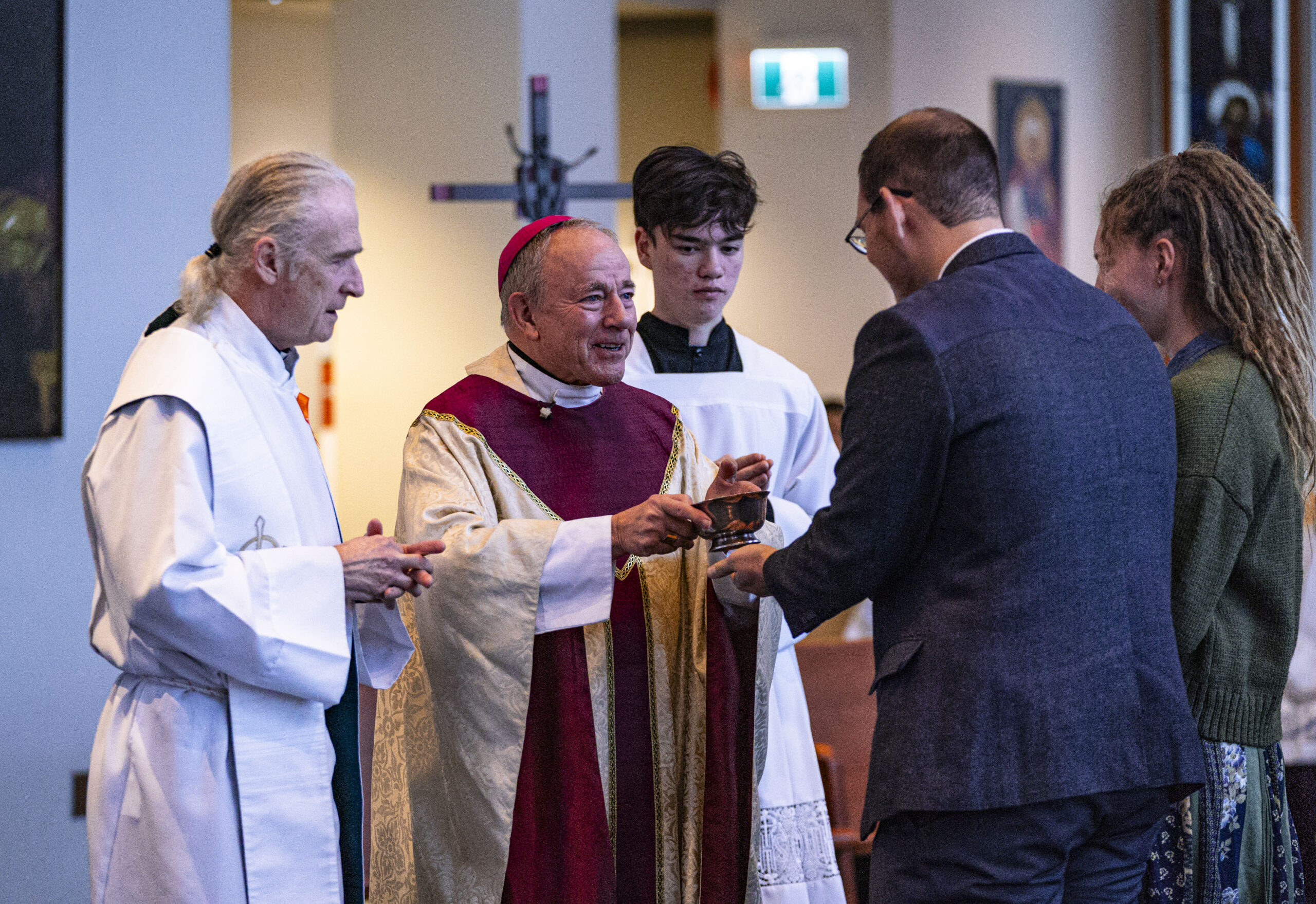
Some of these Masses, like the Red Mass, have a history dating back to the 1200s. The Red Mass, organized by the St. Thomas More Society, is celebrated in honour of the legal profession as a vocation in the service of justice and the common good. This year, it took place at Holy Rosary Cathedral on Thursday, Nov. 7.
“As men and women engaged in the legal profession, yours is an extraordinarily noble vocation,” said Archbishop J. Michael Miller during his homily.
“Being a practising Catholic in … your ministry to the law can sometimes be a lonely place,” said the Archbishop, speaking as if to all working professionals, “so being able to draw strength from faith-filled colleagues can be a great source of encouragement.”
“Dear friends,” he said, “you are at the forefront of working to ensure, most often indirectly, that our legal order is imbued with the spirit and values of the Gospel.
“It’s the Church’s tradition that what you do in service of the law is a service to God himself.
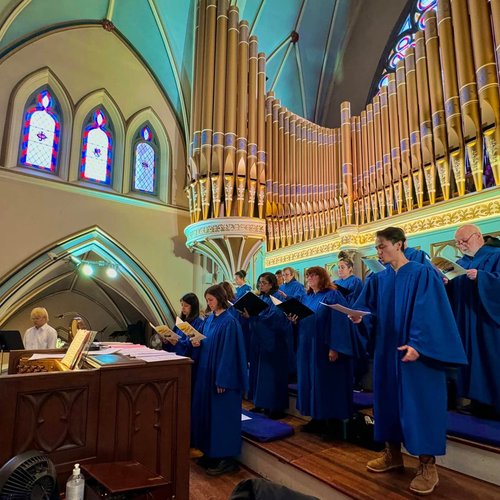
“I am truly grateful for your service to the common good and your desire to make human law and the administration of justice a reflection of God’s law,” said the Archbishop. “Given the ubiquity of lawyer jokes, you’re probably not used to hearing words of thanks, but as the Apostle Paul wrote to the Ephesians, ‘I do not cease to give thanks for you, as I remember you in my prayers.’”
The Gold Mass for scientists was held on Nov. 20 at St. Mark’s Parish at UBC. The Mass also celebrated the life of the patron saint of scientists, St. Albert the Great, whose feast day was Nov. 15.
“Albert was an outstanding scholar, learned not only in theology and philosophy like his contemporaries, but also in botany, geography, astronomy, astrology, mineralogy, alchemy, zoology, physiology, justice, law, friendship, and love,” said the Archbishop.
“Nothing in God’s world – natural or supernatural – was outside his interests,” which is why Pope Pius XI named him the patron of enthusiasts of the natural sciences, the archbishop told the gathering.
“St. Albert the Great reminds us that there is friendship between science and faith and that through their vocation to the study of nature, scientists can take an authentic and fascinating path of holiness,” said the Archbishop.
A great number of people hold beliefs that dismiss “any form of knowledge that is not empirical or any consideration of meaning,” which “eliminates – unjustifiably – any role for faith,” said the Archbishop.
He offered the gathering a seed of hope, calling it “a truly fortuitous development,” that “such a negative attitude to the contribution made by faith might be losing ground today.”
Citing an observation by Pope Francis, the Archbishop said the scientific world, which used to strongly assert its independence from any “spiritual or religious values,” now “seems instead to be increasingly aware of the ever more complex reality of the world and of the human being.”
“With their distinctive approaches to understanding reality, science and religion should enter into a dialogue that would prove fruitful for both,” he said.
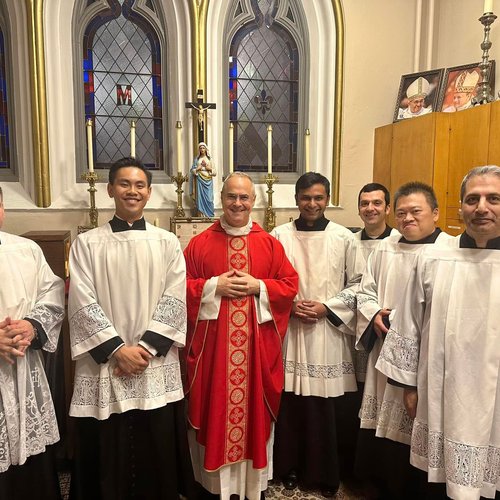
“Science can’t replace the wisdom reliant on divine revelation for answering our most profound questions: those about the meaning of life and death, about ultimate values, and about the nature of progress itself.
“For the believer, science and faith are grounded alike in the absolute truth of God.”
The White Mass took place a few days later at Holy Rosary Cathedral on Nov. 23, the Solemnity of Christ the King, and was organized by the Catholic Physicians Guild.
During his homily, the Archbishop applauded health-care professionals for participating in the tradition of healing started by Christ himself.
St. Luke, “the beloved physician” (Col 4:14), describes Jesus’ actions toward the sick in this way (cf. Lk 5:12–26; 8:40–56): “he approached them, entered their homes, talked with them, listened to them, welcomed them in their suffering and healed them,” said the Archbishop.
The disciples quickly followed in the footsteps of Christ, “the Divine Physician,” he said, and considered it “one of their duties and privileges to be at the side of those who suffer, cultivating a preferential attention to the sick.”
“We are all profoundly grateful to you for embracing your noble vocation and mission in health care, and for showing that your faith in Jesus Christ is inextricably linked to your care for us,” he told the medical professionals.
Your voice matters! Join the conversation by submitting a Letter to the Editor here.