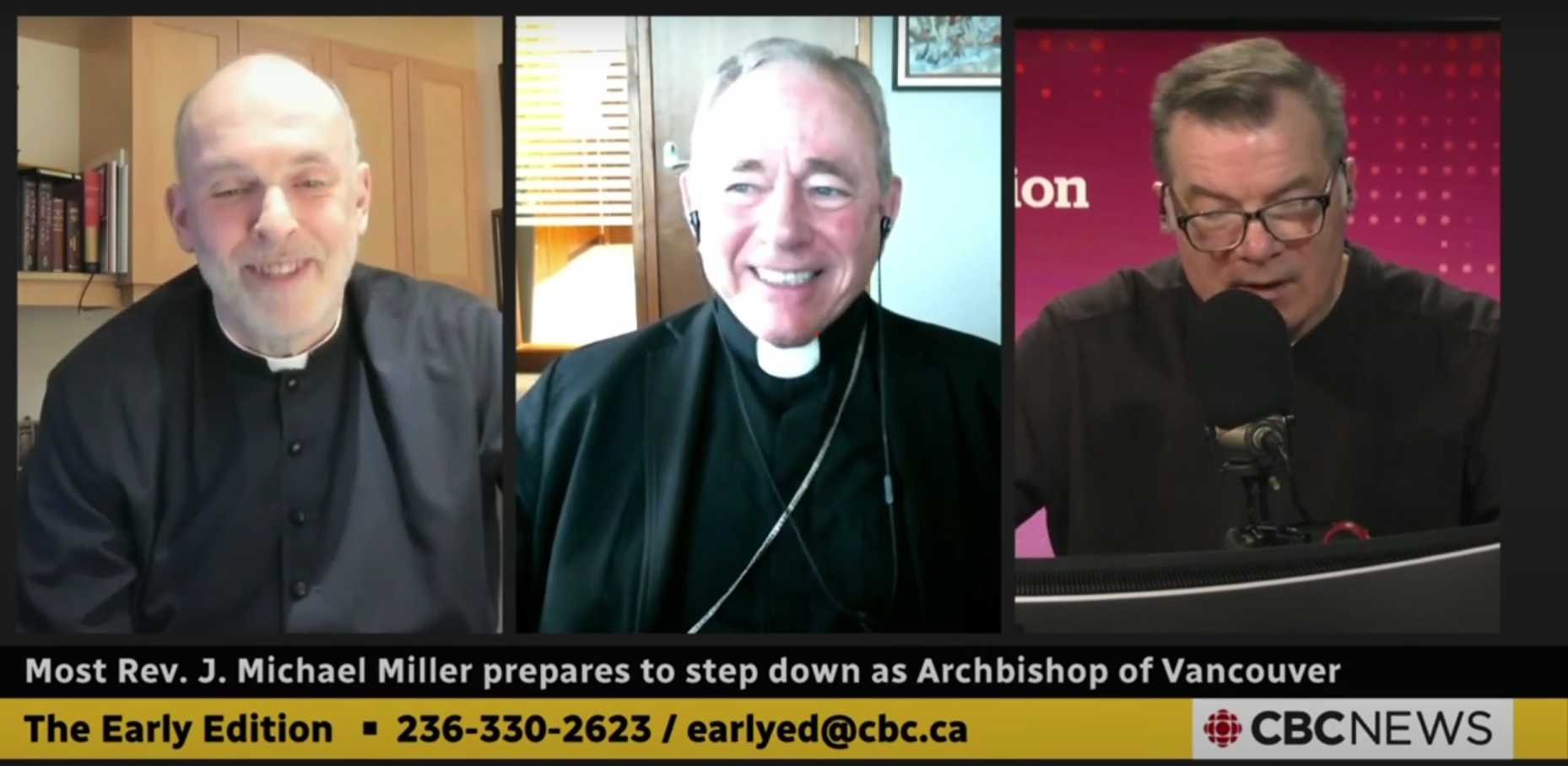

In February, CBC’s Stephen Quinn interviewed Archbishop Miller and Father Bruce-John Hamilton, pastor of Corpus Christi Parish in Vancouver, to discuss the Archbishop’s upcoming retirement and the declining health of Pope Francis. Here is an edited transcript.
The Vatican has confirmed that Archbishop Richard W. Smith of Edmonton will soon become the next Archbishop of Vancouver, with his installation expected in May. Archbishop Smith recently spoke with CBC about his approach to reconciliation with Indigenous people.
The core lesson is that reconciliation unfolds one relationship at a time, he said. I look forward to meeting people. I hope the people of the Vancouver area will find in me a friend — someone who truly does want to walk with them, to learn from them, and to listen to them.
In the meantime, outgoing Archbishop J. Michael Miller has been named Apostolic Administrator of the Archdiocese. He has served as Archbishop of Vancouver since 2009 and joined CBC for a conversation.
CBC: Good morning, Archbishop. As your time as chief shepherd of the Archdiocese comes to a close, what kind of reflection are you doing?
Archbishop Miller:
I can take a cue from Archbishop Smith. Over the past 16 or 17 years, certainly the work toward reconciliation and healing with Indigenous peoples stands out — particularly the signing of the Sacred Covenant between Tk’emlúps te Secwépemc, the Diocese of Kamloops, and the Archdiocese of Vancouver last Easter. We’re preparing to celebrate the first anniversary of that.
There have also been internal matters in the Church as well, particularly confronting the abuse crisis. But there were moments of growth, including the establishment of a permanent diaconate program — mostly married men serving the local Church. Our Archdiocese is vibrant and diverse, and it has been a privilege to serve alongside so many good people.
CBC: How did your resignation come about?
Archbishop Miller:
It came with my 75th birthday — three and a half years ago. Church law requires bishops to submit their resignation at that age, and I’m a bit overdue.
CBC: Let’s listen now to part of Pope Francis’ 2022 apology to residential school survivors during his visit to Canada…
I am sorry. I ask forgiveness, in particular, for the ways in which many members of the Church and of religious communities cooperated — not least through their indifference — in projects of cultural destruction and forced assimilation promoted by the governments of that time, which culminated in the system of residential schools.
CBC: Archbishop, you’ve committed to improving relations with Indigenous peoples. What do you think needs to happen next?
Archbishop Miller:
We’re working carefully and deliberately. One area we’re focusing on is archival support — helping trace and document the histories of First Nations children in the schools. We’re collaborating with archivists and researchers in Kamloops and here in Vancouver.
Also, through the Canadian bishops’ $30 million pledge, we’ve supported Indigenous-led initiatives — not Church projects, but theirs. These have ranged from language revitalization to healing programs, and we’ve responded to their requests for funding in a spirit of partnership.
CBC: The past 16 years have brought significant changes, including the Church’s response to clerical sexual abuse. Why did you choose to publicly name clergy involved in these cases?
Archbishop Miller:
It became clear — from what we saw in other dioceses — that this was the just and fair thing to do. It wasn’t easy. There was no ready-made list. It took significant research. We were also prompted by people who encouraged us to take this step. So, yes, it was a response — and it’s still ongoing.
CBC: Where does the Archdiocese currently stand on the 31 recommendations from the 2019 clergy abuse report?
Archbishop Miller:
We’re pretty far along. Some implementation has been slower — especially in posting information online. I’d say we’re in an okay place — not great — and there’s still work to do.
CBC: Are there still members of the clergy who want to keep this issue under wraps?
Archbishop Miller:
Not really. That’s not the challenge. The challenge is more logistical — gathering records, managing cases. In Canada, I don’t see resistance from clergy to transparency. Maybe a few individual Catholics feel that way, but it’s not a battle I have to fight.
CBC: We’re joined now by Father Bruce-John Hamilton, pastor of Corpus Christi Parish in East Vancouver. Good morning, Father.
Father Hamilton:
Good morning, Stephen.
CBC: How are you reflecting on the appointment of a new Archbishop?
Father Hamilton:
I think it’s a wonderful choice. I don’t know Archbishop Smith personally, but I’ve read a bit about his background. He’s eminently qualified — he served as a parish priest back in Nova Scotia, then became Bishop of Pembroke, spent 17 years in Edmonton, has a doctorate in canon law, and was president of the Canadian Conference of Catholic Bishops. He brings a lot of experience.
CBC: What do you see as the priorities for the Archdiocese in the years ahead?
Father Hamilton:
Certainly Indigenous relations will remain a priority. But this is also a very multiethnic region — in many ways, we’re a gateway to the Orient. I’d like to think the Holy See took that into account when choosing someone so qualified.
There are so many different cultures and communities in this Archdiocese. And there’s also the missionary aspect — even within our own people. We need to re-evangelize, to reignite that fire of Jesus Christ in people’s hearts, and help them rediscover the joy of the Gospel.
CBC: Archbishop Miller, your resignation comes at a time of deep concern for Catholics watching Pope Francis’ health. How have you been reflecting on that?
Archbishop Miller:
Many people are praying for the Pope. His illness reminds us of the central role the Pope plays — not just structurally, but in the imagination of Catholics. He really is a father figure.
Seeing him hospitalized is difficult. We pray for him. We also know earthly life has limits. There’s a mixture of sadness and acceptance.
CBC: Father Hamilton, how is your parish responding to the Pope’s illness?
Father Hamilton:
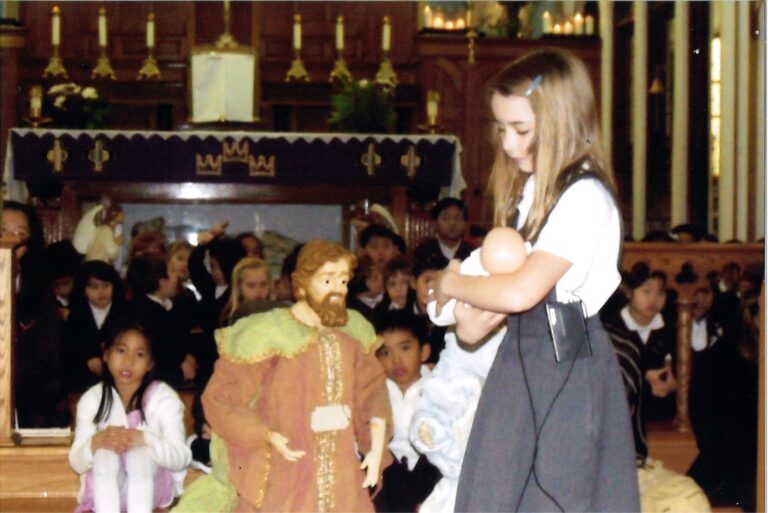
Our parishioners are praying for him daily. We have 466 children in our school, and they’ve created a prayer display at the school entrance. They’re writing personal prayers, linking them together in a prayer chain. Children are especially beautiful in this way — their hearts are open. They’re praying for the Holy Father, and so are the adults. I personally pray for him several times a day.
CBC: Pope Francis is often viewed as more progressive than his predecessors. How do your parishioners feel about that?
Father Hamilton:
Most people focus on his love for the poor. That’s what I hear most often. They appreciate that he wants the Church to be like a field hospital — a place for the wounded. And we’re all wounded in some way. That’s why Jesus came. His love for the poor and the marginalized resonates with many in the parish.
CBC: For young Canadians who’ve never witnessed updates on a Pope’s declining health, what words of comfort can you offer?
Archbishop Miller:
We have a good Pope. A great shepherd. We don’t know if this is truly the end, but all lives do end. That journey — often involving suffering — is part of our shared pilgrimage. We entrust him to God.
Father Hamilton:
We don’t know what lies ahead, but we trust. The Holy Spirit gave us a good Pope and will give us another. People around the world — Catholic and non-Catholic — are praying for him. We place our trust in God.
CBC: Thank you both for your time this morning.
Archbishop Miller:
Thank you very much, Stephen. All the best.
Father Hamilton:
Thank you.
Your voice matters! Join the conversation by submitting a Letter to the Editor here.