
When St. Peter’s Parish in New Westminster began helping Spanish-speaking newcomers settle into life in Canada, the people serving in this ministry initially thought they were helping with practical concerns: how to work towards permanent residency, navigating transit, overcoming the immigration bureaucracy.
As time went on, the team realized that there were other issues at play, such as anxiety over immigration uncertainties or depression that came from relocating to a new place.
To respond to these needs, a mental health ministry was established at St. Peter’s that now helps not only newcomers, but Canadian parishioners as well.
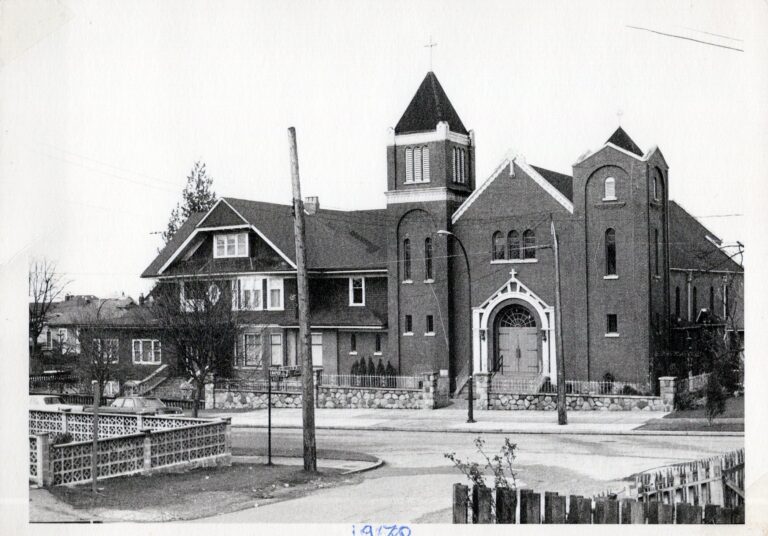
St. Peter’s is located next to several affordable rental buildings, making it an ideal place for immigrants to settle when they first come to Vancouver. As a result, the parish has a large Spanish-speaking community, with members coming from across Central and South America. When Alejandra Espinoza, now the Mental Health Ministry Coordinator, took on her first role as St. Peter’s Spanish Ministry Coordinator in 2024, she was a newcomer herself and knew how hard it was to settle.
“My projects were to try to find things for newcomers that would be resources – people to help them to settle,” she said.
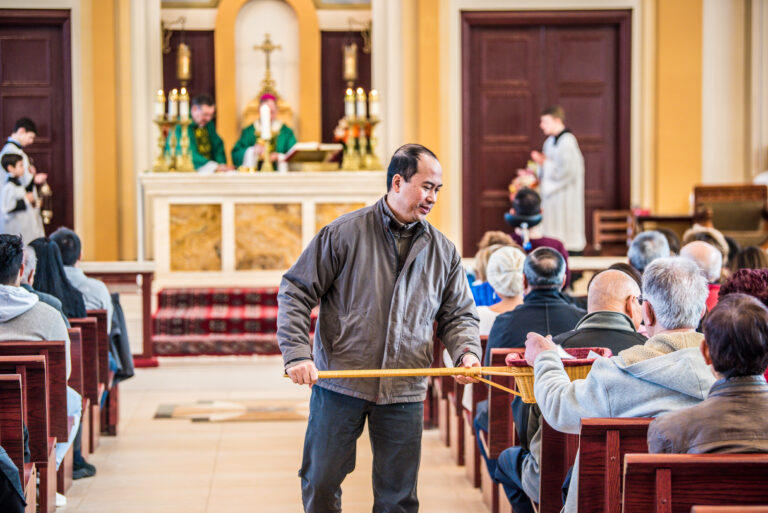
Along with Father Nick Meisl, Espinoza worked with a team to build resources for newcomers: a monthly Spanish Mass, talks on how to navigate the healthcare system, and information on jobs. Grants and donors from the Latin community helped pay for many of these services.
But amidst the work was being done to support newcomers, the same mental health struggles kept surfacing. People were far from home and had lost the community support they once relied on. Work was hard to find, and the question of permanent residency hung over many families. “We encountered that newcomers are suffering a lot with anxiety, depression, grief,” Espinoza said.

The Mental Health Ministry’s team leader, Cecilia Marquina, also saw the need after attending the parish’s Alpha course. “We had a Spanish speaking table,” she recalled, “and at every session we ended up sharing our experiences … because most of us were newcomers. It’s funny how for every topic we ended saying, ‘yeah we’re exhausted and we’re desperate – we don’t know what to do.’ There are so many challenges, but at the end, all of us could say, ‘I’m not alone. I’m not the only one.'”
This grew the ministry towards mental health workshops, which started in 2024 with the help of Mental Health Ministry Facilitator Juan Domingo Vallejo. The response was unexpected and intense. “The reaction of the people that attended the event was, for me, overwhelming,” Espinoza said, “because there was a lot of people crying – crying out like in a desperate way.”
This was around the same time the archdiocese started its own mental health initiatives. The parish received resources from the archdiocese’s Mental Health Coordinator, Jane Waldock. She helped train their team, who also took a Catholic mental health course on Mental Health First Aid.
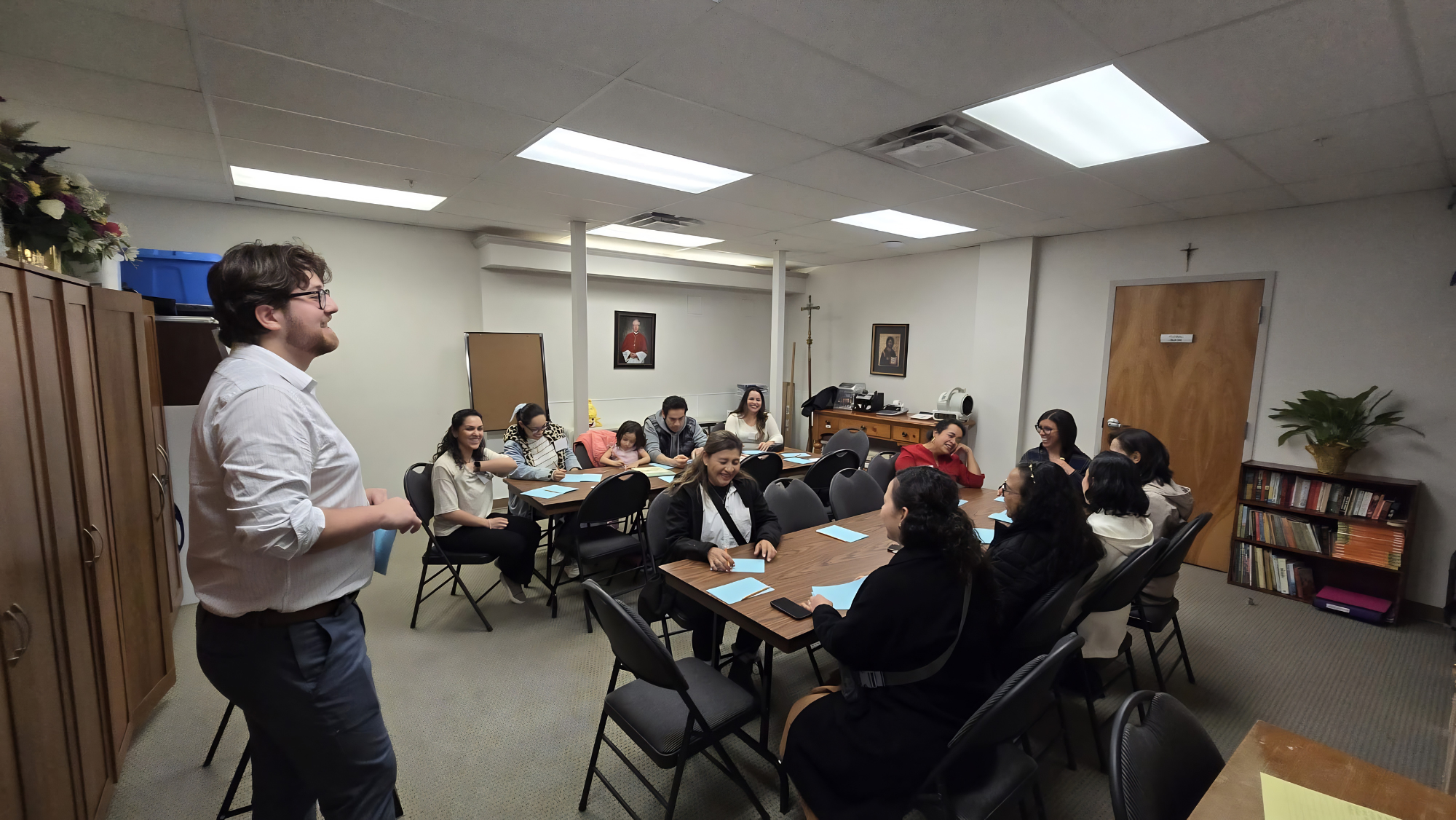
Then came The Sanctuary Course, a structured course that explored the connection between faith and mental health in a small-group format. The team ran the Sanctuary Course with both English and Spanish groups. Before it, the parish had offered one-off talks about every two months, whereas hosting Sanctuary meant meeting weekly and going through the material in small groups.
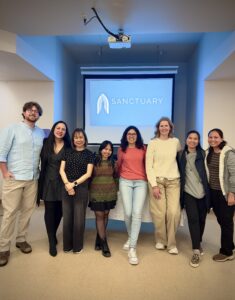
The team calls Sanctuary the turning point.
Vallejo says the consistency mattered. People stayed in touch with the subject all week and came back more open.
With Sanctuary, the Spanish language barrier was removed as well, and people from every cultural group attended. As Espinoza said, “anxiety, depression, suffering is something real for human beings.”
The team learned many lessons. The first was empathy for Canadians. At Vallejo’s table, everyone was Canadian, and many were older parishioners from a generation that rarely talks about mental health.
“It was also, to me, a little shocking,” Vallejo said, “because [my group felt] like part of the older community here at the parish. It’s usually that age range that does not really want to associate with mental health topics at all.”
“By the end of the course, they were all sharing their experiences. It worked – they were really engaged. It really felt like it was a space that they had always needed but never had,” he said.
At the final session, one participant thanked Espinoza for presenting in her second language while talking about her own anxiety. Another wept and asked the team to keep going. Espinoza says it showed her “that the newcomers need [mental health support], but also Canadians need it. Everybody needs it.”
The team also learned the value of listening. Espinoza had thought of listening as something you do without thinking, and the course showed her how much listening matters to a person who is struggling. You don’t need to be a professional to be present for someone.
At the same time, Father Meisl said they have been careful to set expectations. “I think it’s important for the whole ministry to know our boundaries. We’re here, we can listen for people, but then I think it becomes difficult. There’s only so much we can do, but we can point people to different resources like mental health professionals who can help with medical issues and more substantial situations.”
Marquina adds that there is no manual, and the team is still working out what will help parishioners.
The work also asks for humility. Vallejo, who has a degree in psychology, has what he calls a “ridged view” of mental health. He had preconceived notions about different generational approaches to mental health, for example, that older people don’t want to talk about their feelings.
He said that when his audience was comprised of newcomers to Canada, he understood their needs almost instinctively because they related to his own cultural and lived experiences. He understood their anxiety and the depression that can come when a person is detached from the community and people who gave their lives meaning back home.
On the other hand, when the mental health workshops were opened to English speakers and more natural-born Canadians started to attend, Vallejo learned he had to simply show up and listen. Everyone has suffering they need to work through, and he was touched by one woman who spent an entire small group meeting talking about the loss of a loved one. He walked away from the 45-minute session with a new appreciation for the struggles that everyone, not just immigrants, have in life, and the impact that listening sympathetically can have, not just on the person being listened to, but on the listener.
The next step is a support group, an idea that came directly from Sanctuary participants who wanted a continuing safe space. The grief workshop, first offered in Spanish, will run again in English next month. More workshops are planned, and the team says it is open to new ideas.
They also hope the project reaches beyond St. Peter’s. Vallejo hopes other churches will follow. “Once people see that it’s working for us… it’s a lot easier for other people to want to do it.”
Marquina would like to see other parishes share experiences and “start to generate a community,” she said. “At the end, it’s a need for everyone. So, if we can start to exchange some experiences, ideas, with different parishes it will start to get the ball rolling.”