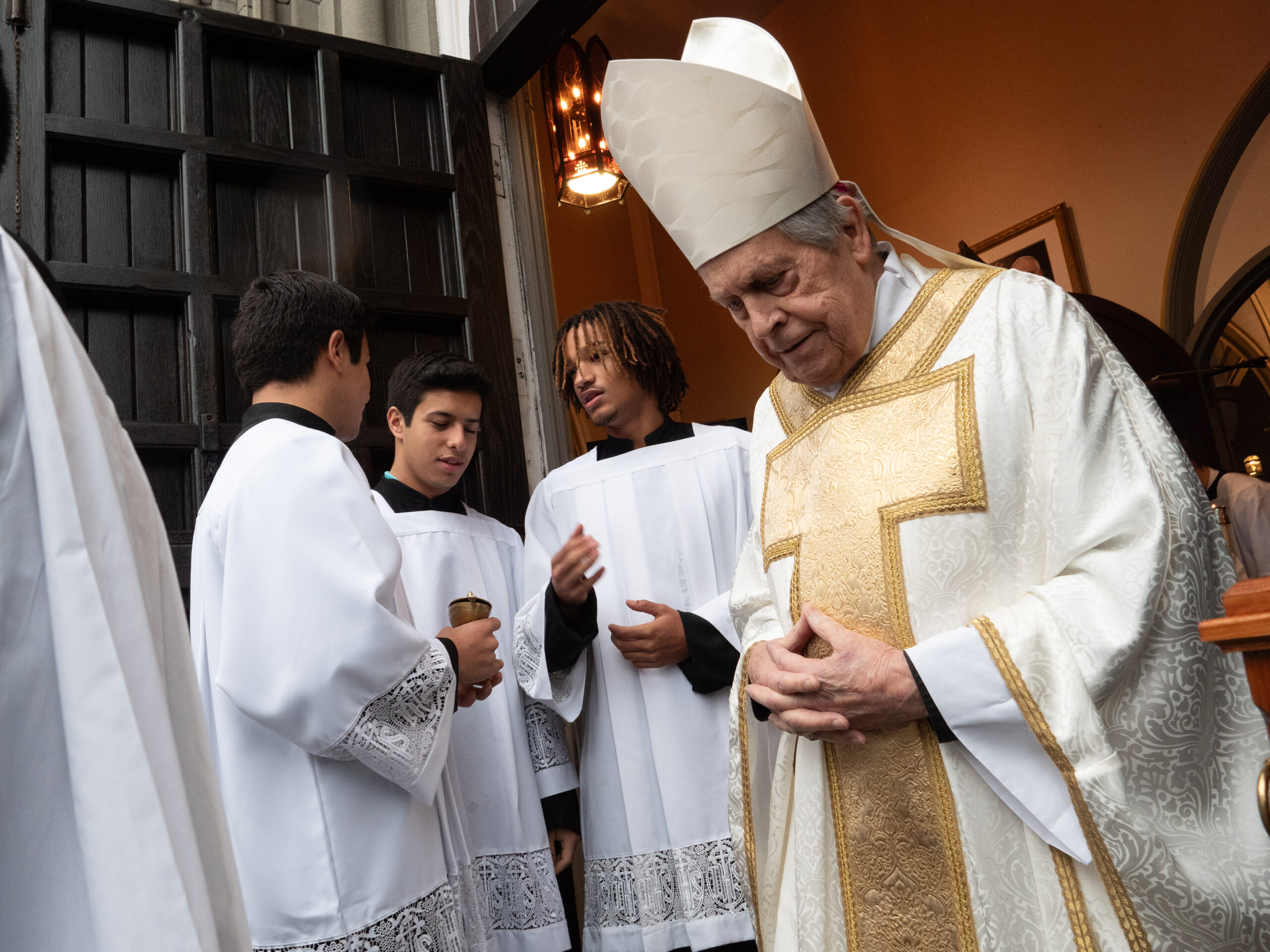

The Archdiocese of Vancouver celebrated the opening of the 2025 Jubilee Year on Sunday with a solemn Pontifical Mass, held on the Feast of the Holy Family.
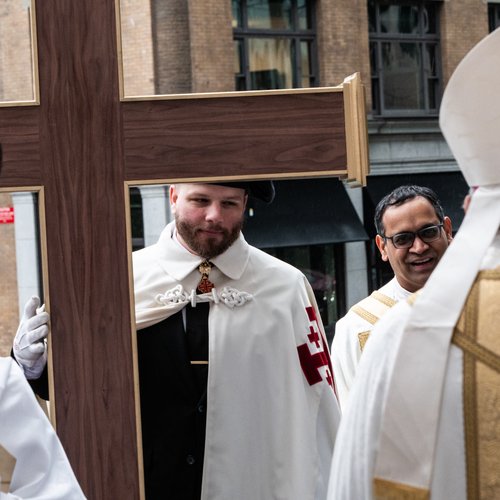
Archbishop J. Michael Miller gathered with about a dozen altar servers, deacons, and lay faithful outside Holy Rosary Cathedral before the Mass for a rite of blessing and prayer to mark the start of the Jubilee celebrations.
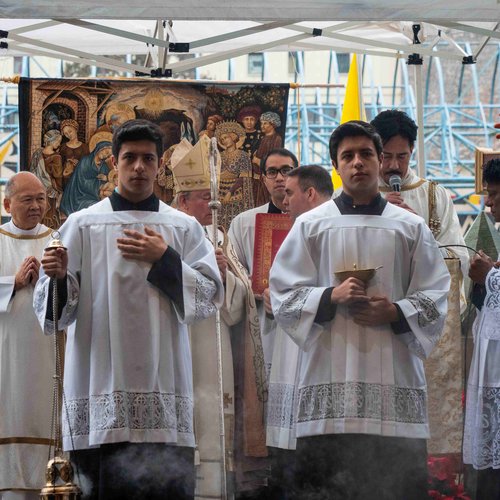
During his opening address, the Archbishop proclaimed, “Brothers and sisters, the mystery of the incarnation of our Saviour Jesus Christ, fostered in the communion of love of the Holy Family of Nazareth, is for us the ground of deep joy and certain hope. In fellowship with the Universal Church, as we celebrate the love of the Father that reveals itself in the flesh of the Word made man and in the sign of the Cross, anchor of salvation, we solemnly open the Jubilee Year for the Church of Vancouver.”
The Archbishop described the year ahead as a time for grace and renewal, saying, “This rite is for us the prelude to a rich experience of grace and mercy. We are ready always to respond to whoever asks the reason for the hope that is in us, especially in this time of war and disorder. May Christ, our peace and our hope, be our companion on the journey in this year of grace and consolation. May the Holy Spirit, who today begins this work both in us and with us, bring it to completion in the day of Christ Jesus.”
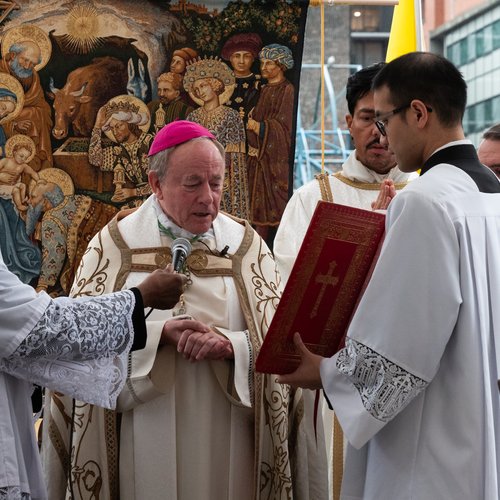
A lay reader read from Pope Francis’ Bull of Indiction for the Jubilee, Spes Non Confundit (Hope Does Not Disappoint), emphasizing the theme of hope for the Jubilee as proclaimed in St. Paul’s Letter to the Romans.
“In the spirit of hope, the Apostle Paul addressed these words of encouragement to the Christian community of Rome. Hope is also the central message of the coming Jubilee that, in accordance with an ancient tradition, the Pope proclaims every 25 years. My thoughts turn to all those pilgrims of hope who will travel to Rome in order to experience the Holy Year, and to all those others who, though unable to visit the City of the Apostles Peter and Paul, will celebrate it in their local Churches. For everyone, may the Jubilee be a moment of genuine, personal encounter with the Lord Jesus, the ‘door’ (cf. Jn 10:7, 9) of our salvation, whom the Church is charged to proclaim always, everywhere, and to all as ‘our hope’ (1 Tim 1:1),” the Bull reads.
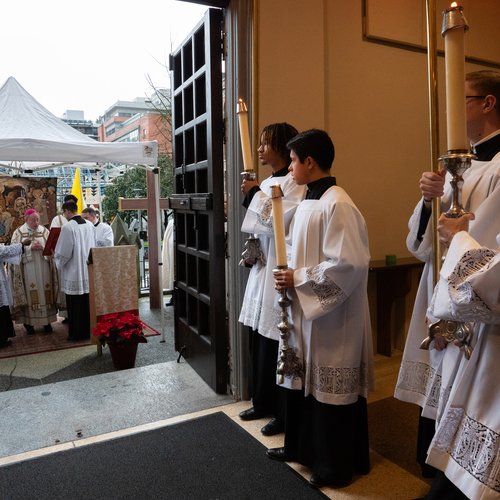
The Pope’s Jubilee message highlights hope as a universal human experience. “Everyone knows what it is to hope. In the heart of each person, hope dwells as the desire and expectation of good things to come, despite our not knowing what the future may bring. Even so, uncertainty about the future may at times give rise to conflicting feelings, ranging from confident trust to apprehensiveness, from serenity to anxiety, from firm conviction to hesitation and doubt. Often we come across people who are discouraged, pessimistic, and cynical about the future, as if nothing could possibly bring them happiness. For all of us, may the Jubilee be an opportunity to be renewed in hope.”
The Bull also pointed to the foundation of hope in Jesus’ love and sacrifice: “Hope is born of love and based on the love springing from the pierced heart of Jesus upon the cross: ‘For if while we were enemies, we were reconciled to God through the death of his Son, much more surely, having been reconciled, will we be saved by his life’ (Rom 5:19). That life becomes manifest in our own life of faith, which begins with baptism, develops in openness to God’s grace, and is enlivened by a hope constantly renewed and confirmed by the working of the Holy Spirit.”
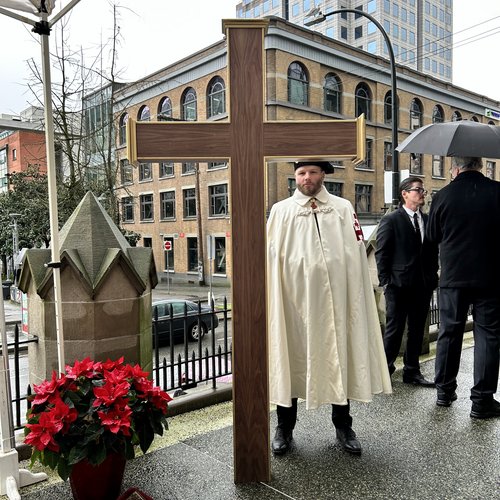
The liturgy continued with a procession into the cathedral with the Jubilee cross carried by a Knight of the Holy Sepulchre, while the choir sang Angels We Have Heard on High.
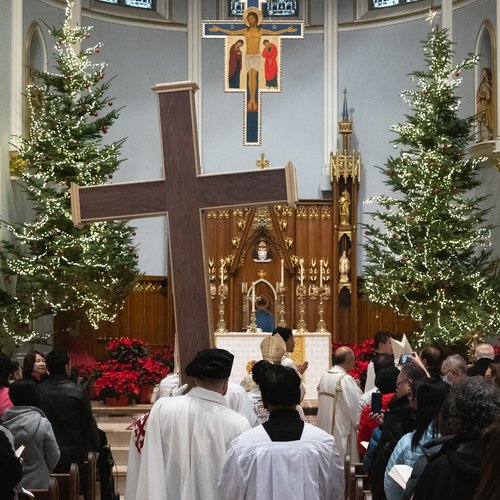
In his homily, Archbishop Miller declared, “The Jubilee Year in the Archdiocese of Vancouver has indeed begun. To emphasize the special significance of this day, Pope Francis mandated that every bishop around the world initiate this year of grace in his diocese, with the rite that we celebrated at the beginning of Mass.”
In the Archdiocese, he said, “we have embarked on a year-long pilgrimage by placing the Glorious Cross of Christ by the baptismal font in our cathedral, where it will remain throughout the year. It is placed in our cathedral to remind us to pray fervently that during this holy year, the Lord will enkindle our hope – hope that we need as we walk the journey of our life.”
The Archbishop said the Church is experiencing an “extraordinary time of grace” intended “to renew in us an experience of a moment of genuine personal encounter with the person of Jesus Christ himself, the one who is the door of our salvation, whom the Church is charged to proclaim always, everywhere, and to all people.
“As Christians who want to be faithful, we have no choice but to fan this flame of hope that has been given to us. For this reason, the grace of a Jubilee Year is to throw open our hearts and the hearts of our brothers and sisters to hope.”
The Jubilee year invites the faithful “to respond gladly and generously to our baptismal call to be disciples who are missionaries, men and women in love with God – and this year especially, heralds of hope to those around us.” In the coming year, the faithful are “called to discover hope in the signs of the times that the Lord gives us in the year soon upon us, 2025.”
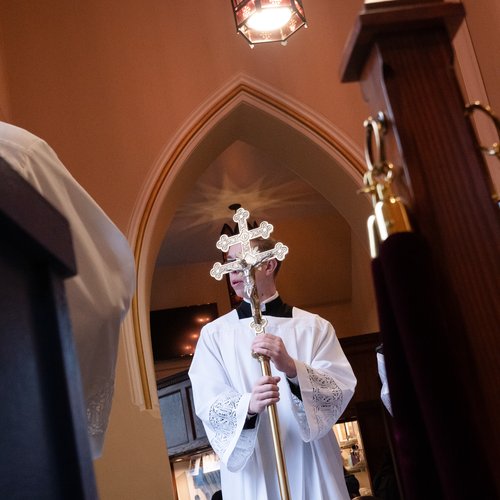
It is a time “to recognize the immense goodness present in our world, lest we be tempted to think ourselves simply overwhelmed by evil and sinfulness,” he said.
“Indeed, in a world so given to skepticism and, sadly, often to despair, this is a year to be intentional about restoring a climate of hope, founded on Jesus Christ and trust in God’s merciful providence.”
The Archbishop said everyone has a duty to bring hope wherever it has been lost, “perhaps by death or unexpected illness, lost by promises broken or dreams shattered, lost by lives overwhelmed by adversity.”
He invited the faithful to “announce hope to the weary who lack the strength to carry on, to the lonely often oppressed by the bitterness of failure, and to all those who are brokenhearted. We are called to bring hope to those who are incarcerated, hope to the cold tents of the homeless, and hope to places desecrated by violence and war.”
Hope is needed not only by the world, he said, but also by the Church, “that when she feels wearied by her exertions and burdened by her frailty, she will always remember that as the Bride of Christ, she is loved with an eternal and faithful love. The Church is called to hold high the light of the Gospel and is sent forth to bring to all the fire that Jesus definitively brought to this world.”
He invited all in the Archdiocese, from the seriously committed to those who are questioning or have left their faith, to become “pilgrims of hope,” opening their hearts “to the joy that the Lord himself wishes to bestow on them during this year of Jubilee.”
Addressing the Gospel narrative for the feast of the Holy Family, the Archbishop said, “The family is the single most important institution on Earth” having its origins at the start of creation.
“It was God’s original plan for man and woman to be a married couple, from whom children should be born. The Son of God so treasured the family that he wanted to be born and to grow up in one.”
Jesus discovered himself as a man by living an ordinary family life with Mary and Joseph in Nazareth, the Archbishop said, one that many think of as peacefully portrayed in nativity scenes, in contrast to their own families, which are “overwhelmed with concerns about work, about money, about how to care for elderly parents, or how to deal with rebellious teenagers.”
The Holy Family, however, was not free of trials and can model how to live as a family, he said. From Mary’s unexpected pregnancy to the family’s fleeing to Egypt to Mary and Joseph losing Jesus for several days, “these challenges can inspire us to see in the Holy Family a family after which we can model our own.”
In their simple life, they took Jesus to the synagogue on the sabbath, to Jerusalem for great feasts, and taught Jesus his faith, with Joseph leading the family’s prayer life.
“Love reigned among the three of them, and God was given first place.”
As today’s families face challenges in praying together and attending church, “our Gospel reminds us to follow, to imitate the example of the Holy Family.”
Jesus’ being lost similarly teaches a lesson, he said. Despite Mary and Joseph being his parents and first teachers in the faith, Jesus was a mystery even to them, the Archbishop said. His response upon being found in the temple “challenges Mary and Joseph to come to grips with the truth that Jesus must first and foremost fulfill his Father’s plan.”
Listening to each other is fundamental in a family, he said, reminding parents “that their ultimate task is not to get their children to do what they want but to encourage them to say yes to what God wants,” even when they don’t understand it or wouldn’t have chosen it themselves.
The vocation of the family, he said, is “simply to accompany each of its members, each one in his or her uniqueness, on their path of the discovery of God and the plan that he has for their life.”
He closed with a prayer that the Holy Family “will protect our families, guide them, and that during this Jubilee our families will grow in the virtue of hope – a hope founded on Jesus Christ – and that they will grow likewise in their love for one another.”
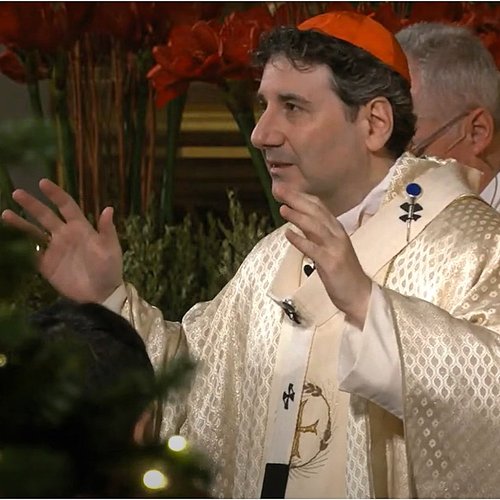
In Toronto, Catholics welcomed Cardinal Francis Leo back home following his journey to Rome earlier this month where he was elevated to the College of Cardinals.
His return was cemented by his presence at the Archdiocese of Toronto’s Solemn Opening Mass of the Jubilee Year, officially kicking off the Holy Year under the theme of “Pilgrims of Hope” with an evening Mass on Dec. 29 at St. Michael’s Cathedral Basilica.
“I think the Lord must be proud and happy that we are here to open this wonderful new Jubilee Year celebration together. This evening we embark together on a year-long journey of spiritual renewal, to replenish our souls with God’s sanctifying grace,” Cardinal Leo said to the crowd gathered at the downtown cathedral.
Following the Gospel reading of the Feast of the Holy Family in Luke 2: 41-52, Cardinal Leo spoke through his homily about Pope Francis’ intentions to have the Jubilee Year act as a grace-filled opportunity to encounter our Lord in a more deep, personal way.
“This is a moment of genuine and personal encounter with Lord Jesus who is the door to our salvation. That is what we do during a jubilee, we receive mercy from God and we give that mercy to others,” he said.
According to Cardinal Leo, those opportunities are available to all Catholics and especially to those within the Archdiocese of Toronto. He spoke to the number of pilgrim churches throughout the Archdiocese tasked with bringing the faithful together over the next 12 months. These include Martyrs’ Shrine in Midland, St. Paul’s Basilica, St. Mary’s and St. Edward the Confessor for the central region, Our Lady of Sorrows and St. Mary’s (Brampton) in the west, St. Barnabas and St. Gregory the Great in the east and St. Padre Pio and St. Mary’s (Barrie) in the north.
Additionally, the celebratory Mass marked the beginning of a multitude of different pilgrimages, initiatives and services that are set to take place over the course of next year for the Jubilee Year in Toronto. These include a pilgrimage led by Cardinal Leo to Martyrs’ Shrine for its 100th anniversary in August, a Jubilee Day with Mary at St. Augustine’s Seminary on May 31 and Office of Catholic Youth and archdiocesan pilgrimages to Rome on July 23 and Nov. 10, respectively.
More than anything, Cardinal Leo expressed his own hopes for 2025, calling on Catholics around the world to be attentive and receptive to the gifts available to us during the Jubilee Year.
“Hope is not the power of wishful and positive thinking, nor is it optimism or pessimism. Hope means to place your trust, to place your life and to place your future in God’s promises,” he said. “God has put aside so many personalized graces with our names on them this year, so we must open up the door of our hearts to receive what God wants to give us because He loves us.”
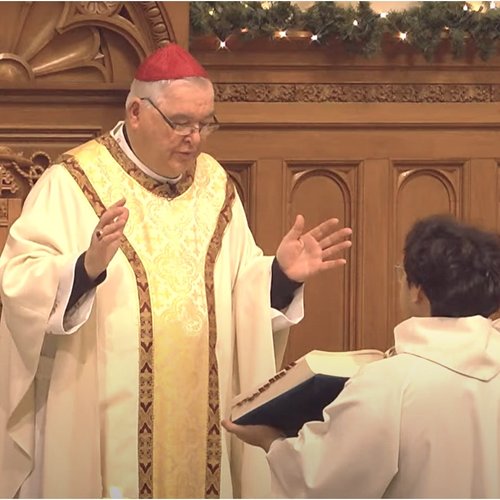
In Winnipeg, Archbishop Richard Gagnon drew upon Pope Francis’ teaching to highlight the connection between hope and kindness, calling them “two things much needed today.”
Noting how the word “kindness” comes from the same root word as kin reveals how families should treat each other, Archbishop Gagnon said.
“We are family of Christ. We are the body of Christ. Our communities need to be kinder to one another. We need to be kinder people.”
He cited the Pope’s view of kindness as “not a diplomatic strategy nor a set of rules that ensures social harmony,” but rather “a form of love that opens hearts to acceptance and helps us all to become humble.”
“Kindness must be intentional,” Archbishop Gagnon said. “We must not be overcome by the violence and the cynicism today that we find all around, but return to God, whose heart is always open. Let us return to him. Let us return to the heart that loves us and forgives us.”
He also noted how Pope Francis used the Holy Doors in Rome to symbolize “God’s heart, always open to grant mercy and forgiveness.”
He ended by noting the Holy Father’s wish for the new year is for hope, “which is a theological virtue, along with faith and love. He prays for peace, fellowship, and gratitude every day for the gifts that we have received from almighty God. These are all characteristics present in the Holy Family and are part and parcel of each authentically Christian family.
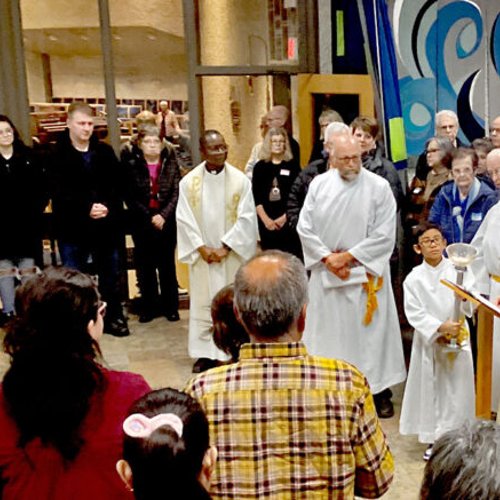
In Saskatoon, Bishop Mark Hagemoen opened the Jubilee 2025 Year on Dec. 28 at Holy Spirit Church.
In a gathering at the entrance of the church at the start of Mass, Bishop Hagemoen proclaimed: “In fellowship with the universal Church, as we celebrate the love of the Father that reveals itself in the flesh of the Word made man and in the sign of the cross, anchor of salvation, we solemnly open the Jubilee Year for the Church of the diocese of Saskatoon.”
The bishop continued: “This rite is for us the prelude to a rich experience of grace and mercy; we are ready always to respond to whoever asks the reason for the hope that is in us, especially in this time of war and disorder. May Christ, our peace and our hope, be our companion on the journey in this year of grace and consolation. May the Holy Spirit, who today begins this work both in us and with us, bring it to completion in the day of Christ Jesus.”
In his homily, Bishop Hagemoen reflected on Pope Francis’ declaration of the theme “Pilgrims of Hope.”
The Holy Father is extremely concerned about obstacles to hope in our time, Bishop Hagemoen noted. “Not just obstacles that are theoretical – real obstacles. There are too many wars in the world… the majority of people on the planet Earth are dealing with some sort of significant conflict, or major inadequacy to their thriving as human beings.”
The bishop quoted Pope Francis’ call to the faithful to be Pilgrims of Hope: “We must fan the flame of hope that has been given us and help everyone to gain new strength and certainty by looking to the future with an open spirit, a trusting heart and far-sighted vision.”
Your voice matters! Join the conversation by submitting a Letter to the Editor here.