CCCB president says points are ‘completely unacceptable’
OTTAWA (CCN)
The conference of Catholic bishops and an array of other groups have condemned recommendations in a special parliamentary report on assisted-death tabled in the House of Commons Feb. 25.
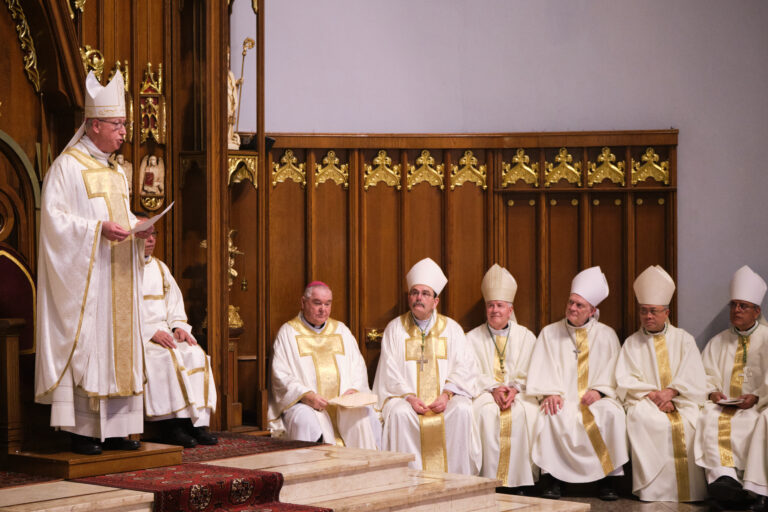
“Killing the mentally and physically ill, whether young or aged, is contrary to caring for and loving one’s brother and sister,” said a pastoral letter from Bishop Douglas Crosby of Hamilton, president of the Canadian Conference of Catholic Bishops. He called the committee report an example of what Pope Francis has called “throw-away culture.”
He urged Catholics to let their elected representatives know the recommendations of the special joint Parliamentary Committee on Physician-Assisted Dying are “completely unacceptable.”
“Canadians, especially those dying or suffering from illness, deserve better,” said Archbishop J. Michael Miller of Vancouver. “It’s alarming how easily suicide is being offered and respect for life eroded.”
The report of the special joint Parliamentary Committee on Physician-Assisted Dying recommends allowing physician-assisted death for those with psychiatric conditions; it opens the way for children under 18 to be euthanized; it would permit advanced directives for people with dementia so they can be euthanized provided they made the directive when competent; and recommends forcing physicians to make an effective referral.
It also recommends all health facilities that receive public funding provide physician-assisted death.
The three Conservative MPs on the committee, including its vice co-chairman, MP Michael Cooper, issued a dissenting report that said the recommendations go far beyond the parameters outlined in the Supreme Court of Canada’s Carter decision. At a Feb. 25 news conference, Cooper described the majority recommendations as “dangerous.”
The dissenting report blasted the lack of protection for the vulnerable and the violation of health professionals’ conscience rights.
Euthanasia Prevention Coalition executive director Alex Schadenberg echoed the dissenting report’s concerns for the vulnerable. He pointed out the only oversight happens after the two doctors who have approved the assisted death send in their reports. “It’s an after-death reporting system,” he said. “The doctor who kills you will send in a report after you’re dead. You have to trust the doctor who kills you.”
Schadenberg pointed to the lack of objective criteria in assessing “intolerable suffering. “It means it’s pretty wide open,” he said.
“Once euthanasia for minors is allowed, as well as for those with dementia based on an advanced directive, there will be arguments for the euthanasia of children and for incompetent adults, Schadenberg warned.
“I have no words to describe how sad and alarming this report is,” said Catholic Organization for Life and Family director Michele Boulva. “If the Trudeau government develops a bill following these lines, it will be the worst legislation in the world – a huge societal failure.”
The Coalition for HealthCARE, which Toronto Cardinal Thomas Collins represented at one of the Committee’s public hearings in early February, came out strongly against the recommendations violation of conscience rights.
“In our view, effective referral and participating in assisted death are morally and ethically the same thing. This would force people of conscience and faith to act against their moral convictions and threaten the very core of why they became physicians, which is to help to heal people,” said Larry Worthen, Coalition member and Executive Director of the Christian Medical and Dental Society of Canada, in a release. “This is discrimination. It is unnecessary. No other jurisdiction in the world requires physicians to refer for assisted death.”
The Coalition also expressed shock over the recommendation to force health care institutions to participate.
“This is a grave threat to a large number of faith-based health care institutions across the country, including hospitals, long-term care facilities, nursing homes and hospices,” Worthen said. “Forcing these members, and leaders of these facilities, to act in this way, would be trampling on their constitutional right to freedom of conscience and religion guaranteed under the Charter.”
Even the Canadian Medical Association’s president Dr. Cindy Forbes said the Committee report “does fall short on the issue of respecting a physician’s right to conscientious objection.”
“As the government moves forward in drafting legislation, we must focus on ensuring effective access while also respecting different views of conscientious objection,” she said. “Both can be achieved. While not addressed by this report, a central mechanism to coordinate access must be a key part of the solution.”
The Catholic Civil Rights League said in a news release the Committee’s “majority recommends the practically unfettered and immediate implementation of death on demand.”
“The League fears for the elderly, the disabled, and those with mental health afflictions, that they will be the subject of increased pressure to take their own lives, rather than gain access to treatment, or palliative care,” the release said. “In every other jurisdiction, the scope of assisted suicide and euthanasia widens, and instances of egregious circumstances of premature death prevail.”
The League stressed forcing physicians to make an “effective referral” is “an infringement of the Charter right of freedom of conscience and religion.”
“These recommendations are reckless, and broadly influenced by a radical philosophy of absolute autonomy,” said Natalie Sonnen, executive director for LifeCanada. “I think they go way beyond what the public had expected and will have a chilling effect on the entire medical profession.”
“We have barely finished Suicide Prevention Week, and lo and behold, our political leaders are promoting a right to assistance in committing suicide,” said a joint-release from the Quebec-based Physicians’ Alliance Against Euthanasia and the grassroots organization Living with Dignity. “This glaring inconsistency highlights the Committee’s eagerness to maintain the confusion that led to the adoption of the Quebec Law.”
The Quebec groups point to the report’s recommendation the “euphemism ‘medical aid in dying’ be used in any future legislation instead of “assisted suicide” or “euthanasia” since those terms are considered “loaded.”
The Catholic Health Association, however, was more conciliatory. “It is too soon to know which of the 21 recommendations may be part of any final legislation,” said a statement from the Association’s president Michael Shea. “As the Federal Government carefully considers the report and begins to draft legislation, we will continue to work in humility and openness with all stakeholders to navigate this issue.”
Schadenberg said if the recommendations concerning referrals becomes part of the legislation, “many good doctors will leave Canada.”
“It’s about time our religious leaders make it clear we will not be complicit in such a law,” Schadenberg said. Religious institutions cannot take part in “killing their patients,” something that is “always morally unacceptable.”
House Leader Dominic Leblanc said a decision on whether to force MPs to support the legislation will be made after the bill is drafted.
Justice Minister Jody Wilson-Raybould said the report will be considered, along with the report of the external panel.
“It’s too early to say what is going to be in the legislation or what’s not going to be in the legislation,” she said.