The Archdiocese of Vancouver has released its first-ever pastoral plan to better reach out to Spanish-speaking Catholics.
“Our Hispanic brothers and sisters (are) such a great blessing in our midst,” wrote Archbishop J. Michael Miller, CSB, in a letter introducing the plan.
A ministry to Spanish speakers has been growing in the archdiocese since two priests and a nun began celebrating Mass in Spanish and reaching out to Chilean refugees in 1973.
“As the Spanish-speaking population continues to grow, the time has come to enhance this endeavour with an intentional plan that brings clarity to the mission and prioritizes where we should focus our efforts,” wrote the Archbishop.
The new plan was launched before a group of Hispanic Ministry workers and volunteers Nov. 19.
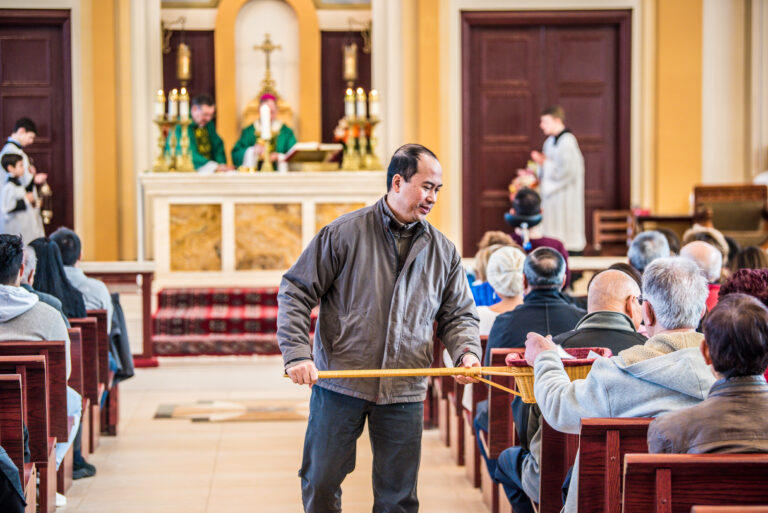
About 140 people, most of them immigrants, gathered at the John Paul II Pastoral Centre for Mass in Spanish and a day of talks about their roles and the future of the ministry.
Father Richard Zanotti, the head of Hispanic Ministry, said Spanish-speaking Catholics are unique in ways other than language.
“The music is very different. We use guitars, drums, and a keyboard, and the style of the music is a little bit different,” he said.
“Community is really important. After Mass, they look forward to having a time where they share food and talk. They’re not in a rush to go home.”
Although Spanish speakers come to B.C. from around the globe, he recognizes “there is some commonality,” including pious practices and devotions to certain saints.
“Some of them have a deeper sense of social justice because they came from experiences of civil war or oppression in their own countries,” he added.
Vancouver welcomes almost 31,000 new immigrants each year, says the pastoral plan, and although the Chinese, Indian, and Filipino populations are the largest growing, thousands of Spanish speakers also enter B.C. each year.
The plan’s goals include promoting Spanish-language worship and programs, such as Bible studies; working alongside existing groups including Marriage Encounter, Charismatic Renewal, and Bodas de Cana; and forming new ministry leaders.
“We have a responsibility of representing the Church in reaching out, in evangelizing, in doing liturgy, and all the different aspects,” Father Zanotti said.
The plan also outlines priorities for serving temporary foreign workers and seasonal farmers.
About 34,000 temporary foreign workers land in Greater Vancouver each year, often picking up jobs in hospitality, food service, housekeeping, and care for children or elderly.
Groups including Couples for Christ, Handmaids, St. Mary’s Migrant Ministry, and St. Joseph’s Migrant Ministry host workshops for them with spiritual and practical advice.
In 2012, more than 6,000 seasonal farm workers, most of them Spanish speaking, got jobs on B.C. farms, mainly in the Fraser Valley, Tri Cities, and Delta, under the government’s Seasonal Agricultural Worker Program.
“To leave your family is not easy, but I need to do it because I need to raise my family,” Serjio Coronado, a farm worker and father of eight, told The B.C. Catholic last year.
“We looked for the Church, and we found the Church, and the Church has extended a hand to us.”
Six churches currently serve seasonal farm workers by celebrating Mass in Spanish at least once a month, providing transportation to and from church, and offering sacraments and practical advice.
They also provide community meals, including an annual Christmas dinner for about 150 farm workers, complete with a buffet, live music, dancing, and raffles.
The Archdiocese also recently launched ministries for Filipinos and Chinese Catholics.