Bishops will begin making ad limina visits to Rome in 2017
By Deborah Gyapong
OTTAWA (CCN)
The Canadian Conference of Catholic Bishops (CCCB) will release a new sexual abuse document in early 2017 and makes its first ad limina visits to Rome in 11 years starting in March.
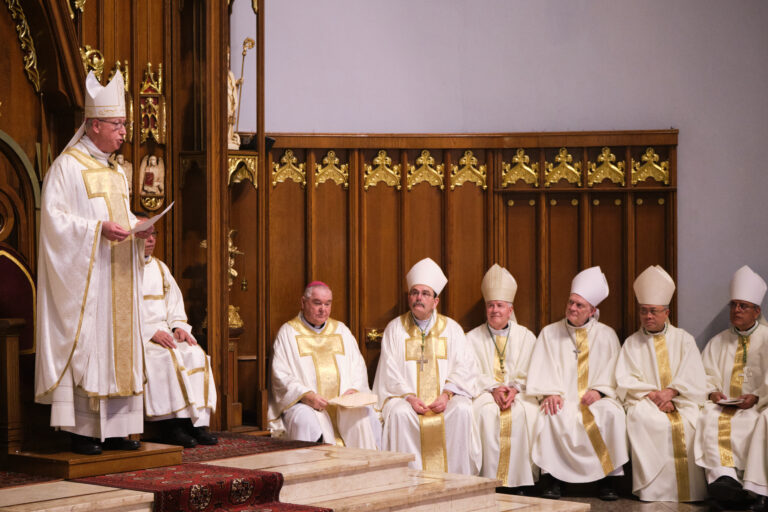
At their annual plenary Sept. 26-30 in Cornwall, Ontario, the more than 80 bishops and eparchs approved in principle a new document on preventing sexual abuse and protecting minors called Moving Towards Healing-The Canadian Experience.
It will follow but not replace the 1992 document From Pain to Hope, said Bishop Douglas Crosby of Hamilton, the CCCB president. “Our experience is so much broader now and so much deeper. This will present a lot more information along the lines of From Pain to Hope but updated.”
Bishops will now have a chance to review the text and send in suggestions and corrections. Bishop Crosby said he expects that if not major changes are required, the document will be approved in November at the next meeting of the CCCB’s Permanent Council and published in early 2017.
The bishops are also discussing the establishment of a new coalition of Catholic organizations with the proposed name of Our Lady of Guadalupe Circle, Crosby said. “There seems to be some interest in it, but there needs to be clarification of purpose and direction.”
The idea sprang from the joint-response of the CCCB, the Canadian Catholic Aboriginal Council (CCAC), the Canadian Religious Conference, and the Canadian Catholic Organization for Development and Peace to the March deadline for the churches’ response to some of the Calls to Action of the Truth and Reconciliation Commission.
“One of things we’ve discovered, the Catholic voice is broader voice,” Bishop Crosby said. “How do we gather the various interests in expressing the Catholic response to these issues.”
Ad limina visits to Rome
In March, Canada’s bishops start their ad limina-meaning ‘on the threshold’ of the Apostles—to Rome to meet with Pope Francis and visit various dicasteries or departments of the Roman Curia.
The last such visits took place in 2006, Bishop Crosby said. While the bishops will meet with the Holy Father, there is still no word whether Pope Francis will visit Canada in the near future to answer a request from the TRC’s Calls to Action that the Pope make an apology to Indigenous Peoples in Canada for Indian Residential Schools.
Bishop Crosby said the Apostolic Nuncio Archbishop Luigi Bonazzi told the bishops during their annual plenary in Cornwall, Ontario Sept. 26-30 the “invitation is in Rome” and they are considering it. “It’s going to be a decision of the Holy Father,” said Bishop Crosby. “He gets lots of invitations to countries now and he’s going on 80.”
The bishops will visit Rome in regional groups, starting with the Atlantic bishops in March. They will be followed by the Quebec Bishops, then the Ontario Bishops, and finally the Western Bishops, according to Halifax Archbishop Anthony Mancini.
The Atlantic bishops will focus on the “impact and consequences of sexual abuse, the scandal, the crisis of that on the life of the Church in the Atlantic region,” said Archbishop Mancini. “It’s a very delicate subject.”
Quebec will deal with euthanasia in the “context of a highly secularized society;” Ontario will also deal with euthanasia and assisted suicide and on Catholic schools. The Western bishops will discuss the priority of reconciliation with Canada’s Indigenous Peoples, he said.
The bishops agreed to not all share the same topics, so that by the time all the bishops have met with the Pope, he’ll have an overview,” Bishop Mancini said.
Future of COLF and CCODP
The bishops also reviewed the Catholic Organization for Development and Peace, which marks its 50th anniversary next year. Bishop Crosby said he, as the CCCB president, would be issuing a statement “reflecting on the satisfaction of the bishops for the work accomplished over the last 50 years and the immense amount of good coming out of Development and Peace.”
The agency is looking for a new executive director, as the previous director David Leduc departed before his probationary year was up.
The bishops will also review the mandate of the Catholic Organization for Life and Family (COLF), which marked its 20th anniversary this year. COLF’s director Michele Boulva is retiring at the end of 2016, so while a search is underway for her replacement, the bishops will review the mandate of the organization, and whether it will continue as an autonomous organization co-sponsored by the CCCB and the Knights of Columbus Supreme Council.
Bishop Crosby said the bishops have a positive view of COLF. It has “done wonderful work,” and its many publications on life and family issues have been “helpful, pastorally timely and appropriate.”
The bishops will be sending in a questionnaire concerning COLF to guide the process, but one issue that came up in the plenary was how to get COLF’s excellent publications better known among the grassroots, Bishop Crosby said. One idea was the establishment of parish groups throughout the country similar to those for the Canadian Catholic Organization for Development and Peace, he said. “No decisions have been taken,” the bishop said. “We’ll wait and see the results of the consultation, and then we’ll make proposals.”
New causes
The Canadian bishops dedicated Canada’s three latest saints to particular causes, as they are allowed to do by the Congregation for the Causes of Saints, said Bishop Crosby.
St. Francois Laval, Canada’s first bishops, has been declared by the Conference the patron saint of the bishops of Canada. St. Brother Andre of Montreal has been declared the patron saint of family caregivers, “those who care for the sick at home,” Bishop Crosby said.
St. Kateri Tekakwitha, whom Pope Benedict called the “Protectress of Canada,” has been given the “liturgical title of Protectress of Canada,” he said.
“Canadians can pray for her intercession for our country.”