Government focusing on complete families and women at risk
By Deborah Gyapong
OTTAWA (CCN)
Despite calls from religious leaders to respond to a genocide of Christians in the Middle East, Canada is not making any extra provisions for Christian refugees from Syria.
“We are not focusing on any ethnic or religious minorities,” said Nancy Chan, a communications advisor for Immigration, Refugees and Citizenship Canada in a Dec. 23 email.
Chan said the government is focusing on: “complete families; women at risk; and persons identified as vulnerable due to membership in the LGBTI community” in order to “to maximize the success in resettlement while minimizing security risks”
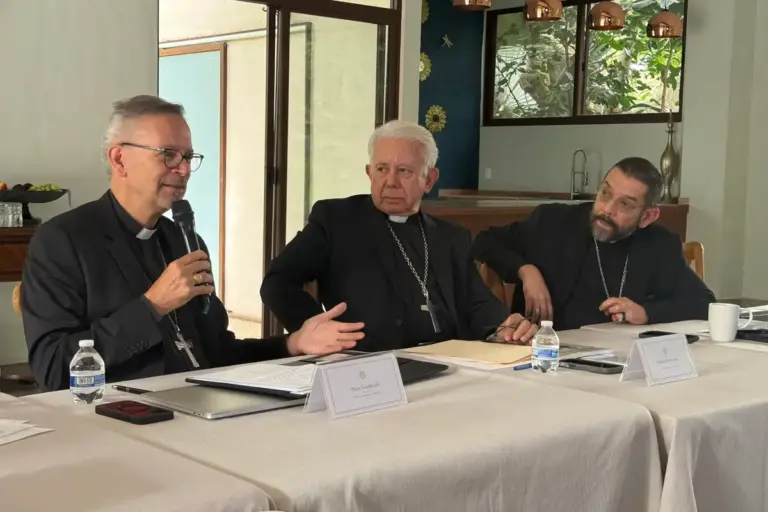
In a Dec. 15 open letter, the Canadian Conference of Catholic Bishops (CCB) president Hamilton Bishop Douglas Crosby and Canadian Rabbinic Caucus co-chair Rabbi Baruch Frydman-Kohl had urged Foreign Affairs Minister St‚phane Dion to make persecuted Christians a priority.
The letter cited Pope Francis and Rabbi Jonathan Sacks who have both described the persecution of Middle East Christians as genocide.
Catholic Near East Welfare Association (CNEWA) Canada national director Carl H‚tu has said at least ten per cent of the refugees Canada receives from Syria should be Christian since that is their proportion of the Syrian population. H‚tu has pointed out Christians and other religious minorities face additional persecution beyond the hardship and devastation of war affecting Syrians of all religions.
In a Dec. 23 news conference, Immigration Minister John McCallum said the government still aimed at bringing in 10,000 Syrian refugees by the end of 2015, but faced challenges. He said he compared the flow of refugees to a wave.
“It starts slow, and it builds up,” he said. “And once the wave builds to maximum level, large numbers of refugees are able to fly across the ocean to Canada. And so one thing I can say with certainty is that our fundamental target will be hit, that is to say well before the end of February, 25,000 Syrian refugees will have landed in Canada as permanent residents.”
McCallum said the government still hopes to receive 10,000 Syrian refugees by Dec. 31.
“That certainly remains our target,” he said. ” We are working day and night to achieve it, but there are certain factors outside our control like the weather — as you know, flights in late December are sometimes cancelled because of weather or delayed — and human nature.”
“If an individual is told that his or her family can come to Canada with two days’ notice, they may not be ready to come in two days because much as their desire strongly to be here, they also want to say goodbye to their friends,” he said.
McCallum said the government was “learning by doing.”
“This is something totally new,” he said. “We’ve never done anything like this in our history on such — at such speed.”
As of Dec. 23, Canada had received 1,869 refugees. Among them 339 are Government-Assisted Refugees, or GARs; 1,297 are privately sponsored and most going to Quebec, Immigration Associate Deputy Minister Dawn Edlund told journalists.
The 25,000 people received by the end of Feb. will be a combination of GARs and privately-sponsored refugees. The government will meet its commitment to bring in a total of 25,000 GARs by the end of 2016. The Minister has said the total number of Syrian refugees received by Canada between Nov. 4, 2015 and the end of 2016 could be in the range of 35,000 to 50,000 depending on the number of privately sponsored refugees.
The minister described his recent visit to refugee camps in Jordan and Lebanon, where Canadian personnel, including Canadian Armed Forces are helping with the processing of refugees and ensuring medical checks are done. McCallum also spoke of efforts in Canada to ensure refugees have a place to stay and support once they arrive in Canada.
McCallum said a challenge is out to corporate Canada to raise $50 million to help settle the refugees. Money is also coming in from Christian and Muslim groups, he said.