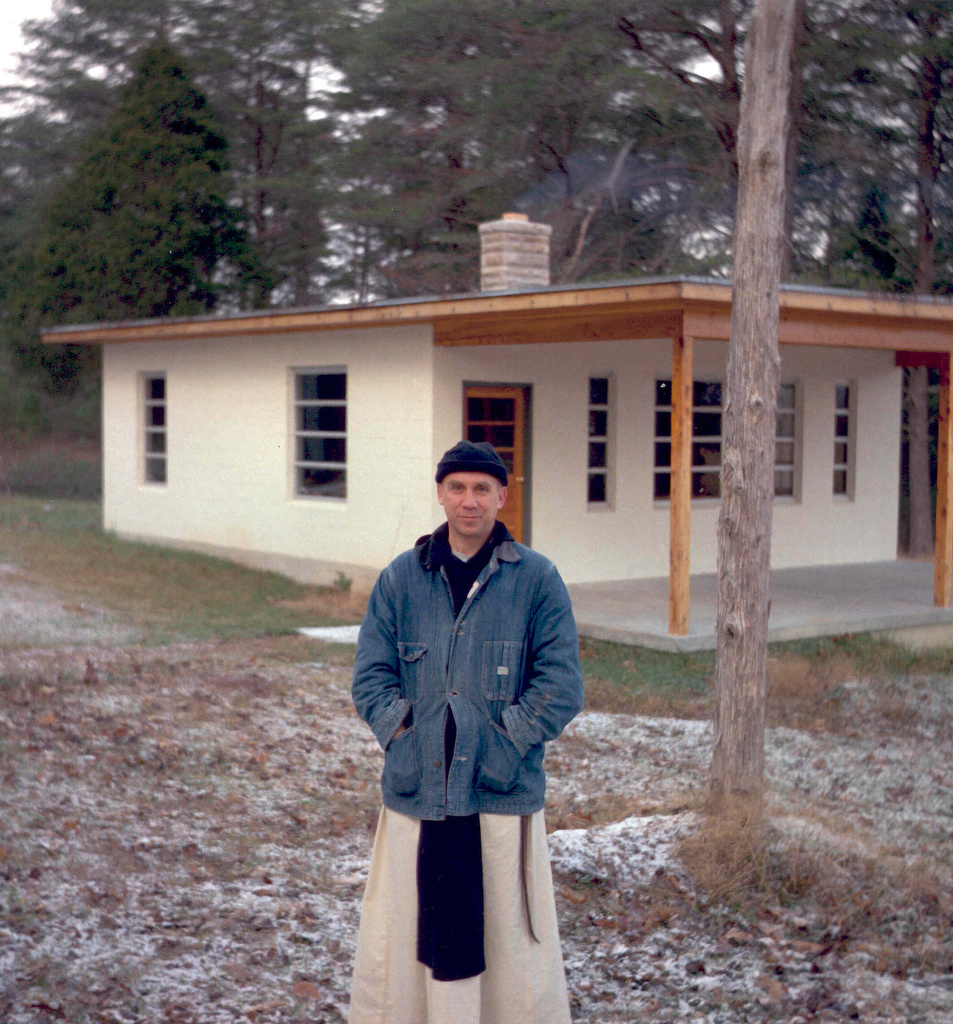

VANCOUVER—Academics are praising the contributions of a Catholic theologian, activist, poet, and Trappist monk born one century ago.
More than 100 students and professors from various Christian backgrounds gathered at Regent College at UBC Jan. 29 to celebrate the 100th anniversary of Father Thomas Merton’s birth.
“The Christian faith is about learning stillness, quietness, attentiveness, receptivity, and the spiritual discipline of knowing how, interiorly, to be still,” said Ron Dart, an associate professor at the University of the Fraser Valley, summing up some of Father Merton’s teachings.
“In that stillness, there are depths revealed to us that will never be revealed to us in our hyperactivity.”
Father Merton was born Jan. 31, 1915, in France. He became a Catholic and joined the Order of Cistercians of the Strict Observance, a group of ascetic monks more commonly known as Trappists, in Kentucky at age 26.
Dart found similarities between Father Merton and Christian apologist C.S. Lewis, born 17 years earlier.
“Both Merton and Lewis, as they entered the modern world, were confronted with a dominant paradigm which sat like a monarch on a throne of secularism, rationalism, logic, empiricism, and objectivity.”
They countered it by critiquing modernity and returning to tradition, myth, poetry, and symbolism, Dart said.
“They were looking for an alternative Christian way of life that is not assimilated into the modern and that calls people to slow down, to go a little deeper, be a little still, and much more will be revealed in the listening.”
Dart continued that Father Merton was also concerned with ecological issues, rights for minorities, war, and interfaith dialogue; he personally knew the Dalai Lama and Buddhist Vietnamese peace activist Thich Nhat Hanh.
His actions stemmed from deep contemplation and faith, according to Trinity Western University professor Lynn Szabo. She found evidence of this in his poetry.
“Merton’s poetics are grounded in his belief that the natural world bears the tracings of a God Whose presence is other and cannot be confined to the cosmos,” she told the crowd.
His insights sprang from silence, Scripture, and Catholic tradition, she explained. His journal entries and poems vividly describe the beauty of the outdoors.
His poetry is “the fruit of a mystical poetics engaging the spirit of God and his life as a stranger, a monk, and a poet who envisioned the transformative powers of poetry as theology.”
Another scholar praised Father Merton as a Christian humanist who viewed all things from the starting point of the mystery of the Incarnation.
“For Merton, the goal of Christianity is the freedom to become what we are meant to be,” said Jens Zimmermann, who holds the Canada research chair in interpretation, religion, and culture at Trinity Western University.
“Contemplation and asceticism, the disciplines that Merton sought in the monastic life … enable us to enter into the freedom of the children of God.”
Father Merton was in Bangkok to promote dialogue with Eastern religions when he died from an accidental electrocution in 1968.
The Thomas Merton Society of Canada was behind the talk at Regent College. It also co-sponsored events at Simon Fraser University and several churches, and it intends to schedule presentations throughout the year.