
VATICAN CITY (CNS) — Calling Pope Leo XIV’s handover of 62 Indigenous artifacts “a milestone in the long journey of reconciliation and healing,” Archbishop Richard Smith says the return comes at a particularly fitting moment as the Jubilee Year of Hope draws to a close.
“I think it’s important for us to stress that it’s happening in the context of the Jubilee of Hope,” he told America magazine after the audience. “This Jubilee, like previous jubilees, wants to emphasize the importance of healing relationships. We’re in this for the long haul, we’ve made that commitment, and we’re going to keep it.” He added that “it’s really on us to carry it forward, and we’re truly committed to do that.”
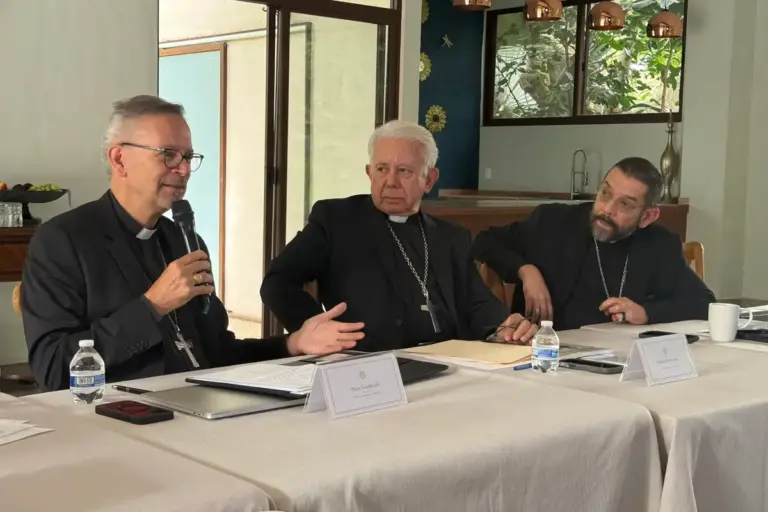
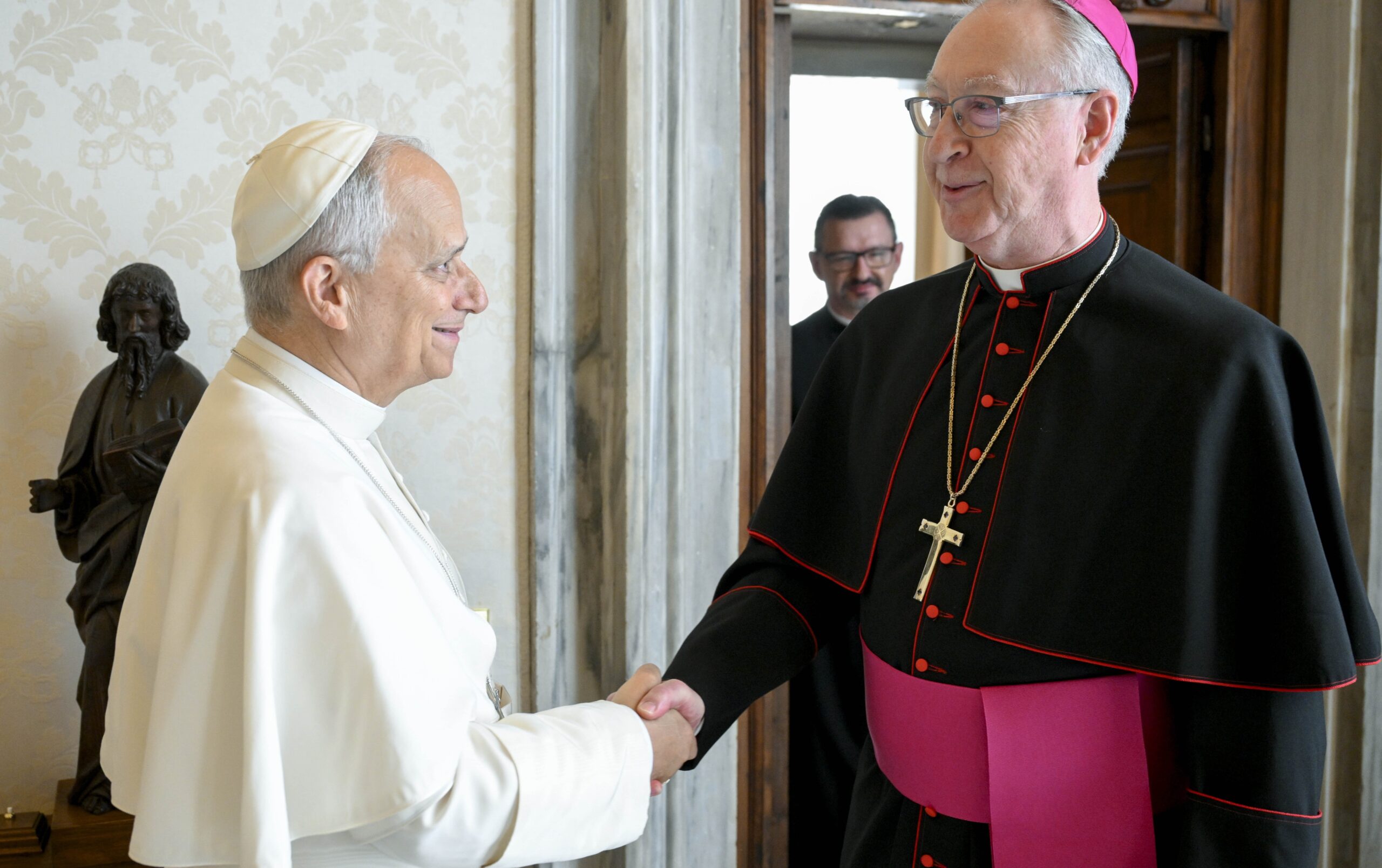
Pope Leo formally entrusted the artifacts — including an Inuit kayak, masks, moccasins, and etchings that have been held in the Vatican Museums for more than a century — to leaders of the Canadian Conference of Catholic Bishops Nov. 15. The audience took place in the Apostolic Palace with Bishop Pierre Goudreault, CCCB president; Archbishop Smith of Vancouver; and Father Jean Vézina, the conference’s general secretary.
The moment was welcomed by Canadian pilgrims in Rome. “It is a great day for Canada in Rome,” said Father Tim Hanley, chair of the Archdiocese of Toronto’s Jubilee Committee, later that day when telling a group of Toronto pilgrims about the handover.
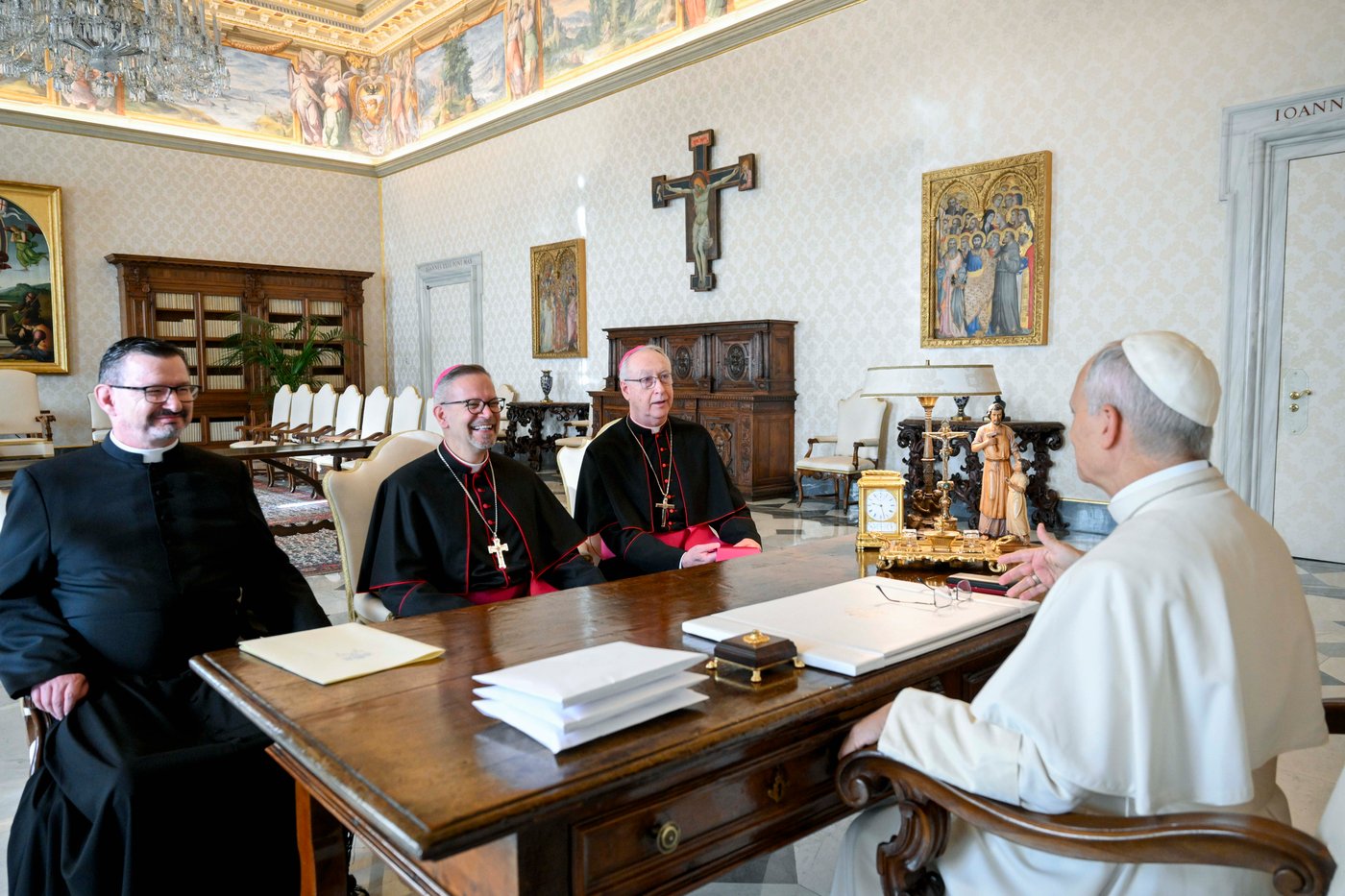
Pope Leo XIV meets with Father Jean Vezina, general secretary of the CCCB, President Bishop Pierre Goudreault of Sainte-Anne-de-la-Pocatière, Quebec, and Vancouver Archbishop Richard Smith, a member of the Canadian Catholic Indigenous Council. (CNS photo/Vatican Media)
According to a joint statement from the Holy See and the CCCB, the gift marks “the conclusion of the journey initiated by Pope Francis,” who met repeatedly with Indigenous delegations before his 2022 “penitential pilgrimage” to Canada and later directed that the items be returned. Pope Leo “desires that this gift represent a concrete sign of dialogue, respect and fraternity,” the statement said.
Indigenous community representatives had previously viewed several of the items during a private tour of the Vatican Museums in the spring of 2022, when they travelled to Rome to meet Pope Francis ahead of his visit to Canada.
Archbishop Smith said the bishops’ role throughout the process “has really been a facilitating one, just working with the Holy See, working with the Indigenous leaders to make this happen.” He emphasized that much of the momentum traces back to Pope Francis: “This journey goes back to Pope Francis—I’d like to emphasize that; it’s really something that grew out of his heart.”
Pope Leo’s decision to give the artifacts to the Canadian bishops instead of to the government or an Indigenous organization “is a tangible sign of his desire to help Canada’s Bishops walk alongside Indigenous Peoples in a spirit of reconciliation during the Jubilee Year of Hope and beyond,” Bishop Goudreault said.
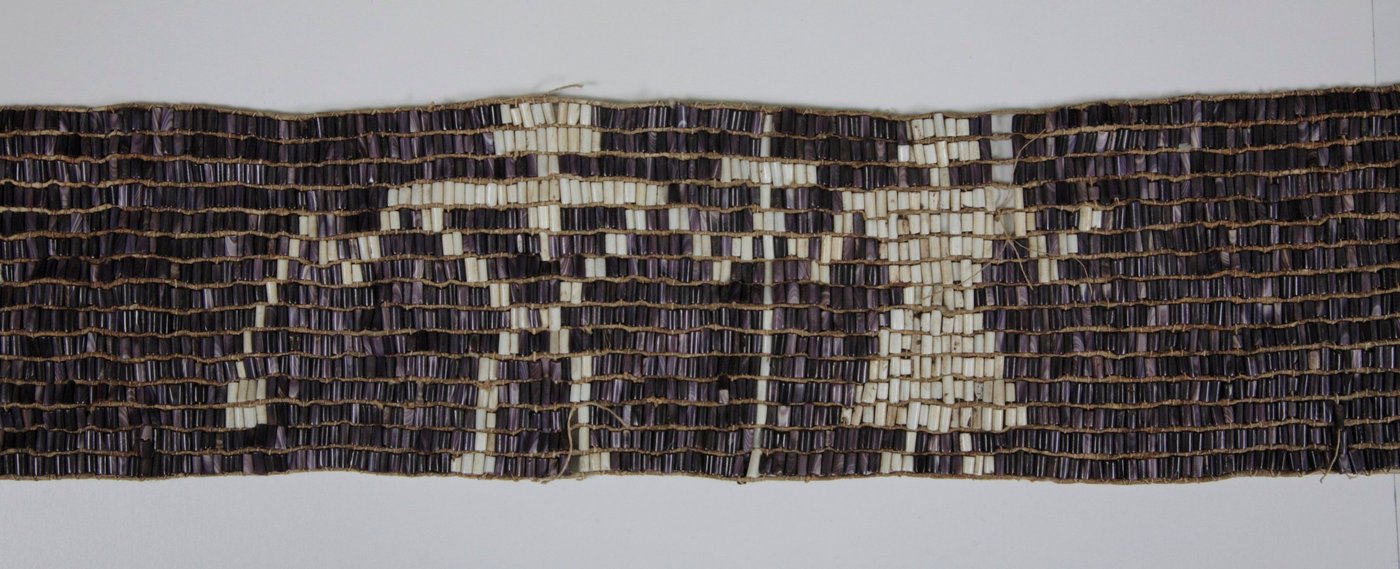
A wampum belt, from what is now Quebec, symbolizing Indigenous people forming an alliance with French Catholic colonizers is seen in this 2008 file photo from the Vatican Museums’ ethnological collection. (CNS photo/courtesy Vatican Museums)
The principal partner of the CCCB in the process has been the Inuvialuit Regional Corporation, which other Indigenous organizations agreed would take the lead, particularly given that the collection includes an Inuvialuit whaling kayak from the Western Arctic.
The artifacts, from First Nations, Métis, and Inuit communities, “are part of the patrimony received on the occasion of the Vatican Missionary Exhibition of 1925,” the joint statement said. Missionaries sent them to Rome between 1923 and 1925 for the exhibition encouraged by Pope Pius XI, and they were later incorporated into the Vatican’s ethnological collection. Along with the artifacts, the Vatican Museums transferred documentation certifying their origins and their transport to Rome for the 1925 display.
Archbishop Smith recalled visiting the Vatican Museums with Indigenous representatives in March 2022, where he noted two categories of objects. The first consists of artifacts “that are not clearly designated as donations,” which make up the 62 items going to the bishops. The second consists of objects “that were clearly gifts to the Pope through the years. The Vatican is going to honor the will of the donor and keep them there and care for them.”
The CCCB said it will “proceed, as soon as possible, to transfer these artifacts to the National Indigenous Organizations,” ensuring they are reunited with their communities of origin. The bishops also affirmed they are committed to safeguarding, respecting, and preserving the items in cooperation with the Directorate of Cultural Heritage of Vatican City State.
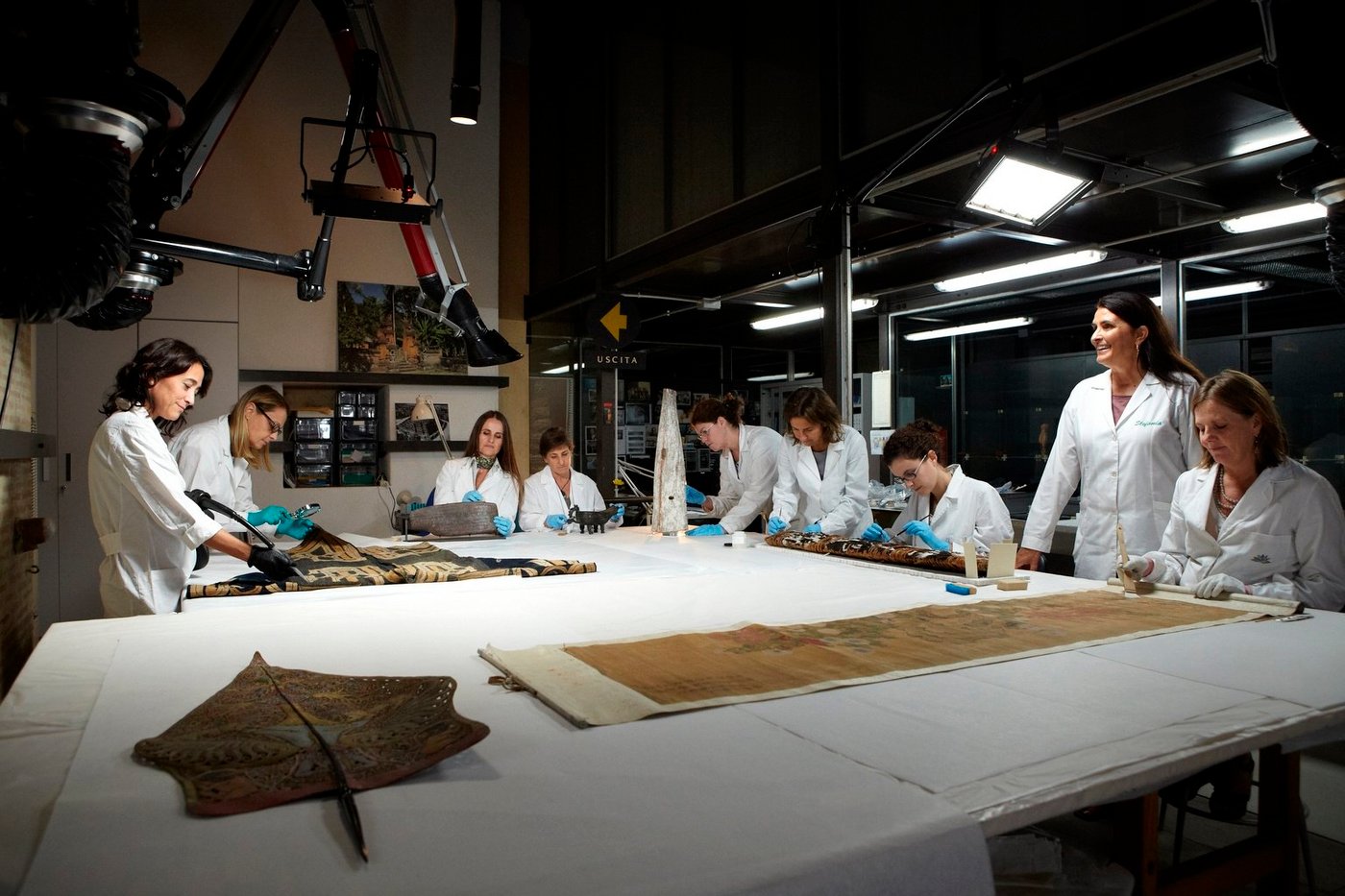
Expert restorers work in the conservation laboratory for ethnological materials at the Vatican Museums in this file photo from 2013. (CNS photo/courtesy Vatican Museums)
“We really want to leave it to the Indigenous leaders to be the first to see them,” Archbishop Smith said. He expects the CCCB “to be invited to be with the Indigenous leaders to witness the arrival of the artifacts in Canada,” calling this “another instance of our ‘walking together,’ which was the theme of the papal visit.” He added, “We’re really grateful for the way the Indigenous peoples have invited us into the whole process.”
Members of Indigenous communities have long requested the return of the items. Speaking to reporters in April 2023, Pope Francis said, “This is the Seventh Commandment: if you have stolen something, you must give it back.” Returning what can be returned, he added, is the right course.
The return of the artifacts “is an important and a right step,” said Joyce Napier, Canada’s ambassador to the Holy See. She was among the dignitaries in Rome that day, attending the liturgy in which Cardinal Francis Leo took possession of his titular church, Santa Maria della Salute, in the Primavalle district.
Following the morning audience, Bishop Goudreault and Archbishop Smith concelebrated with Cardinal Leo at the evening Mass, part of a full day of Jubilee-related events for Canadian pilgrims and Church leaders.
The Vatican has taken similar steps in recent years, including giving the Orthodox Church of Greece three fragments of the Parthenon Marbles in 2023, which the church later transferred to the Greek government.
Napier told Catholic News Service the items will first go to the Canadian Museum of History in Gatineau, Quebec, where Indigenous experts and elders will identify them, confirm their provenance, and determine where they should ultimately be kept.
With files from The Catholic Register and Vatican News
Your voice matters! Join the conversation by submitting a Letter to the Editor here.