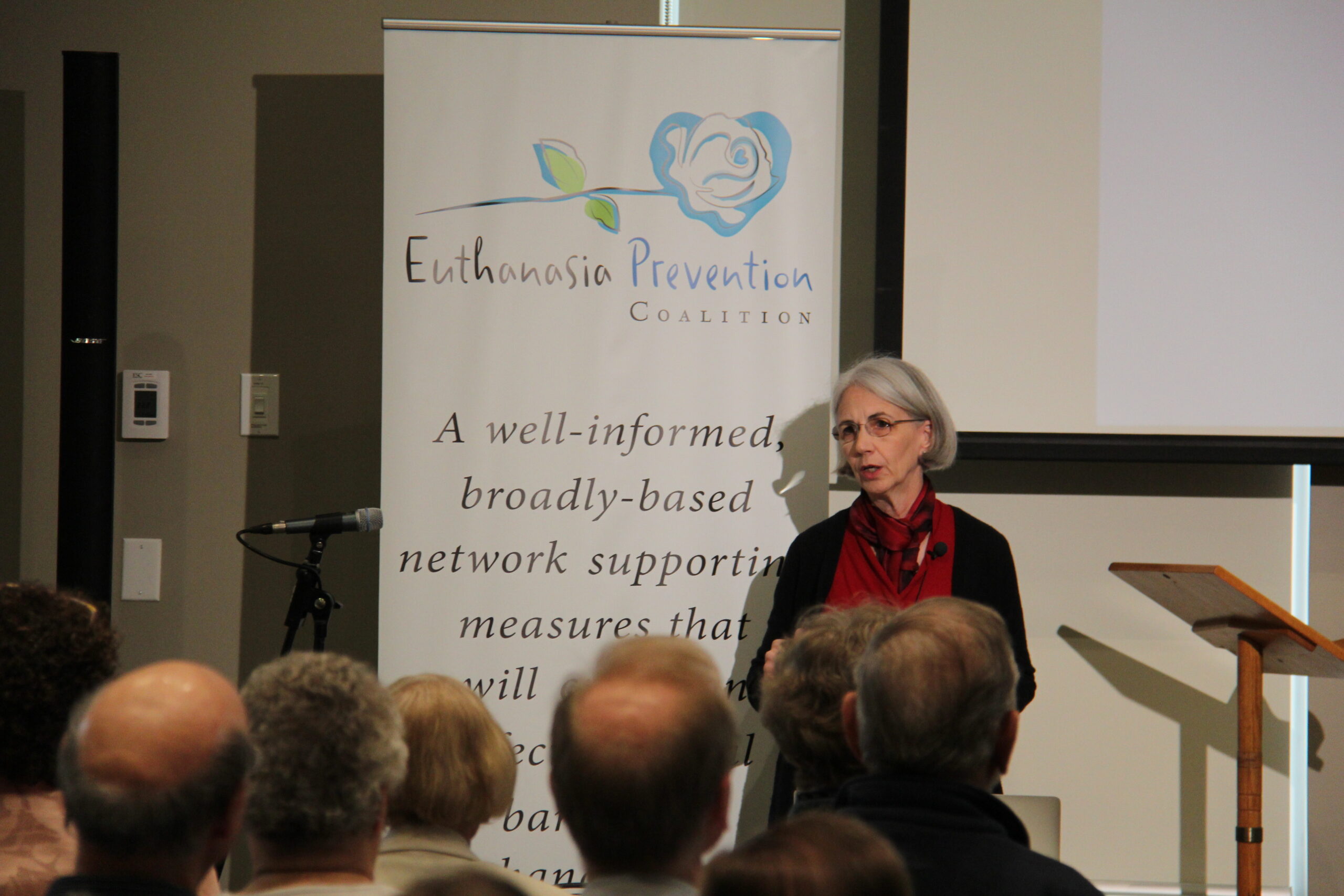

VANCOUVER—Assisted suicide was the hot topic that drew hundreds to the first public event at the archdiocese’s new headquarters.
“This is not about someone saying it’s my body, my choice,” said Alex Schadenberg, head of the Euthanasia Prevention Coalition, at the John Paul II Pastoral Centre March 27.
“It’s about somebody else agreeing to do it. It’s about allowing, in law, somebody to kill you. That’s what it comes down to.”
Schadenberg, who started the coalition against “mercy killing” in 1999, outlined how euthanasia laws have been interpreted in Belgium, Oregon, and other areas to show situations Canadians could face since the Supreme Court of Canada struck down in February the law governing murder in the special case of what is called “assisted suicide.”
“Canadians are in the fog. They have no idea what this is actually about,” he said. “Remember, the Supreme Court of Canada said nothing about terminal illness.”
Euthanasia was introduced for children in Belgium last year. “That should not surprise you. If it’s okay to kill somebody who’s 56, 70, 29, or 19, why would it not be okay to do it to someone who is 7, 6, 5, 4, 3, 2, or 1?”
The hall was filled with about 150 participants during an afternoon seminar; another 150 attended a similar talk in the evening given by Doctor Williard Johnston, president of the Euthanasia Prevention Coalition of B.C.
Palliative care physician Doctor Margaret Cottle said the government rejected capital punishment over the concern that one innocent person may be executed.
“I have a lawyer friend who says, ‘We’re coming to a place where we are going to be forbidden by law to kill the guilty, and may be forced by law to kill the innocent.'”
Recent statistics from Belgium show 4.6 per cent of all deaths in that country in 2013 were by “assisted suicide.” Cottle calculated if that became true here, 11,184 people would be killed in one year.
“It would be tied with the fourth leading cause of death,” lung disease, she warned. “The only things that are higher than 11,000 people are cancer, heart disease, and stroke.”
Betty McCloud, 86, attended the seminar because the Supreme Court’s ruling worried her. “I’m beginning to feel vulnerable at the very fact of going in to a hospital,” she said.
“I’m trying to learn everything I can so I can speak with knowledge, and to help others, and to lose my feeling of vulnerability and be more active.”
Geraldine Campbell, a member of St. Francis de Sales Parish, said she feels concerned for family members.
“A point that stuck with me was we don’t believe in capital punishment because one (innocent) person may die, and yet we’re willing to do this when a huge amount of error can be made,” said the former palliative care volunteer.
“That was a good fact that could be passed on to friends or to people in an elevator or in a store.”
Mark Warawa, the Conservative MP for Langley, attended the afternoon seminar. “The government is in a time of consultation. What you say will have an influence on the direction the government is taking.”