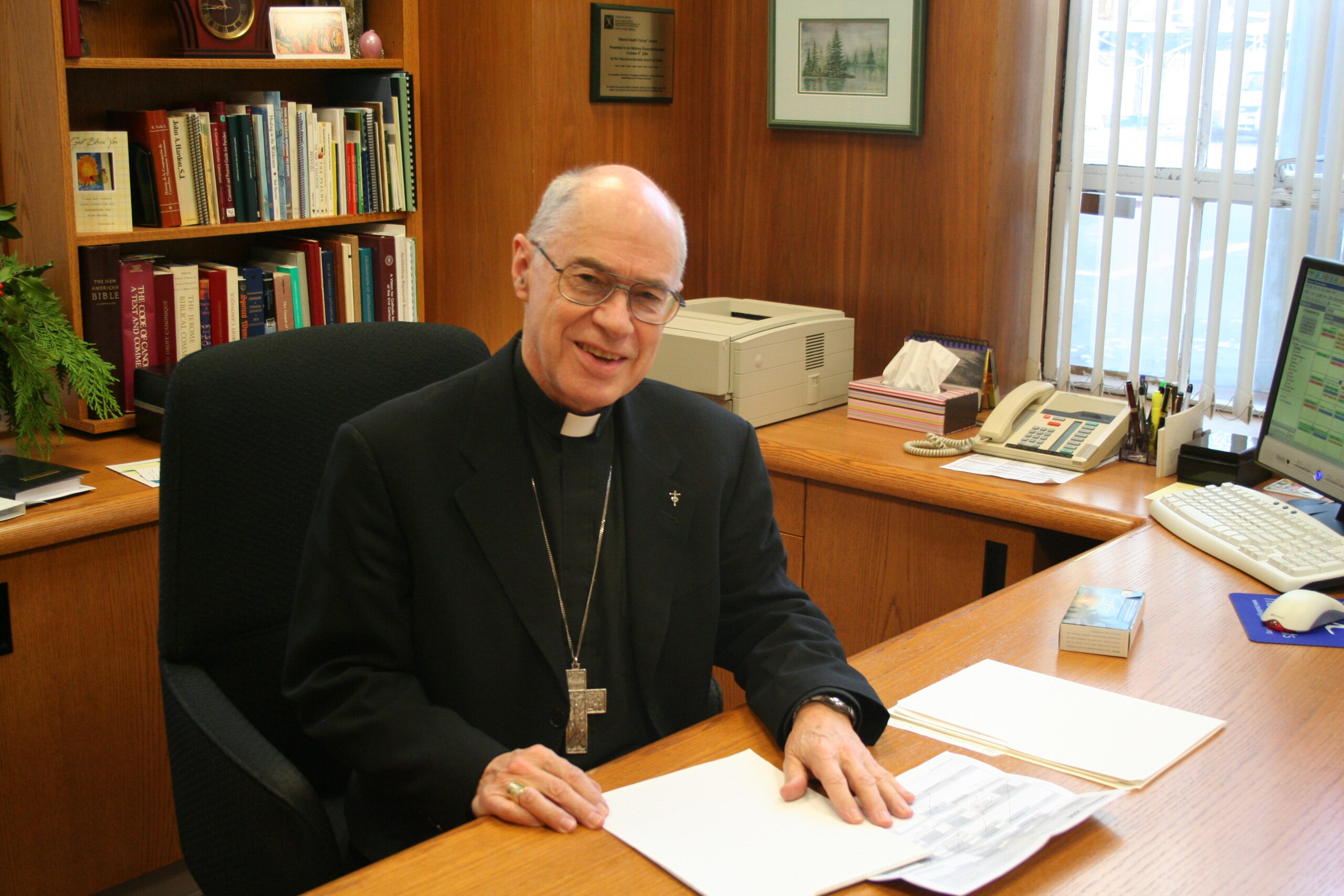

VANCOUVER—The Marianist Archbishop of Vancouver from 2004 to 2009 has died at age 75.
Archbishop Emeritus Raymond Roussin, SM, who had been tasked with closing down one diocese, pulling another out of debt, and handling his own struggle with depression and illness, was known as a courageous leader. His motto was Fortes in Fide, or “Steadfast in the Faith.”
“Bishop Ray was the good shepherd,” said Bishop Gary Gordon of Victoria. “He never complained. He was never angry or bitter or resentful. Ray was the classic gentleman, and was truly the good shepherd who carried all of our crosses for us.”
Archbishop Roussin passed away April 24.
St. Louis
Born June 17, 1939, in St. Boniface, Man., Raymond Roussin wasn’t sure if he wanted to be a priest. He liked English literature and geography, and entertained the idea of becoming a teacher.
One day, during an exam, a teacher asked Roussin if he’d thought of becoming a Marianist. The question stayed in his mind all summer, and in the fall of 1955, Roussin entered the Society of Mary community in St. Louis, Mo.
Within two years, he finished high school and pronounced his first vows, then joined a Marianist community in San Antonio, Tex., to study education at St. Mary’s University.
While he studied, he taught French, Latin, and English to elementary and high school students and was professed a Marianist brother. He earned a Licence in Theology in Fribourg, Switzerland, and was ordained a priest there March 21, 1970.
Ten years later, Father Roussin was appointed provincial superior of the Marianists in Canada.
Gravelbourg
Father Roussin was ordained a bishop of the diocese of Gravelbourg June 14, 1995. The mostly francophone diocese, in south Saskatchewan, had been established in 1930.
Before Bishop Roussin arrived, the population had been decreasing, and Saskatchewan bishops had called for a reorganization of diocesan boundaries. The new prelate was tasked with helping the faithful smoothly transition to either the Archdiocese of Regina or the Diocese of Saskatoon.
“When you close down a diocese, it isn’t just like turning a key and turning out the lights,” said Bishop Gordon, who was consecrated a bishop by Archbishop Roussin over a decade later.
“This is a huge emotional and physical reality that has a big impact on people. It’s a very hard thing to do. Ask any bishop that’s had to close a parish.”
In 1998 Bishop Roussin was appointed Coadjutor Bishop of Victoria and moved west to serve alongside Bishop Remi De Roo.
Victoria
At Bishop De Roo’s retirement in 1999, Bishop Roussin automatically took the helm.
“They loved him in Victoria because of his gentleness and wit,” said Archbishop Richard Gagnon of Winnipeg. He was ordained a bishop by Bishop Roussin and succeeded him as Bishop of Victoria in 2004.
“Victoria had some very difficult financial problems when he arrived,” he said.
Early on, Bishop Roussin found out the diocese was dealing with huge debt. The B.C. Catholic reported in 2004 that the diocese had racked up $5 million in debt due to bad investments and had guaranteed a $12 million mortgage in the hopes of recovering its losses. The bank started calling.
Archbishop Roussin handled the issue with a successful campaign of parishioners buying debentures to help with the debt. No churches or schools were sold and regular communication kept the faithful informed about how the diocese’s finances were faring.
“He faced the brunt of it. It was not an easy assignment for his six years,” Archbishop Gagnon said. “He was a gentle man who was given many difficult assignments in his life as a bishop. He bore them with faith and firmness of heart and great joy.”


Vancouver
After Archbishop Adam Exner, OMI, retired from his Vancouver post Jan. 10, 2004, Archbishop Roussin was appointed to take the wheel of his largest diocese yet.
“I distinctly remember that the congregation was reaching out to love this man. He looked a bit shy and overwhelmed,” said Bishop Stephen Jensen of Prince George, who was administrator of Holy Rosary Cathedral at the time.
“He always impressed people as a very humble and unassuming fellow, very approachable.”
One distinct mark of Archbishop Roussin’s service in Vancouver was his struggle with depression, which he spoke about openly.
“He allowed himself to be very vulnerable,” said Bishop Jensen. Archbishop Roussin gave interviews on the topic to the Vancouver Sun and several radio shows.
Archbishop Gagnon called him a “figure of hope and solidarity” for other Catholics who faced depression.
Bishop Gordon agreed. “What he did is he allowed people the ability to have some hope. This really was helpful for so many people to not be isolated.”
Archbishop Roussin also worked toward reconciliation with native people; he was the first Archbishop of Vancouver to issue an apology for the abuses students suffered at residential schools.
“Although these schools involved many people who worked selflessly and honourably, the system itself was deeply flawed,” he said at a March 5, 2008, event connected with the Truth and Reconciliation Commission.
“Removing children from their culture and their families is a profound moral concern. It is especially painful to know that some children suffered sexual and physical abuse at the hands of their teachers and caregivers. As Archbishop of Vancouver, I express my deep regret and I apologize for any wrongs committed here.”
Bishop Gordon enjoyed Archbishop Roussin’s support for his reconciliation efforts and said the prelate took a “wonderful leadership role” in the first nations archdiocesan council. “He was a man of dialogue and a humble man.”
Winnipeg
Because of a neurological illness, Archbishop Roussin resigned his post in 2009 and moved to Winnipeg to the care of his sister, Mrs. Lucille Lang, leaving the Archdiocese of Vancouver to his coadjutor Archbishop J. Michael Miller, CSB.
“The words of the prophet Isaiah, ‘A man of suffering, and acquainted with infirmity,’ are appropriate to describe Archbishop Roussin,” said Msgr. Gregory Smith, the pastor of Christ the Redeemer Parish in West Vancouver.
He travelled with Archbishop Roussin to Rome to meet Pope Benedict XVI. “He never allowed his own pain to stop him from caring for others.”
Prayers for Archbishop Roussin were scheduled for the evening of May 1 and his funeral Mass for May 2 in St. Boniface Cathedral in Winnipeg.