Submission not necessarily a weakness
Taking over the whole world … it’s rarely seen as an admirable idea.
The negative connotations associated with world domination are just a little too frightening for anyone who wants to live with personal dignity and security.
Yet, while we resent and fear domination, I’ve likewise heard many people – particularly women – voice opposition to the virtue of meekness. We don’t want anyone to control us, and simultaneously we don’t want to take anything lying down, so to speak.
In the Beatitudes, these two concepts – domination and meekness – meet each other. “Blessed are the meek for they will inherit the earth,”(Matthew 5:5).
It isn’t the tyrants, bullies, and slave drivers who will inherit the earth, we are told. Certainly, they may try to control parts of it, but it’s the meek who will be rewarded.
What does all of this mean? Does meekness imply we are called to sit back and allow others to make all of our decisions? Does meekness mean women should stay silent and accept lower pay than their male contemporaries? Does the Bible say introverts should never have a voice? Does acting meekly mean those with less confidence shouldn’t be allowed to share their ideas? Do we need to let others put us down in order to inherit God’s Kingdom?
I think we can all agree that the Bible would never suggest any of the above. As Donald DeMarco states in his article The Virtue of Meekness, “Meekness is more synonymous with empowerment than it is with weakness because, as St. Thomas Aquinas wrote, meekness makes a man self-possessed … When we are overcome by anger, we lose that sense of ourselves that allows God to dwell within us. Anger excludes God; meekness invites His presence.”
He goes on to say, “Since meekness is self-possession in the face of adversity, it enables a person to do good in response to evil. Meekness is not cowardice, timidity, or servility … meekness is the higher path.”
When we feel the urge to vent our anger or voice our concerns in aggressive ways, we not only exclude God, we exclude people. I have this problem in my own family, when I become frustrated about household responsibilities. Instead of calmly describing situations and stating my feelings, I tend to lose my temper. This gains nothing for anyone. I feel guilty. No one listens. The situation doesn’t improve and a vicious cycle continues.
When I allow God to enter my heart, I share my feelings peacefully and respectfully. I am not allowing myself to be walked over; in fact, I encourage the opposite. When I pray for meekness, God calms me so that I can express myself in ways that are heard. I can precipitate positive change when I have a positive tone and demeanour. I can adhere to honesty and strength, yet in embracing meekness, success is more probable because it means I will also be kind.
A woman I met claimed that she hated hearing Mary referred to as “meek” because it made Mary sound like a pushover. As a modern-day woman, she wanted no share in being identified as meek.
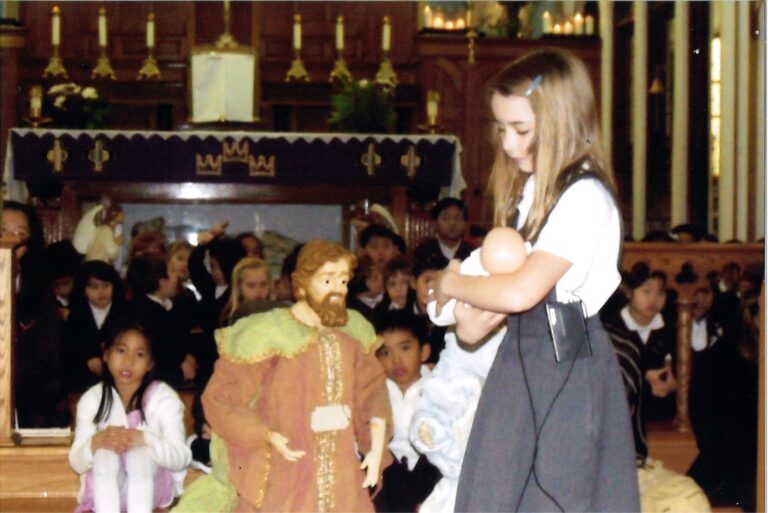
I wish I could meet that woman again to share Donald DeMarco’s definition. Meekness does not downplay Mary’s character; it celebrates her strength. In adversity, Mary accepted a huge challenge. She said “yes” to God, knowing that being unwed and pregnant could result in ridicule and even death.
I assume Mary was afraid, but she did not permit fear to turn to anger; instead, she allowed God to work within her. She put the needs of others ahead of her own and gave birth to our Saviour. What a wonderful role model for all of humanity, and especially for women. Mary – a young girl – played a key role in changing the world!
I pray that I will be blessed to share my feelings and beliefs effectively, leading with love, not power. Both at home and in the world, I pray for the meekness – the strength – to take the higher road.